

Case Study
What can be learned from others about marketing restrictions on unhealthy foods and beverages? What can be learned from others about marketing restrictions on unhealthy foods and beverages?
Background
Since 2007, the United Kingdom has banned advertising for foods and beverages high in fat, salt and sugar (HFSS) during children’s television programs and programs with a high proportion of child viewers, with restrictions extended to nonbroadcast media in 2017. However, research showed children were still being exposed to marketing.
“Despite this regulatory protection we know that children watch all types of TV programming, not just shows aimed directly at them.” – U.K. government guidelines, 2019
In 2020, the U.K. government launched its obesity strategy, which introduced its intention to tighten existing marketing restrictions and add new measures to restrict the volume (e.g., “buy one get one free”) and placement of promotions for HFSS foods.
Policy development and public support
2019 consultation: The government consulted on the TV and online advertising restrictions. Results showed strong public support:
- 79% of respondents supported a 9 p.m. TV watershed
2020 consultation: In late 2020, the government initiated a second public consultation on restricting HFSS online.
- 74% of respondents supported total online advertising restrictions
In June 2021, the government published its response to the consultations, confirming it would proceed with both TV and paid online restrictions, citing strong public support and evidence on marketing’s impact on children’s diets as key factors in the decision. The U.K. government considered but rejected an online watershed, recognizing that fragmented online restrictions face significant enforcement challenges in protecting children.
What the policy includes
The new policy represents one of the most extensive approaches to restricting unhealthy food marketing to which children are exposed to date.
TV restrictions:
- 9 p.m. watershed for HFSS advertising on television and on-demand services
Online restrictions:
- Total ban on all paid-for HFSS advertising online
- Applies 24 hours a day
- Covers display ads, paid search, social media advertising and other paid digital formats
Key Success Factors
- The policy restricts all HFSS marketing, not just child-targeted content, reflecting the understanding that child-directed restrictions alone are insufficient to protect children.
- Covers traditional broadcast media and digital platforms, recognizing the increasing importance of digital exposure.
- The government relied on a series of public consultations to gauge support and transparently shared responses and actions.
Remaining Gaps
- The policy faced repeated delays due to industry pressure—originally slated for 2023, then pushed to October 2025 and again to January 2026—illustrating how industry lobbying can slow even well-designed policies.
- The 9 p.m. TV watershed leaves children and the general population exposed to HFSS advertising outside these hours.
- The policy exempts brand advertising, allowing companies to continue promoting their brands if ads don’t show specific HFSS products (e.g., McDonald’s golden arches without showing a Big Mac). This exemption followed industry lobbying.
- The nutrient profile model does not account for nonsugar sweeteners, meaning companies can reformulate products by replacing sugar with alternative sweeteners to avoid classification as HFSS without meaningfully improving nutritional quality.
- The restrictions apply to paid-for advertising on broadcast and online only, leaving significant marketing exposure unrestricted, including:
- Sponsorships
- Corporate social responsibility initiatives
- Company websites and social media pages (owned media)
- Outdoor and audio media (podcasts, radio)
Resources:
View the 2019 and 2020 consultation summaries with government responses and policy decisions
View the 2022 consultation summary on the draft regulations
View the primary legislation and regulations in English
Learn more about recommendations for regulating digital marketing of unhealthy foods in technical reports from Healthy Eating Research and the World Health Organization
Background
In 2012, Chile passed the Law of Food Labeling and Advertising, pioneering an approach that would combine front-of-package warning labels, restrictions on food industry marketing and school sales bans into a single, coordinated framework. The law was implemented in 2016 after four years of developing the regulations.
How marketing restrictions were linked with other policies
Chile created a nutrient profile model to unite all the policies in the law, establishing thresholds for calories, added sugar, sodium and saturated fat. Products containing these nutrients and exceeding the thresholds were classified as “high in” and faced three requirements at once:
- Front-of-package warning labels: Black octagons alerting consumers to high levels of nutrients of concern
- Restrictions on food industry marketing: Banned from using child-directed techniques and advertising to children under age 14
- School sales bans: Prohibited from sale or promotion in schools
This integration helped create consistency across food environments. The declines in nutrients of concern were greater than those typically observed by standalone policies, showing the importance of multi-component approaches.
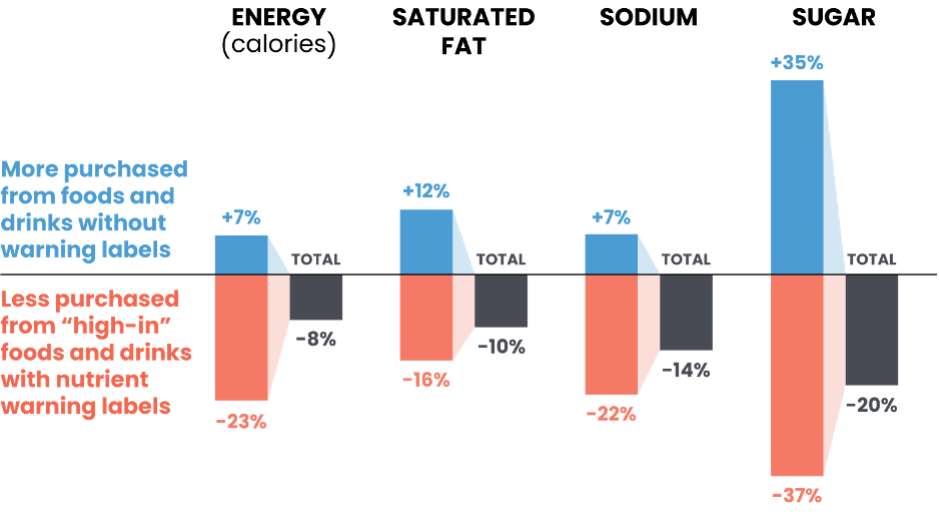
Source: Global Food Research Program UNC-Chapel Hill. Chileans bought less sugar, salt, saturated fat, and calories at the grocery store after trailblazing warning label law, with high compliance from the food industry.
Implementation approach
Restrictions on food industry marketing were implemented in two phases:
- Phase 1 (2016):
- Banned child-directed marketing techniques (e.g., cartoon characters, free gifts or toys) across media channels
- Banned advertising on children’s television programs and websites with 20% or more child audience aged under 14
An evaluation found that children were still being exposed to unhealthy food advertising after Phase 1 because they watched general audience programming, not just children’s shows.
- Phase 2 (2018):
- Extended to a daytime ban (6 a.m. to 10 p.m.) on TV and cinema advertising for all audiences
- Digital restrictions remained focused on child-directed content and children’s platforms
Key Success Factors
- Multi-component policies create synergistic effects—restrictions on food industry marketing work well alongside warning labels and school bans.
- Comprehensive daytime broadcast bans worked better than targeting only child-focused programming.
- One nutrient profile model for all policies reduced complexity and created consistency across food environments.
Remaining Gaps
- Digital marketing is largely unregulated: although Chile’s regulation covers digital media, the term “child-directed” only covers a small portion of what children see online, particularly on social media.
- The nutrient profile model could be strengthened: While Chile’s nutrient thresholds have become stricter over time, they are not as stringent as other models, such as WHO regional nutrient profile models.
- Nonsugar sweeteners are not included, meaning companies can circumvent regulations by replacing sugars with alternative sweeteners.
- Television advertising restrictions apply only between 6 a.m. and 10 p.m., leaving children and the general population exposed to unhealthy food advertising outside these hours.
- The policy defines children as under 14, which falls short of the international standard under the UN Convention on the Rights of the Child (18).
View the original regulation in English or Spanish (implemented 2016) and the revised regulation in Spanish (implemented 2019)
For evaluation data on Chile’s policy package, see Food Policy Hub’s marketing restriction evidence page and the Global Food Research Program at UNC-Chapel Hill’s marketing restriction fact sheet
Read this case study from the World Bank Group to learn more about how Chile developed and implemented the Food Labeling and Advertising Law
See Food Policy Hub’s best practice recommendations for comprehensive marketing restrictions
To learn more about best practice nutrient profile models see the Global Health Advocacy Incubator’s position paper Nutrient Profile Models: A valuable tool for developing healthy food policies