

How can marketing restrictions on unhealthy foods and beverages be adopted? How can marketing restrictions on unhealthy foods and beverages be adopted?
Gather local evidence on why marketing restrictions are needed on sweetened beverages and foods high in nutrients and ingredients of concern (e.g., saturated fat, salt, sugar, nonsugar sweetener) that are often ultra-processed.
This includes health and nutrition data (such as obesity rates and diet-related chronic diseases) as well as information on marketing exposure and its power to influence consumption (such as the frequency of marketing exposure and the proportion of marketing devoted to unhealthy foods).
- Indicators to use: UNICEF’s Analysis Tool (Worksheets)
- Types of marketing-specific data to capture: p. 21 of World Cancer Research Fund International’s Building momentum: lessons on implementing robust restrictions of food and non-alcoholic beverage marketing to children
- Country-specific data sources: Table 3 on p. 22 of UNICEF and the World Health Organization’s Taking action to protect children from the harmful impact of food marketing A child rights-based approach
Use global evidence to support local data (e.g., effects of marketing on food preferences, requests and dietary intake). Collect information on food marketing policies that have been implemented elsewhere to support the case for the policy and its design. If strengthening existing regulations to better align with best practices, collect evidence that relates to the proposed policy change.
- Global implementation examples: Appendix 2 on p. 16 of UNICEF’s Marketing of unhealthy foods and non-alcoholic beverages to children
➔ Global data and resources: Food Policy Hub’s evidence pag
➔ View Food Policy Hub’s best practice recommendations for restricting food and beverage marketing
This information should be used to craft an evidence-based policy, justify its introduction and provide baseline data for evaluating policy change. The data should be collected, summarized and publicized to build policy support.
Decision tree to guide data collection decisions:
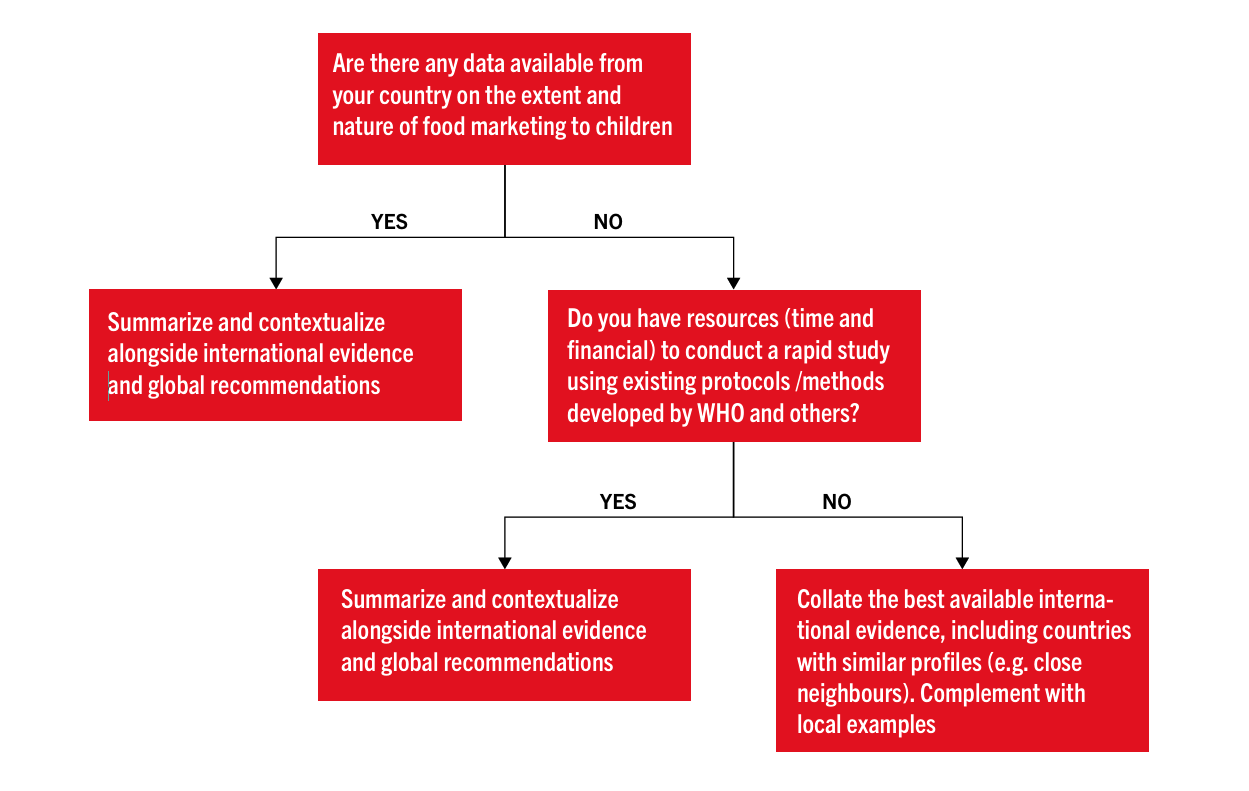
Source: UNICEF and the World Health Organization’s Taking action to protect children from the harmful impact of food marketing A child rights-based approach.
International frameworks and guidelines require governments to take action to prevent noncommunicable diseases and to protect the health of children.
Documents that can help build the case for policy:
- pp. 11–14 of World Cancer Research Fund International’s Building momentum: lessons on implementing robust restrictions of food and non-alcoholic beverage marketing to children
- Figure 3 on p. 10 of UNICEF’s A Child Rights-Based Approach to Food Marketing: A Guide for Policy Makers
Develop measurable policy objectives
Policy objectives should focus on reducing population exposure to the marketing of unhealthy foods and beverages—and its power to influence dietary preferences, behaviors and intake—including all marketing to which children may be exposed, through mandatory, comprehensive restrictions across all platforms and marketing practices. Objectives should be clear and measurable in the short-term.
- Food marketing policy objective examples: p. 20 of World Cancer Research Fund International’s Building momentum: lessons on implementing robust restrictions of food and non-alcoholic beverage marketing to children.
- Note that while these examples are for child-directed marketing, they can be adapted and built upon to align with best practice recommendations.
The scope should cover all marketing to which children may be exposed
Many policy objectives focus exclusively on marketing targeted at children. To effectively protect children, policies should apply to all unhealthy food and beverage marketing to which they may be exposed. Age-based restrictions alone are insufficient, because:
- Children’s and adults’ media spaces are not clearly separated
- Adults purchase food for children and shape their preferences
- Industry can migrate to unregulated channels
- Enforcement is hampered by the lack of clear criteria for determining whether an ad is child-directed
Research the policy environment
Determine the policy’s scope and definitions, including cross-border marketing, and ensure they align with other existing or planned nutrition policies. Ideally food marketing policy is paired with other policies including front-of-package labeling, fiscal policies and school nutrition policies.
➔ See Food Policy Hub’s case study “How Chile Integrated Marketing Restrictions Into Comprehensive Food Policy.”
Understand the legal context
Review laws to determine the legal entry point and understand the legal, constitutional and human rights frameworks that can be used to support the case for mandatory, comprehensive marketing restrictions. Many countries have legislation or guidance that addresses other forms of marketing and other health-harming commodities, such as tobacco.
Comprehensive bans are legitimate public health measures that can be lawful and proportionate under international human rights law and many countries’ constitutional law, protecting people’s rights to health and adequate food and nutrition and strengthening consumers’ ability to make decisions that prioritize their well-being.
- Searchable database of food marketing laws and court decisions: Global Health Advocacy Incubator and O’Neill Institute for National and Global Health Law’s FULL database
- Human rights documents repository: Global Health Advocacy Incubator’s Right to Health Policy Hub
- Child rights and key articles:
- Table 2 on p. 15 of UNICEF and the World Health Organization’s Taking action to protect children from the harmful impact of food marketing A child rights-based approach
- Annex on p. 54 of UNICEF’s A Child Rights-Based Approach to Food Marketing: A Guide for Policy Makers
- Key legal factors: Global Health Advocacy Incubator’s Legal Advocacy Action Guide Legal Strategies for Public Health and Industry Accountability
- Legal assessment of commercial speech and marketing restrictions: Cambridge University Press’ Journal of Law, Medicine & Ethics special issue Commercial Speech and Commercial Determinants of Health
- Legal frameworks and governance structures: Table 4 on p. 24 of UNICEF and the World Health Organization’s Taking action to protect children from the harmful impact of food marketing A child rights-based approach
- Potential legal entry points: Box 8 on p. 27
- Legal considerations for digital marketing restrictions: pp. 68-73 of the World Health Organization’s Restricting digital marketing in the context of tobacco, alcohol, food and beverages, and breast-milk substitutes: existing approaches and policy options
- Tool to assess a country’s legal environment: Annex 2 on p. 98
Map potential stakeholders
Many actors can positively or negatively influence the course of marketing restrictions, including:
- Policymakers
- Academics
- Civil society advocates and organizations
- The food and beverage industry
- Media industry
Mapping these actors helps identify their influence and if, when and how to best engage them. Allies can join forces in coalitions to advance the policy (See section: Build academic, government and civil society coalitions).
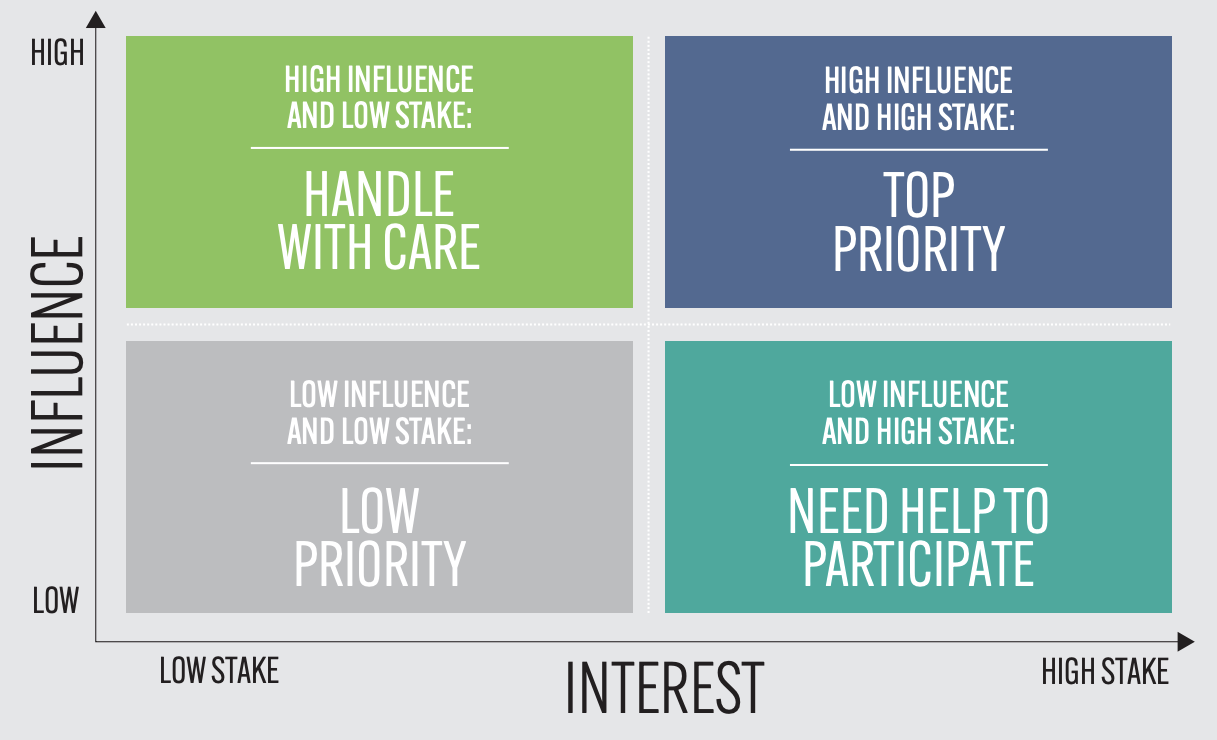
Example interest-influence grid (Toolbox 2 on p. 21). Source: Action for health taxes from policy development to implementation. Geneva: World Health Organization and the United Nations Development Programme, 2024.
- Potential stakeholders in food and beverage marketing restrictions:
- Table 5 on p. 29 of UNICEF and the World Health Organization’s Taking action to protect children from the harmful impact of food marketing A child rights-based approach
- Figure 3 on p. 12 of the World Health Organization’s A framework for implementing the set of recommendations on the marketing of foods and non-alcoholic beverages to children
- Guidance on conducting a stakeholder analysis:
- Toolbox 2 on p. 21 of the World Health Organization’s and United Nation Development Program’s Action for health taxes from policy development to implementation
- pp. 23–26 of the United Nation Development Program’s Institutional and Context Analysis for the Sustainable Development Goals
- Template for stakeholder analysis:
- pp. 7-9 of Global Health Advocacy Incubator’s Advocacy Action Guide Four Phases to Health Policy Success
Industry Interference Tactics to Anticipate:
- Shift blame to individuals, parents or lack of physical activity rather than corporate practices
- Spread disinformation through media
- Corporate-wash and lobby to cultivate political allies
Resources:
- Cambridge University Press: Journal of Law, Medicine & Ethics special issue Commercial Speech and Commercial Determinants of Health
- Global Health Advocacy Incubator: Advocacy Action Guide Four Phases to Health Policy Success
- Global Health Advocacy Incubator and O’Neill Institute for National and Global Health Law: FULL database
- Global Health Advocacy Incubator: Legal Advocacy Action Guide Legal Strategies for Public Health and Industry Accountability
- Global Health Advocacy Incubator: Right to Health Policy Hub
- Food Policy Hub: Evidence page
- UNICEF: A Child Rights-Based Approach to Food Marketing: A Guide for Policy Makers
- UNICEF: Landscape Analysis Tool and Worksheets
- UNICEF: Marketing of unhealthy foods and non-alcoholic beverages to children
- UNICEF and the World Health Organization: Taking action to protect children from the harmful impact of food marketing A child rights-based approach
- United Nation Development Program: Institutional and Context Analysis for the Sustainable Development Goals.
- World Cancer Research Fund International: Building momentum: lessons on implementing robust restrictions of food and non-alcoholic beverage marketing to children
- World Health Organization and United Nation Development Program: Action for health taxes from policy development to implementation
- World Health Organization: A framework for implementing the set of recommendations on the marketing of foods and non-alcoholic beverages to children
- World Health Organization: Restricting digital marketing in the context of tobacco, alcohol, food and beverages, and breast-milk substitutes: existing approaches and policy options
WHO’s definition of marketing
“Any form of commercial communication, message or action that acts to advertise or otherwise promote a product or service, or its related brand, and is designed to increase, or has the effect of increasing, the recognition, appeal and/or consumption of particular products or services.”
When only product marketing is regulated, companies often shift their focus to brand marketing—promoting well-known logos and brand identity as a stand-in for specific products. Restricting brand marketing is legally complex, but without it, a persistent gap in protecting young people from unhealthy food marketing remains.
Food and beverage marketing is ubiquitous, with the vast majority promoting unhealthy products. While marketing landscapes vary by context, marketing practices are increasingly similar across countries as digital media rises, and global best practices can be adapted locally to design effective solutions.
- Global examples of marketing tactics: pp. 20-39 of Global Health Advocacy Incubator’s Marketing Exposed: A Global Public Health Threat for Food Policy
A food marketing policy should address two components: exposure (reach and frequency) and power (creative content, design and execution, such as using cartoon characters).
Policies have traditionally focused on broadcast media, which remains an important source of unhealthy food marketing. However, companies increasingly use diverse marketing channels, especially digital, to build brands and consumer relationships.
Digital marketing presents new regulatory challenges. It uses decentralized platforms and novel techniques like influencer marketing and data-driven targeted advertising. As people spend more time online, companies have followed, making digital platforms central points of exposure that must be regulated.
Marketing tactics may include:
Exposure (Channels)
- Broadcast (television, radio, movies)
- Print (magazines, billboards, posters)
- Digital media (company-owned websites, third-party websites, games, apps, social media, AI-driven targeted advertising)
- Product packaging
- School, retail and other environments
Power (Techniques)
- Using animations (e.g., talking food)
- Using child-targeted music, jingles, voices or language (“Hey kids!”)
- Using brand mascots or licensed characters (e.g., McDonald’s clown Ronald McDonald, Elsa from Disney’s Frozen on cereal boxes)
- Featuring celebrities and influencers, both real and fictional (Pepsi’s sponsorship of footballers like Lionel Messi)
- Adopting appealing packaging or colors (e.g., gummy candy shaped like animals or “Shrek”-themed Snickers bars with green filling)
- Sponsoring events or sports teams (e.g., Coca-Cola sponsors the FIFA World Cup and releases limited edition World Cup-themed products)
- Product placement (e.g., Pepsi cans on judging tables during TV competitions like Vietnam Idol and American Idol)
- Downloads (e.g., ringtones, wallpapers)
- Incentives for purchasing products (e.g., McDonald’s Happy Meals with toys for kids, toys in cereal boxes)
Digital data collection: an emerging frontier in food marketing
Food and beverage companies increasingly use data on children’s online activities and preferences to personalize and target marketing, amplifying its reach and persuasive power. The collection, use and sale of children’s data for this purpose infringes their rights to health, privacy and freedom from manipulation, a critical and growing gap as digital marketing regulations continue to evolve (See section: Develop comprehensive marketing restrictions).
- Learn more about digital marketing: Center for Digital Democracy’s
- Typology of digital marketing: Table 1 on p. 8 of Healthy Eating Research’s Evidence-Based Recommendations to Mitigate Harms from Digital Food Marketing to Children Ages 2-17
Industry Interference Tactics to Anticipate:
- Claim marketing is not targeted to specific populations
- Align marketing with social or environmental causes to appear generous and distract from harms (e.g., sponsor children’s sports teams, promote environmental initiatives like water cleanup campaigns)
- Capitalize on emotions to connect brands and products with positive memories and experiences
- Shift to digital channels where marketing is harder to quantify and track
Resources:
- Center for Digital Democracy: Digital Food Marketing Research: Global Trends
- Center for Digital Democracy: Big Food, Big Tech and the Global Childhood Obesity Pandemic
- Global Health Advocacy Incubator: Marketing Exposed: A Global Public Health Threat for Food Policy
- Healthy Eating Research: Evidence-Based Recommendations to Mitigate Harms from Digital Food Marketing to Children Ages 2-17
Building strong, multisectoral coalitions that act as a united front is important for policy success. Coalition members must not be associated with the food and beverage industry.
Government partnerships
The government should lead food marketing policy development but engage and consult with civil society and academia. Multiple government departments should work together (e.g., child protection, health and education, consumer affairs, media and communication), potentially through a government-led working group.
Civil society partnerships
Civil society coalitions, free of conflict of interest, can help ensure health objectives remain central throughout the policy process.
They can also:
- Reveal and counter industry marketing tactics and interference
- Convey public support to policymakers
- Communicate the health impacts of unhealthy food marketing and the benefits of restrictions
- Engage stakeholders including parents, children and other affected parties
- Collaborate with actors tackling the marketing of other health-harming products, including tobacco, alcohol or breast-milk substitutes
- Building effective civil society coalitions:
- Watch Global Health Advocacy Incubator’s webinar Building Effective Coalitions for Public Health Advocacy Campaigns
- pp. 16-19 of Global Health Advocacy Incubator’s Advocacy Action Guide Four Phases to Health Policy Success
Academic partnerships
Researchers can support the government by providing evidence for the policy that is free from conflicts of interest—from the policy rationale and design to evidence needed to defend the proposal against industry arguments and conduct evaluations. Technical working groups may be established to facilitate this.
Industry Interference Tactics to Anticipate:
- Attempt to influence working groups
- Criticize, infiltrate and monitor public health advocates and groups
- Co-opt public health academics and communities through confusing narratives and funded projects
Resources:
- Global Health Advocacy Incubator: Advocacy Action Guide Four Phases to Health Policy Success
- Global Health Advocacy Incubator: Building Effective Coalitions for Public Health Advocacy Campaigns
The food and beverage industry markets its products to shape social norms and influence eating habits, especially among children and underserved communities. It positions products as essential consumer items to increase sales and distract from their impacts on human and planetary health.
- Global examples of industry marketing tactics: pp. 20-39 of Global Health Advocacy Incubator’s Marketing Exposed: A Global Public Health Threat for Food Policy
Pushing for self-regulation
The industry interferes in government efforts to restrict marketing, often by pushing for self-regulation. However, these voluntary pledges are ineffective: they lack evidence of effectiveness, have limited scope, place control in the hands of an industry with conflicting incentives and lack proper accountability mechanisms.
For example, most voluntary pledges claim not to use licensed characters, celebrities or other child-targeted tactics on products not meeting industry-designed nutritional criteria, but they exempt product packaging and company-owned brand characters from these restrictions.
- Fact sheet on industry self-regulation: Global Food Research Program at UNC-Chapel Hill’s Industry Self-regulation: Empty pledges
Threatening legal action
The food and beverage industry may threaten or take legal action against governments seeking to implement marketing restrictions, using international investment, trade or domestic law.
Legal considerations and how to mitigate risks of challenges:
- pp. 36–38 of World Cancer Research Fund International’s Building momentum: lessons on implementing robust restrictions of food and non-alcoholic beverage marketing to children
- pp. 41–43 of UNICEF and the World Health Organization’s Taking action to protect children from the harmful impact of food marketing A child rights-based approach
How to manage conflicts of interest
Governments must actively manage conflicts of interest when developing marketing restrictions. Conflicts of interest arise when the food and beverage industry’s interests influence decision-making at the expense of public health, going beyond standard public consultations to shape how the industry itself is regulated.
When industry actors have undue influence over the regulatory process, they may skew decisions in ways that weaken or delay effective restrictions, making robust mechanisms to identify and manage these conflicts of interest integral to protecting the integrity of policy development.
Guidance on mechanisms to manage conflicts of interest:
- p. 32 of World Cancer Research Fund International’s Building momentum: lessons on implementing robust restrictions of food and non-alcoholic beverage marketing to children
- p. 32 of UNICEF and the World Health Organization’s Taking action to protect children from the harmful impact of food marketing A child rights-based approach
➔ Food Policy Hub’s countering industry interference page
Common arguments from marketing restriction opponents and effective counterarguments:
- Table 2 on pp. 7–8 of the World Health Organization and UNICEF’s Protecting children from the harmful impact of food marketing: policy brief
- p. 12 of UNICEF’s Marketing of unhealthy foods and non-alcoholic beverages to children
- Table 6 on pp. 30–31 of UNICEF and the World Health Organization’s Taking action to protect children from the harmful impact of food marketing A child rights-based approach
Resources:
- Global Health Advocacy Incubator: Marketing Exposed: A Global Public Health Threat for Food Policy
- Global Food Research Program at UNC-Chapel Hill: Industry Self-regulation: Empty pledges
- UNICEF: Marketing of unhealthy foods and non-alcoholic beverages to children
- UNICEF and the World Health Organization: Taking action to protect children from the harmful impact of food marketing A child rights-based approach
- World Health Organization and UNICEF: Protecting children from the harmful impact of food marketing: policy brief
- World Cancer Research Fund International: Building momentum: lessons on implementing robust restrictions of food and non-alcoholic beverage marketing to children
Demonstrating widespread support for food marketing policy among the public, policymakers and other stakeholders increases the likelihood of policy adoption.
Develop a communication strategy
Civil society should engage the media to put and keep marketing restrictions on the policy agenda and develop a comprehensive framework for communication to the public and policymakers.
Communication should be structured in key phases:
- Build the case for why the policy is needed
- Identify the cause of the problem that the proposed solution will help solve
- Articulate the solution and how supporters can help
- Communication framework for front-of-package labeling that can be adapted to marketing restrictions: pp. 36-43 of What’s in Our Food? A guide to introducing front-of-package nutrient labels
- Guide to public health communication and media advocacy campaigns: Global Health Advocacy Incubator’s Communications & Media Advocacy Action Guide
- Example communications campaign: Showcasing children’s high exposure to food and beverage marketing in Mexico.
Build broader stakeholder support
Civil society can use the following strategies to build broader stakeholder support:
- Produce resources that support policy advocacy and implementation (e.g., toolkits, reports)
- Reach decision-makers through open letters or by organizing a petition and/or letter-writing campaign
- Set up meetings with policymakers
- Organize public conferences/debates and rallies that engage allied policymakers
- Advocacy tactics and strategies: pp. 11–13 of Slow Food’s toolkit From Plate to Politics
Children and other groups especially affected by the marketing of unhealthy food and beverages should be engaged in advocacy.
- Campaigns to engage youth in food policy: U.K. youth activist movement Bite Back’s campaigns
- Examples of public mobilization around marketing restrictions: p. 34 of UNICEF and the World Health Organization’s Taking action to protect children from the harmful impact of food marketing A child rights-based approach
Public consultations
The government should hold a public consultation on draft regulations and actively involve civil society organizations in the discussion and development of draft regulations. Civil society can submit comments and encourage community members to participate, helping to ensure that a broad range of voices beyond industry are represented in the process. The government’s final decisions should prioritize public health evidence over other interests.
- Guidance on submitting effective public comments: Global Health Advocacy Incubator’s Effective Advocacy Through Public Comments to Agencies
Industry Interference Tactics to Anticipate:
- Build relationships with the public, media and policymakers to amplify industry messaging
- Propose voluntary alternatives instead of mandatory policies
Resources:
- Bite Back: Campaigns
- Global Health Advocacy Incubator: Communications & Media Advocacy Action Guide
- Global Health Advocacy Incubator: Effective Advocacy Through Public Comments to Agencies.
- Slow Food: From Plate to Politics
- UNICEF and the World Health Organization: Taking action to protect children from the harmful impact of food marketing A child rights-based approach
- Vital Strategies: Campaigns
- Vital Strategies, Global Health Advocacy Incubator and O’Neill Institute for National and Global Health Law: What’s in Our Food? A guide to introducing effective front-of-package nutrient labels — 2025 edition
WHO acknowledges that countries may start with a stepwise or “partial” approach to restricting marketing, such as focusing on certain channels or certain foods. However, research and experience show that stepwise policies leave people inadequately protected since the industry migrates marketing to unregulated areas and uses this approach to delay policy implementation.
Comprehensive food marketing policies are ideal because they’re as expansive as possible, reducing the risk of migration to unregulated spaces.
➔ See Food Policy Hub’s best practice recommendations to learn what makes a policy comprehensive
60 countries restrict children’s exposure to unhealthy food marketing
World Health Organization. Policies to protect children from the harmful impact of food marketing: WHO guideline. Geneva: World Health Organization; 2023.
Of those 60 countries, 20 countries have mandatory policies to restrict children’s exposure to unhealthy food marketing.
World Health Organization. Policies to protect children from the harmful impact of food marketing: WHO guideline. Geneva: World Health Organization; 2023.
9 countries ban unhealthy food marketing in schools
Global Food Research Program at UNC-Chapel Hill. National policies regulating the school food environment: Maps. 2026.
Few countries have comprehensive policies limiting both exposure and persuasive power across multiple settings (e.g., Chile, Mexico, Portugal, U.K.)
Global Food Research Program at UNC-Chapel Hill. Marketing restrictions around the world: Maps. 2024.
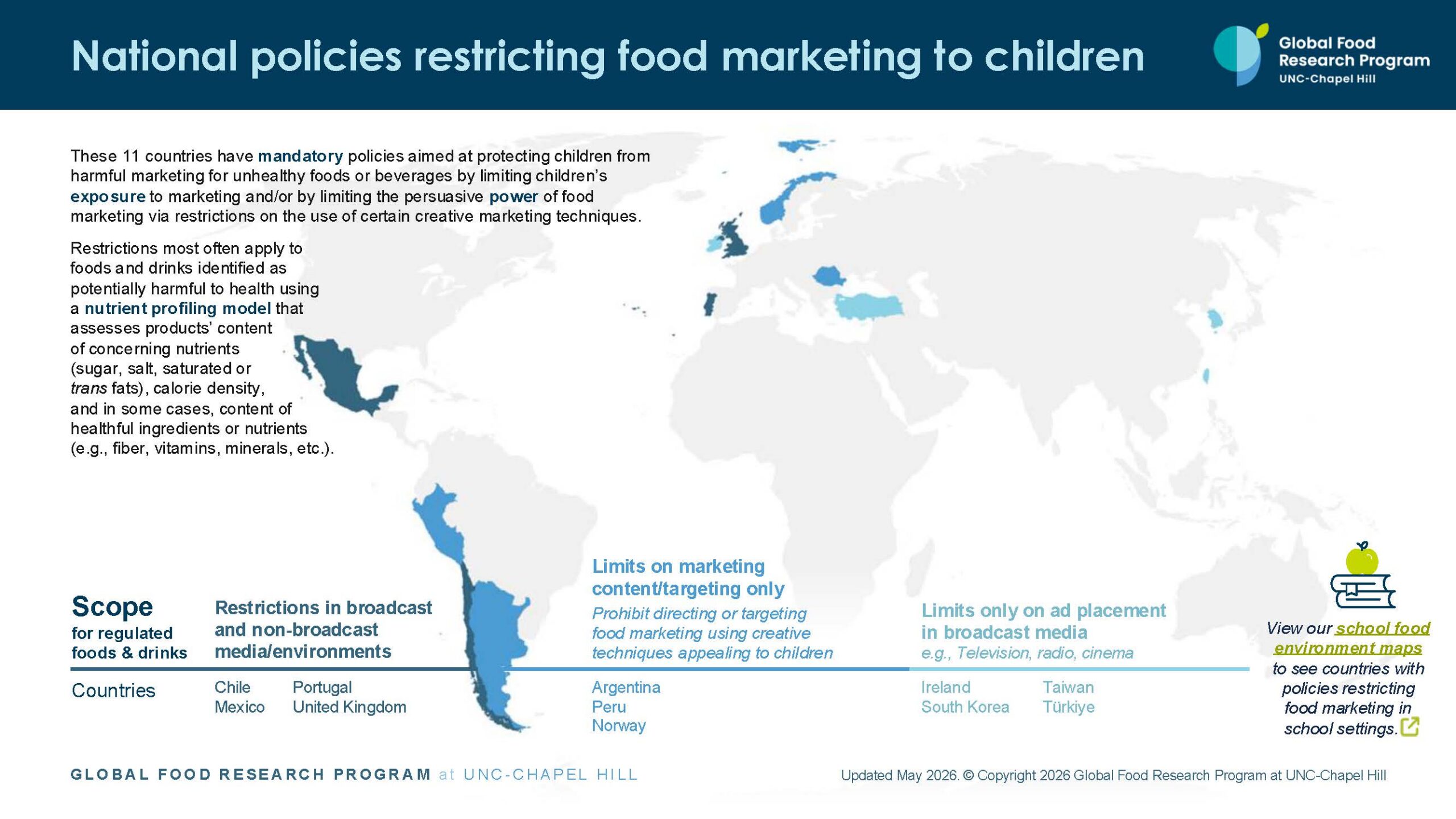
Source: Global Food Research Program at UNC-Chapel Hill. Maps: Restrictions on marketing food to children.
Implemented marketing restrictions:
- Table on p. 8 of UNICEF’s Marketing of unhealthy foods and non-alcoholic beverages to children
- Table 1 on p. 11 of UNICEF and the World Health Organization’s Taking action to protect children from the harmful impact of food marketing A child rights-based approach
- Global Health Advocacy Incubator and O’Neill Institute for National and Global Health Law: FULL database
- World Cancer Research Fund International’s NOURISHING database
When developing a policy to restrict unhealthy food marketing, address these five key questions:
- Which regulatory measure should be used?
- Whom should the policy protect?
- What types of marketing should be restricted?
- To what extent should marketing be restricted?
- Which foods and beverages should the policy apply to?
1. Which regulatory measure should be used?
Governments should adopt binding, enforceable laws—not voluntary or self-regulatory approaches. Only mandatory measures create accountability, help ensure compliance and enable states to fulfill their human rights obligations.
- Benefits of mandatory approaches: p. 24 of World Cancer Research Fund International’s Building momentum: lessons on implementing robust restrictions of food and non-alcoholic beverage marketing to children
- Evidence on why industry self-regulation is not effective: Global Food Research Program at UNC-Chapel Hill’s Industry Self-regulation: Empty pledges
2. Whom should the policy protect?
Marketing restrictions have traditionally focused only on marketing explicitly targeted at or directed at children, but this narrow approach is both limiting and ineffective. To meaningfully protect children, policies must apply to all unhealthy food and beverage marketing they may be exposed to, not just marketing intended for them. Age-based restrictions alone are insufficient, because:
- Children’s and adults’ media spaces are not clearly separated
- Adults purchase food for children and shape their preferences
- Industry can migrate to unregulated channels
- Enforcement is hampered by the lack of clear criteria for determining whether an ad is child-directed
3. Which types of marketing should be restricted?
Marketing restrictions should cover all channels and types of marketing exposure, including:
- Cross-border marketing: Food packaging, product placement, digital
- Digital marketing: Social media, websites, apps, online gaming
- Indirect tactics: Corporate social responsibility initiatives, influencer and celebrity promotions, sponsorships
International cooperation, including through regional public health networks, is needed to address cross-border marketing.
- Understanding the digital marketing landscape: Vital Strategies’ webinar Sick from Scrolling: Protecting the Next Generation from the Flood of Unregulated Social Media Marketing
- Regulating digital marketing: Annex 1 on p. 94 of the World Health Organization’s Restricting digital marketing in the context of tobacco, alcohol, food and beverages, and breast-milk substitutes: existing approaches and policy options
4. To what extent should marketing be restricted?
All marketing of unhealthy foods and beverages—ideally identified by a nutrient profile model—should be restricted. Many countries have focused on marketing “directed at” or “targeted to” children; however, this does not include marketing that children are exposed to that is not explicitly targeted to them.
5. Which foods and beverages should be restricted?
Research shows that marketing restrictions are more effective when they use an evidence-based nutrient profile model to determine which foods should be subject to restricted marketing.
What are nutrient profile models?
Nutrient profile models categorize food and beverage products based on their nutritional composition for health-related purposes. These models use specific thresholds to determine whether foods contain excessive amounts of nutrients or ingredients to limit (see example below).
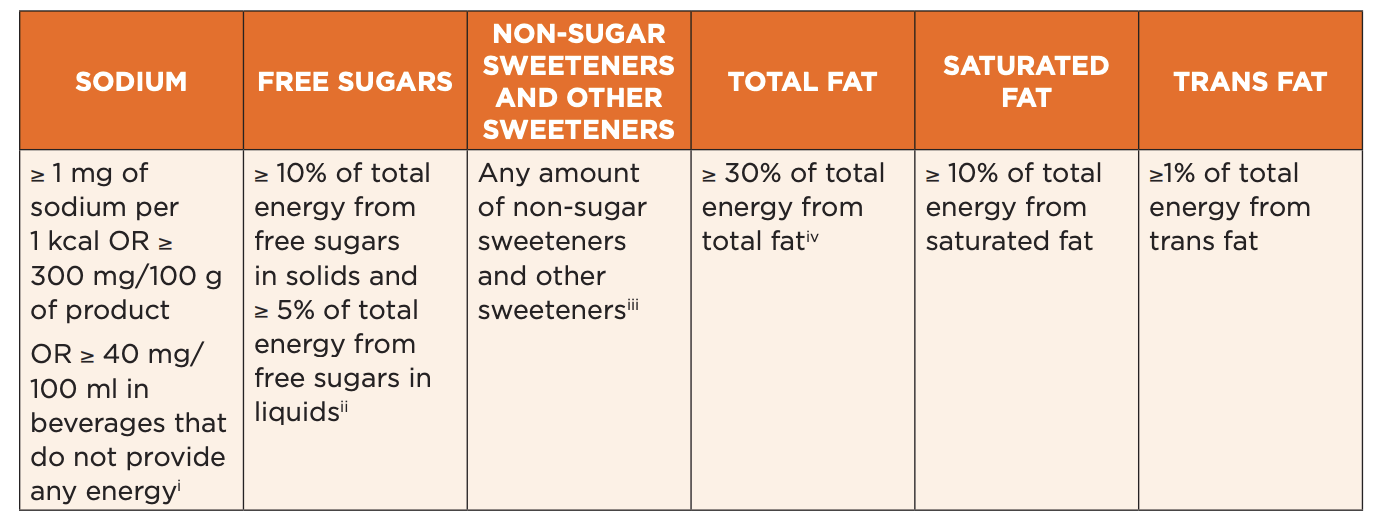
Recommended criteria for identifying food and drinks excessive in nutrients and ingredients of concern curated from PAHO, SEARO and AFRO regional nutrient profile models. Source: Global Health Advocacy Incubator’s Position Paper Nutrient Profile Models: A valuable tool for developing healthy food policies
Using nutrient profile models helps align different healthy food policies. For example, if a front-of-package warning labeling policy relies on a strong nutrient profile model to determine which foods and beverages receive at least one warning label, marketing restrictions can apply to the same products. This consistency strengthens both policies, reduces administrative burden and makes enforcement clearer.
➔ See Food Policy Hub’s case study “How Chile Integrated Marketing Restrictions Into Comprehensive Food Policy”
- Learn more about best practice nutrition profile models:
- Global Health Advocacy Incubator’s position paper Nutrient Profile Models: A valuable tool for developing healthy food policies
- Download the infographic: Best Practices for Adopting and Implementing a Nutrient Profile Model
- Global Health Advocacy incubator’s open-access course Nutrient Profile Models: A Tool for Healthy Food Policies on their Health Advocacy Training & Collaboration Hub (HATCH)
- Global Health Advocacy Incubator’s position paper Nutrient Profile Models: A valuable tool for developing healthy food policies
Industry Interference Tactics to Anticipate:
- Propose alternative solutions, such as self-regulation or voluntary policies rather than mandatory regulations
- Attack and attempt to undermine the marketing regulation or nutrient thresholds for the nutrient profile model
- Claim there is not enough evidence to make a decision
- Threaten or take legal action
- Lobby against policy development
- Challenge marketing restrictions as violations of their right to “commercial speech”— i.e., the right to promote their products and activities for economic gain
- Engage the media to communicate favorable messages, for example, the narrative that educational initiatives are more effective than marketing restrictions
- Showcase corporate social responsibility initiatives and similar efforts to distract from the conversation around marketing restrictions
Resources:
- Global Health Advocacy Incubator: Nutrient Profile Models: A valuable tool for developing healthy food policies
- Global Health Advocacy Incubator: Advancing Marketing Restrictions on Ultra Processed Food and Beverages webinar
- Global Health Advocacy incubator: Nutrient Profile Models: A Tool for Healthy Food Policies on the Health Advocacy Training & Collaboration Hub (HATCH)
- Global Food Research Program at UNC-Chapel Hill: Maps: Restrictions on marketing food to children
- Global Food Research Program at UNC-Chapel Hill: Industry Self-regulation: Empty pledges
- UNICEF: Marketing of unhealthy foods and non-alcoholic beverages to children
- UNICEF and the World Health Organization: Taking action to protect children from the harmful impact of food marketing A child rights-based approach
- World Cancer Research Fund International: Building momentum: lessons on implementing robust restrictions of food and non-alcoholic beverage marketing to children
- World Health Organization: Restricting digital marketing in the context of tobacco, alcohol, food and beverages, and breast-milk substitutes: existing approaches and policy options
- Global Health Advocacy Incubator and O’Neill Institute for National and Global Health Law: FULL database
Implementation, monitoring and enforcement of marketing restrictions should be considered throughout the policy process, including during early phases.
The implementation plan should clearly specify:
- The government agency responsible for monitoring and enforcement
- Sanctions for noncompliance
- Human, financial and other resources needed to sustain monitoring and enforcement
- Training for government authorities on the scope of their duties, with special emphasis on those responsible for enforcement
- Public awareness campaigns explaining what the policy means, with particular attention to underserved communities
- Clear compliance guidance for businesses, including marketers and food companies
- A reasonable but firm implementation timeline—the industry often seeks to prolong implementation, so timelines should be strictly set, with consideration for extended deadlines for smaller businesses
Inform the public that the policy is in effect
Use mass media campaigns to help ensure consumers are aware of their rights and how to advocate for them. If the public is able to report noncompliance as part of enforcement efforts, demonstrate how they can report their findings.
Monitor implementation
The monitoring system should include oversight by the appropriate government agency, as well as public reports about infringements. Given the wide variety of places where marketing appears and the wide array of forms in which it appears, monitoring efforts will need to be broad. It may be useful to leverage existing monitoring mechanisms for other marketing areas, as well as new technologies such as artificial intelligence for harder-to-capture digital marketing.
- Comprehensive monitoring and enforcement guidance: p. 44 of UNICEF and the World Health Organization’s Taking action to protect children from the harmful impact of food marketing A child rights-based approach
- Comprehensive monitoring and enforcement guidance for digital marketing: pp. 48–67 of the World Health Organization’s Restricting digital marketing in the context of tobacco, alcohol, food and beverages, and breast-milk substitutes: existing approaches and policy options
- Protocols and templates for monitoring unhealthy food and beverage marketing:
- Content from WHO Regional Office for Europe
- The Nordic monitoring protocol
- Protocols and templates for monitoring the marketing of breast-milk substitutes:
- WHO NetCode toolkit for periodic assessments or ongoing monitoring systems
Develop an enforcement system
The food marketing policy should be accompanied by a transparent and accessible complaints process that allows individuals, entities and organizations to report violations. This process should then trigger investigation, followed by appropriate action from the enforcement agency. The system should have sanctions that are severe enough to deter companies from not complying with the regulations.
- Examples of enforcement mechanisms from different countries: Box 7 on p. 36 of the World Health Organization’s A framework for implementing the set of recommendations on the marketing of foods and non-alcoholic beverages to children
- Examples of sanctions: Box 16 on p. 51 of UNICEF and the World Health Organization’s Taking action to protect children from the harmful impact of food marketing A child rights-based approach
Industry Interference Tactics to Anticipate:
- Threaten or take legal action
- Lobby against bill to delay implementation
- Launch media campaigns to turn the public and policymakers against the policy
- Engage in and publicize corporate social responsibility initiatives
- Transfer marketing from regulated to unregulated channels (e.g., from broadcast to digital)
- Shift marketing tactics based on the specific products being regulated (e.g., marketing brands instead of products, or increasing marketing for other products including those with nonsugar sweeteners)
Resources:
- UNICEF and the World Health Organization: Taking action to protect children from the harmful impact of food marketing A child rights-based approach
- World Health Organization: A framework for implementing the set of recommendations on the marketing of foods and non-alcoholic beverages to children
- World Health Organization: Restricting digital marketing in the context of tobacco, alcohol, food and beverages, and breast-milk substitutes: existing approaches and policy options
- WHO Regional Office for Europe: Monitoring of Marketing of Unhealthy Products to Children and Adolescents – Protocols and Templates
- World Health Organization: NetCode toolkit: monitoring the marketing of breast-milk substitutes: protocol for periodic assessments
- World Health Organization: Netcode toolkit: monitoring the marketing of breast-milk substitutes: protocol for ongoing monitoring systems
- Nordic Co-operation: Monitoring food marketing to children
After introducing marketing restrictions, evaluate:
- Whether the policy is being executed as intended
- Effectiveness in achieving policy objectives
- Impact on longer-term goals
Evidence is important to:
- Identify policy loopholes exploited by industry
- Support enforcement
- Maintain support for the policy
- Showcase evidence of effectiveness should the food and beverage industry introduce legal challenges
Who should conduct evaluations
Evaluations should be conducted by governments or by independent groups of academic experts with no conflicts of interest, clear terms of reference and public funding. Results should be publicly communicated through reports and peer-reviewed papers.
Evaluate provisions left out of restrictions
Evaluate aspects of the restriction that did not meet best practices to help make the case for extending its coverage.
For example, if the restriction focused on children under age 14, capturing information on changes in exposure of children over age 14 as a result of the restriction could help make the case for more comprehensive coverage.
Evaluations may measure:
1. Are marketing restrictions working as intended? (Process evaluation)
- The extent of implementation of the policy, including:
- Breaches of compliance and trends over time
- Whether marketing shifted toward channels, times or age groups not covered by regulations
- Resources related to monitoring process indicators: Table 6 on p. 44 of World Health Organization’s A framework for implementing the set of recommendations on the marketing of foods and non-alcoholic beverages to children
2. Are marketing restrictions meeting objectives? (Outcome evaluation)
- People’s exposure to marketing for unhealthy food and beverages, in places and during times covered and not covered by the restriction
- Techniques used by the food and beverage industry that are covered and not covered by the restriction (e.g., changes in use of brand characters)
- Examples of outcome monitoring and indicators: Table 7 on p. 46-50 of the World Health Organization’s A framework for implementing the set of recommendations on the marketing of foods and non-alcoholic beverages to children
3. Are marketing restrictions achieving longer-term goals? (Impact evaluation)
- People’s awareness, attitudes, beliefs and preferences toward food marketing and changes over time
- Effect on population-level dietary intake, including targeted nutrients of concern (e.g., saturated fat, salt and sugar), and on rates of diet-related chronic diseases
Set expectations on outcomes and evaluation timeframes
It is important to set stakeholder expectations about what outcomes can be evaluated within what timeframe. The food and beverage industry may use lack of short-term impact to argue that the policy did not work. Academics and advocates should emphasize that meaningful health impacts often take many years to measure. Evidence shows that well-designed regulations improve overall food environments and diets, which is why policies should be as comprehensive as possible.
- Details on what to monitor and evaluate and appropriate methods: Table 5 on p. 40–41 of the World Health Organization’s A framework for implementing the set of recommendations on the marketing of foods and non-alcoholic beverages to children
Industry Interference Tactics to Anticipate:
- Fund research to try to prove the policy is ineffective, potentially including evidence of economic harm
Resources: