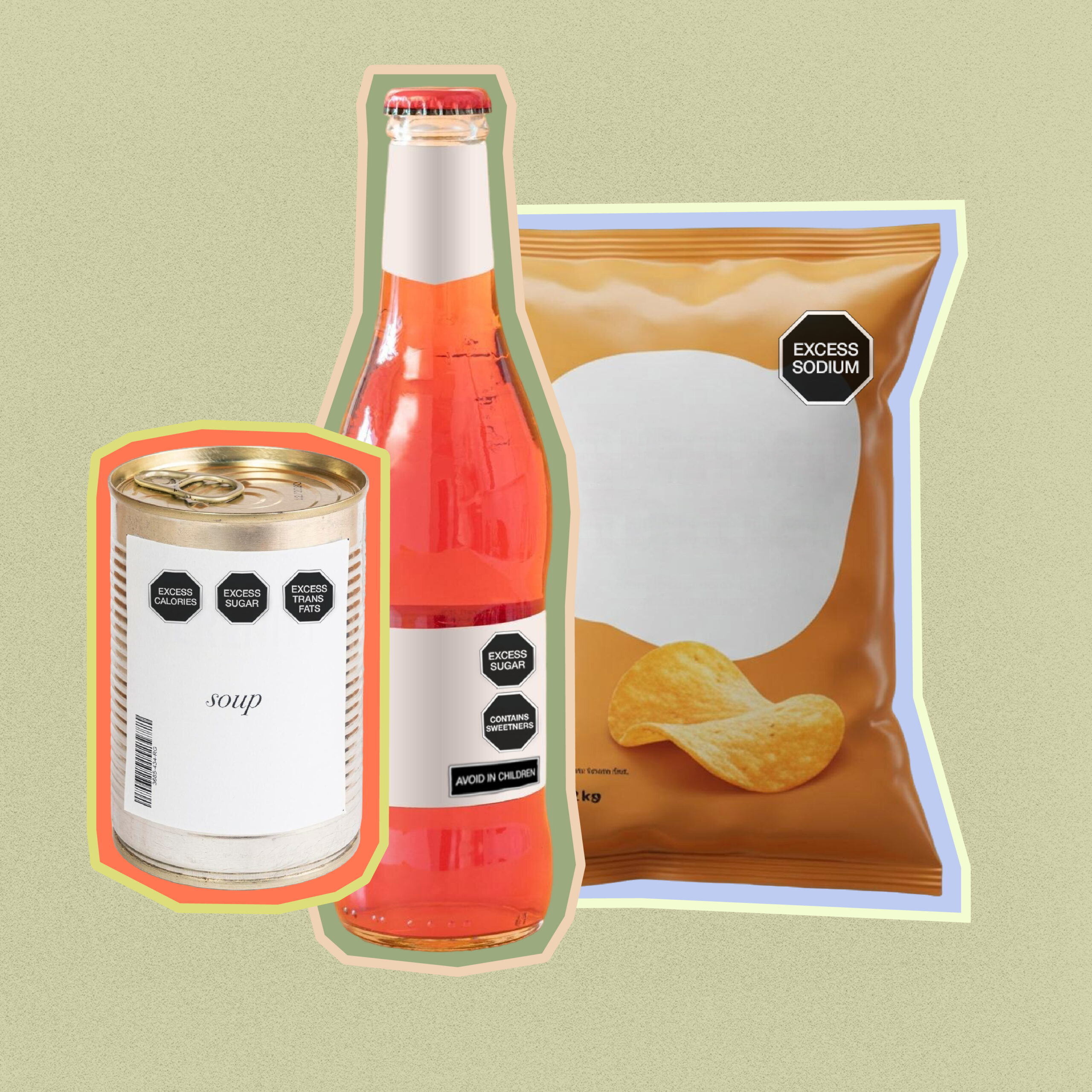
How can front-of-package labeling be adopted? How can front-of-package labeling be adopted?
Build the Policy Rationale
Gather local evidence on the problems that front-of-package labels are needed to address (e.g., high childhood overweight/obesity rates, rising rates of Type 2 diabetes, etc.).
- Indicators to use: UNICEF’s Analysis Tool (Worksheets)
- Country-specific data sources:
- WHO Global Database on Child Growth and Malnutrition
- The DHS Program Demographic and Health Surveys
- Check if your country has a national nutrition survey
- Global data to supplement local evidence: Food Policy Hub’s evidence page
This information will be important to craft an appropriate policy based on science, including establishing the policy objective, justifying the policy’s implementation and providing baseline data to evaluate policy change. It should be collected, summarized and publicized to build support for the policy.
Front-of-package labeling is recommended by the World Health Organization in several key documents (e.g., WHO NCD Global Action Plan for the Prevention and Control of NCDs 2013-2030).
- Document list: P. 8 of World Cancer Research Fund International’s Building momentum: lessons on implementing a robust front-of-pack food label
Develop measurable policy objectives
Before selecting a front-of-package labeling approach to use, governments need to set clear objectives for what the policy will attempt to do and how.
Strong policy objective: Increase consumers’ ability to identify foods high in nutrients and ingredients of concern and reduce their purchases and consumption.
Outcomes should be measurable by a shorter-term evaluation, such as changes in consumer food purchasing or food composition. Setting stakeholder expectations of what is measurable by when can help protect against claims the policy did not achieve its objectives, including in legal defense.
- More details and examples of policy objectives from different countries:
- P. 16 of World Cancer Research Fund International’s Building momentum: lessons on implementing a robust front-of-pack food label
- P. 15 and P. 16 of UNICEF’s Front-of-Pack Nutrition Labelling: A ‘How-to’ Guide for Countries
- P. 3 of Global Health Advocacy Incubator’s FOPWL regulations around the globe
Research the policy environment
It is important to understand what nutrition policies currently exist to position the front-of-package labeling policy as part of a package of actions geared toward addressing the issues outlined in “policy rationale.” This also promotes alignment between nutrition policies to create an environment that enables healthier food choices.
- Tips and guiding questions: Global Health Advocacy Incubator’s Legal Issues in the Design and Implementation of Public Health Measures
Understand the legal context
It is important to understand whether there are existing laws that may affect the development of the labeling policy, as well as which national and international laws can be leveraged to advance it.
These may include:
- Consumer protection law
- Public health law
- Human rights law (e.g., right to health, right to access information, right to adequate food and nutrition)
- Key legal factors: Global Health Advocacy Incubator’s Key Legal Factors for Developing Front-of-Package Labeling Regulations
- Guiding questions on legal context: Table 2 of UNICEF’s Front-of-Pack Nutrition Labelling: A ‘How-to’ Guide for Countries
- Human rights documents repository: Global Health Advocacy Incubator’s Right to Health Policy Hub
- Spanish-language guides on human rights obligations: Georgetown Law O’Neill Institute’s Front-of-Package Labeling Compliance with Human Rights Obligations and Compatibility with Other International Legal Frameworks and Front-of-Package Labeling Materialization of States’ Human Rights Obligations
Map potential stakeholders
The feasibility of passing and introducing a front-of-package labeling policy depends on political and public support. Conducting a stakeholder mapping analysis to determine different stakeholders’—and especially policymakers’ interest, influence and position—is important to know who to engage and how.
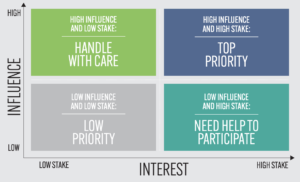
Example interest-influence grid (Toolbox 2 on p. 21). Source: Action for health taxes from policy development to implementation. Geneva: World Health Organization and the United Nations Development Programme, 2024. Licence: CC BY-NC-SA 3.0 IGO.
- Guidance on conducting a stakeholder analysis:
- Toolbox 2 on p. 21 of the World Health Organization’s and United Nation Development Program’s Action for health taxes from policy development to implementation
- P. 23-26 of the United Nation Development Program’s Institutional and Context Analysis for the Sustainable Development Goals
- Sample stakeholder analysis: Table 3 in UNICEF’s Front-of-Pack Nutrition Labelling: A ‘How-to’ Guide for Countries
Industry Interference Examples:
- Attempt to reframe the issue as one of individual responsibility or blame lack of physical activity for the rise in overweight/obesity
- Promote disinformation via the media
- Corporate-wash and lobby to develop political allies
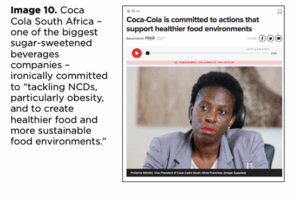
Source: Global Health Advocacy Incubator’s Behind the Labels Big Food’s War on Healthy Food Policies
Resources:
- Food Policy Hub: Front-of-package labeling evidence page
- Georgetown Law O’Neill Institute: Front-of-Package Labeling Compliance with Human Rights Obligations and Compatibility with Other International Legal Frameworks
- Georgetown Law O’Neill Institute: Front-of-Package Labeling Materialization of States’ Human Rights Obligations
- Global Health Advocacy Incubator: Key Legal Factors for Developing Front-of-Package Labeling Regulations
- Global Health Advocacy Incubator: Legal Issues in the Design and Implementation of Public Health Measures
- Global Health Advocacy Incubator: Right to Health Policy Hub
- Global Health Advocacy Incubator: FOPWL regulations around the globe
- UNICEF: Landscape Analysis Tool and Worksheets
- UNICEF: Front-of-Pack Nutrition Labelling: A ‘How-to’ Guide for Countries
- United Nation Development Program: Institutional and Context Analysis for the Sustainable Development Goals
- World Cancer Research Fund International: Building momentum: lessons on implementing a robust front-of-pack food label
- World Health Organization: Guiding principles and framework manual for front-of-pack labelling for promoting healthy diet
- World Health Organization and United Nation Development Program: Action for health taxes from policy development to implementation
Three key steps to choosing a labeling approach:
- Conduct exploratory research (if resources are available)
- Select a label design and underlying nutrient profile model that best fits the policy objective based on the evidence base and local context
- Test its effectiveness
1. Conduct exploratory research
Exploratory research provides information that can help inform your labeling approach. For example, focus groups with the public can gauge knowledge and understanding of how people make decisions about purchasing food (especially packaged food) or identify barriers that may affect how certain designs are perceived.
While this research is valuable, it is not required if time or resources are limited. There is plenty of existing exploratory research available to analyze.
- List of existing exploratory research: P. 16 of Vital Strategies, Global Health Advocacy Incubator and O’Neill Institute for National and Global Health Law’s “What’s in Our Food?”
2. Select a label design and underlying nutrient profile model that best fits the policy objective based on the evidence base and local context
A label design may be an adaptation of an existing label, the same label used by a different jurisdiction or an entirely new label. There are many studies on the main existing front-of-package label approaches.
Evidence shows that front-of-package labels that are:
- Mandatory for applicable food products
- Interpretive—clarifying information to make it easier for consumers to process
- Focused on specific nutrients of concern (e.g., sugar, salt, fat)
are most effective in discouraging purchases of foods high in nutrients and ingredients of concern that are often ultra-processed.
These are all qualities of the nutrient warning label design, which evidence to date shows is most effective in helping consumers identify unhealthy products and reducing purchases.
10
countries use nutrient warning labels
Source
Global Food Research Program at UNC-Chapel Hill. Front-of-package labeling policies around the world: Maps. 2025 March.
9
are in the process of developing warning label policies
Source
Global Food Research Program at UNC-Chapel Hill. Front-of-package labeling policies around the world: Maps. 2025 March.
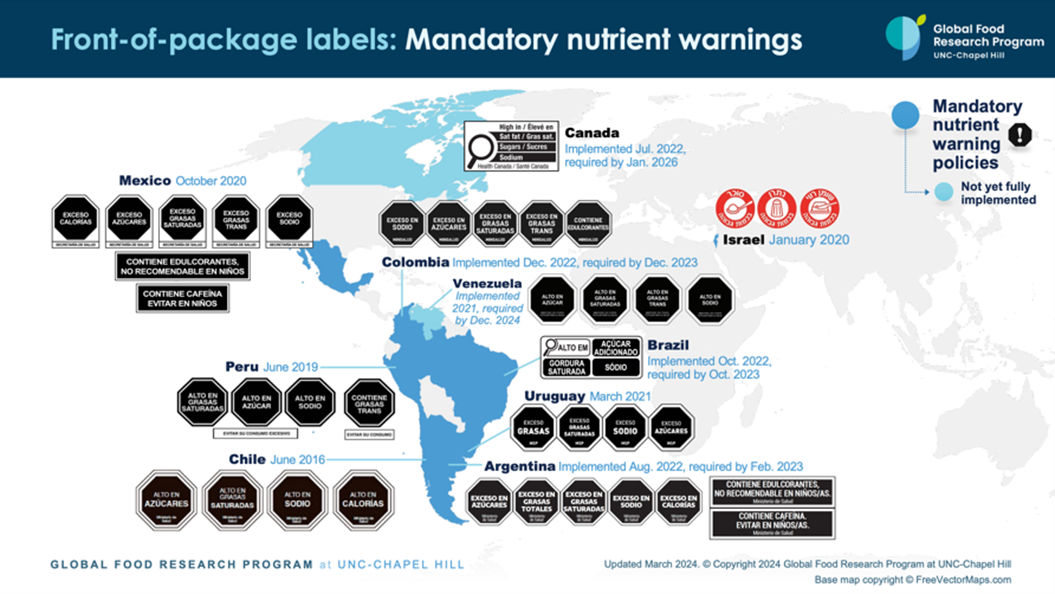
Source: Global Food Research Program at UNC-Chapel Hill. Front-of-package labeling policies around the world: Maps. 2025 March.
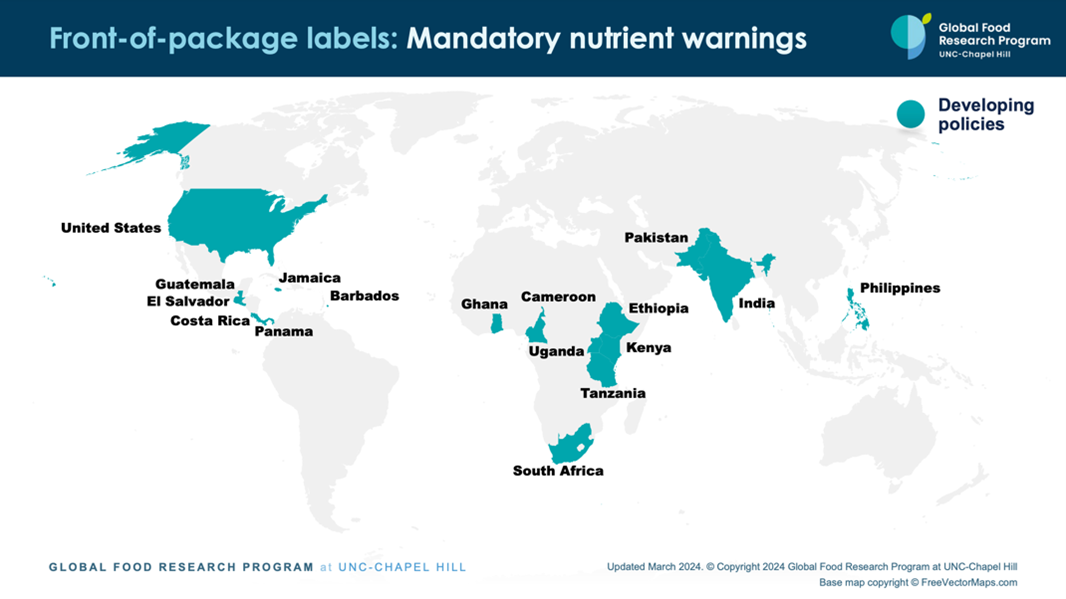
Source: Global Food Research Program at UNC-Chapel Hill. Front-of-package labeling policies around the world: Maps. 2025 March.
- Evidence on existing label designs: Global Food Research Program at UNC-Chapel Hill’s fact sheet Front-of-package labeling to empower consumers and promote healthy diets
3. Test its effectiveness
The selected label design should ideally be tested in the local context to help ensure it works as intended before being officially proposed. However, since there is now a large existing research base, this step is not strictly required if resources are limited.
Results should align with the intended objective. For example, food warning labels should demonstrate that the system helps people understand nutritional information and improves consumers’ ability to identify unhealthy products. Research results should be presented to stakeholders, made public and ideally published in a peer-reviewed journal for external validation.
- Comprehensive testing guidance: P. 17-48 of Pan American Health Organization’s Research to Support the Development of Front-of-Package Labeling Regulations for Food Products in the Americas: Methods, Tools, and Procedures. Study protocols are available in Annexes 2 and 3.
- Monitoring and evaluation framework: Appendix 3 in WHO’s Guiding principles and framework manual for front-of-pack labelling for promoting healthy die
- Warning label testing protocols: P. 25 of Vital Strategies, Global Health Advocacy Incubator and O’Neill Institute for National and Global Health Law’s “What’s in Our Food?” for warning label testing protocols and p. 28 for randomized control trial study design guidance
Industry Interference Examples:
- Propose alternative solutions, such as self-regulation rather than a mandatory policy, or a label design that is less effective (e.g., Guideline Daily Amount)
- Push for more research to be collected to delay process
- Fund research that supports alternative policy options
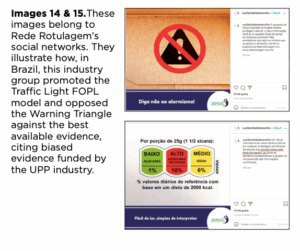
Source: Global Health Advocacy Incubator’s Behind the Labels Big Food’s War on Healthy Food Policies
Resources:
- Global Food Research Program at UNC-Chapel Hill: Front-of-package labeling to empower consumers and promote healthy diets
- Pan American Health Organization: Research to Support the Development of Front-of-Package Labeling Regulations for Food Products in the Americas: Methods, Tools, and Procedures
- Vital Strategies, Global Health Advocacy Incubator and O’Neill Institute for National and Global Health Law: What’s in Our Food? A guide to introducing front-of-package nutrient labels
- World Health Organization: Guiding principles and framework manual for front-of-pack labelling for promoting healthy diet
Building strong multisectoral coalitions free of food and beverage industry representation is important for policy success.
Academic partnerships
Researchers can support the government by providing evidence for the policy that is free from conflicts of interest—from the policy rationale to the label design to evidence needed to defend the proposal from industry interference. It may be useful to establish technical working groups, particularly committees of researchers and other experts independent from the government (e.g., design/communication specialists and legal experts).
- Guidance on establishing technical working groups: P. 17 of UNICEF’s Front-of-Pack Nutrition Labelling: A ‘How-to’ Guide for Countries
- Recommended fields of expertise for independent expert advisory committee: P. 29 of Vital Strategies, Global Health Advocacy Incubator and O’Neill Institute for National and Global Health Law’s What’s in Our Food?
Civil society partnerships
A civil society-led coalition that is free from conflicts of interest can strengthen the call for front-of-package labels and offer oversight to help ensure health objectives remain central throughout the policy process. These coalitions should include representatives from many corners of the labeling arena, such as children’s rights advocates, consumer movements, local food movements and other relevant stakeholders.
What civil society coalitions can do:
- Demonstrate to policymakers the extent of public support for labels
- Convey the public health benefits of labeling through media campaigns and other tools
- Use media to generate public debate and support
- Counter industry interference
- Sample communication strategy: P. 37 of Vital Strategies, Global Health Advocacy Incubator and O’Neill Institute for National and Global Health Law’s What’s in Our Food?

Members of the Alliance for an Adequate and Healthy Diet, a civil society coalition in Brazil, push Brazil’s National Health Surveillance Agency to approve food warning labels. Source: Jéssica Ribeiro: What’s in Our Food? A guide to introducing front-of-package nutrient labels
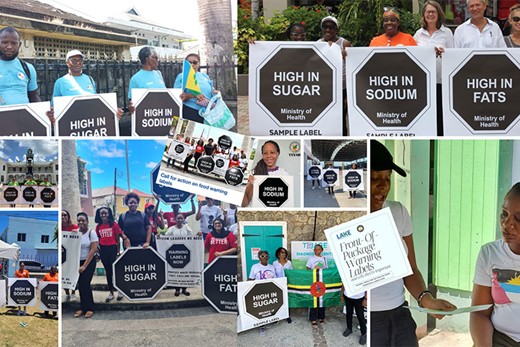
The Healthy Caribbean Coalition organized a regional call to action ahead of a CARICOM member state vote on a regional standard for labeling pre-packaged foods that includes octagonal warning labels. Source: Healthy Caribbean Coalition
Industry Interference Examples:
- Influence technical working groups
- Criticize, infiltrate and monitor public health advocates and groups
- Use front groups that appear to be researchers or civil society organizations to represent industry interests
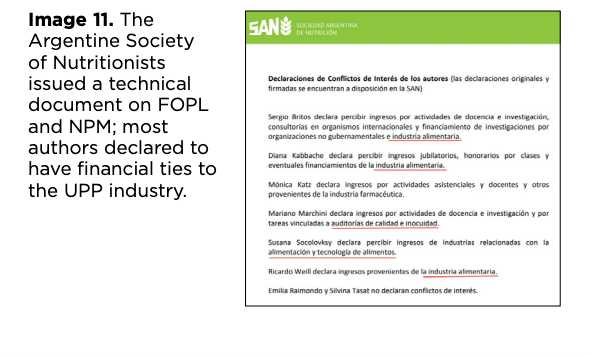
Source: Global Health Advocacy Incubator’s Behind the Labels Big Food’s War on Healthy Food Policies
Resources:
- Vital Strategies, Global Health Advocacy Incubator and O’Neill Institute for National and Global Health Law: What’s in Our Food? A guide to introducing front-of-package nutrient labels
- UNICEF: Front-of-Pack Nutrition Labelling: A ‘How-to’ Guide for Countries
The food and beverage industry often strongly opposes front-of-package labeling measures and attempts to thwart them using a variety of strategies. Policy stakeholders must anticipate this interference at every point in the policy process.
The food and beverage industry’s strategies follow a similar playbook that is adapted for each country and context. Therefore, it is important to understand what tactics the industry has used and the arguments it has made during other countries’ front-of-package labeling policy processes to prepare for them.
- Global industry interference examples: Global Health Advocacy Incubator’s Behind the Labels Big Food’s War on Healthy Food Policies
In recent years, due to increasing pressure for healthy food policies, the industry has shifted toward weakening policies rather than outright opposing them (e.g., suggesting less effective front-of-package labeling designs or approaches).
- Background on the food and beverage industry: UNICEF’s webinar Addressing food and beverage industry interference in policy-making for an overview of which companies constitute the “food and beverage industry,” examples of industry interference at different stages in the policy cycle, and more
- Industry tactics and counterstrategies:
- Global Health Advocacy Incubator’s Behind the Labels Big Food’s War on Healthy Food Policies
- Global Health Advocacy Incubator’s Global Industry Tactics to Weaken Front of-Package Labeling Policies
- P. 31-37 of World Cancer Research Fund International’s Building momentum: lessons on implementing a robust front-of-pack food label
- Responses to common industry international trade legal arguments: Global Health Advocacy Incubator’s Front-of-Package Labeling Preparing for International Trade Legal Arguments
- Responses to economic arguments: Global Health Advocacy Incubator’s Responses to the food and beverage industry’s economic arguments against healthy food policies
- Potential legal challenges and mitigation strategies: P. 28-30 of World Cancer Research Fund International’s Building momentum: lessons on implementing a robust front-of-pack food label
Resources:
- Global Health Advocacy Incubator: Behind the Labels Big Food’s War on Healthy Food Policies
- Global Health Advocacy Incubator: Front-of-Package Labeling Preparing for International Trade Legal Arguments
- Global Health Advocacy Incubator: Global Industry Tactics to Weaken Front of-Package Labeling Policies
- Global Health Advocacy Incubator: Responses to the food and beverage industry’s economic arguments against healthy food policies
- UNICEF: Addressing food and beverage industry interference in policy-making
- World Cancer Research Fund International: Building momentum: lessons on implementing a robust front-of-pack food label
Demonstrating widespread support for front-of-package labeling among the public, policymakers and experts across a range of fields, increases the likelihood of the policy being adopted.
Develop a communication framework
Civil society should develop a comprehensive communication framework to rally support and garner media attention. Communication activities can be targeted to the public or policymakers, depending on the objective.
Communication should be structured in key phases:
- Build the case for why the policy is needed
- Identify the cause of the problem that the proposed solution will help solve
- Articulate the solution and how supporters can help
- Communication framework and campaign examples: P. 37-43 of Vital Strategies, Global Health Advocacy Incubator and O’Neill Institute for National and Global Health Law’s What’s in Our Food? A guide to introducing effective front-of-package nutrient labels
- Campaign development tools: Global Health Advocacy Incubator’s Communications & Media Advocacy Action Guide

A campaign for clear food warning labels in Mexico. Source: Let’s Demand Clear Labels (Exijamos etiquetados claros), Alianza por la Salud Alimentaria, Mexico
Build broader stakeholder support
Civil society can use the following strategies to build broader stakeholder support:
- Produce resources that support policy advocacy and implementation (e.g., toolkits, reports)
- Reach decision-makers through open letters or by organizing a petition and/or letter-writing campaign
- Set up meetings with policymakers
- Organize public conferences/debates and rallies that engage allied policymakers
- Advocacy tactics and strategies: P. 11-13 of Slow Food’s toolkit From Plate to Politics
Engage policymakers effectively
Messaging to policymakers should be targeted to their specific portfolios and interests. For example, to reach a policymaker with a trade and employment portfolio, use economic arguments that demonstrate front-of-package labeling does not negatively affect trade or lead to job losses.
Consider when to engage policymakers based on when the issue is top-of-mind. For example, have they just attended an international forum on food policy issues?
- Guide to communicating with policymakers: Food and Agriculture Organization’s Communicating With Policymakers
Industry Interference Examples:
- Build relationships with the public, media and policymakers, and use them as spokespeople for the industry’s messaging
- Develop media campaigns that challenge the front-of-package labeling policy
Resources:
- Food and Agriculture Organization: Communicating With Policymakers
- Global Health Advocacy Incubator: Communications & Media Advocacy Action Guide
- Slow Food: From Plate to Politics: Your Toolkit to Feed Local Change
- Vital Strategies, Global Health Advocacy Incubator and O’Neill Institute for National and Global Health Law: What’s in Our Food? A guide to introducing effective front-of-package nutrient labels
Designing a front-of-package labeling policy based on local contextual and exploratory evidence, as well as global evidence and lessons learned from other countries, increases the chance of successful implementation.
–>Country examples: Food Policy Hub’s front-of-package labeling case studies
Who should lead policy development?
The process of developing the policy should be government-led, with the support of civil society and researchers free from conflict of interest. Different government departments should work together. For example, health departments should engage departments related to trade and investment law to ensure the policy aligns with both domestic and international trade requirements.
The food and beverage industry will need to be consulted regarding the technicality of implementing front-of-package labels. However, the government should have clear guidelines on how the industry is engaged, follow typical legislative consultation procedures and ensure that public health interests are prioritized over other interests.
What are the three key policy decisions?
- Legislative framework
- Scope of policy (choice of nutrient profile model)
- Choice of label format
1. Legislative framework
It is important to understand the legislative framework governing the safety and quality of food (criminal law, consumer protection law, etc.) to guide decisions on policy scope and labeling format.
Other key considerations and recommendations include that:
- The policy should be mandatory: Global evidence shows mandatory front-of-package labeling policies are more effective than voluntary ones.
- The policy should ideally be part of a comprehensive package: Introducing other regulations for healthier food environments alongside the front-of-package labeling policy, or aligning existing policies—such as regulating the marketing of products that carry unhealthy labels and limiting health claims (e.g., “all natural”) and other types of claims—will make it more effective.
- The policy should have strong definitions and be based on the policy objective: Identify relevant definitions in existing regulations (e.g., ultra-processed foods, nutrients of concern). If the definitions are strong, use them to ensure consistency and reduce consumer confusion. If they are weak, strengthen them across regulations.
- Examples of legislation and definitions: P. 3 and 5-7 of Global Health Advocacy Incubator’s FOPWL regulations around the globe
- How to evaluate the legislative framework: P. 17 of World Cancer Research Fund International’s Building momentum: lessons on implementing a robust front-of-pack food label
2. Scope of policy
The policy scope should determine:
- Which products are covered
- Which are excluded
- Which nutrient profile model will be used
- What nutrients/additives will be addressed and the nutritional thresholds
- Policy scope recommendations: P. 25 of Global Health Advocacy Incubator’s FOPWL regulations around the globe
Understanding nutrient profile models
Nutrient profile models are used to classify food by nutritional composition and to define which foods are subject to regulations, like front-of-package labels, based on nutrient thresholds. When the proportion of nutrients in a certain product exceed WHO-recommended intake, a nutrient profile model should classify that product as having an excessive amount of that nutrient of concern.
All WHO regions have developed nutrient profile models that can be used and/or adapted for local contexts. Adopting a regional model may be beneficial since it requires fewer resources and a shorter implementation timeline.
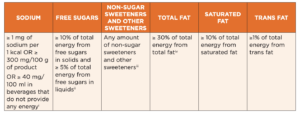
Recommended criteria for identifying food and drinks excessive in nutrients and ingredients of concern curated from PAHO, SEARO and AFRO regional nutrient profile models. Source: Global Health Advocacy Incubator’s Position Paper Nutrient Profile Models: A valuable tool for developing healthy food policies
- Guidance on adopting a strong nutrient profile model: Global Health Advocacy Incubator’s Position Paper Nutrient Profile Models: A valuable tool for developing healthy food policies
- Nutrient profile model calculator: Global Health Advocacy Incubator’s Nutrient Profile Model Calculator for Front-of-Package Warning Labels can be used to identify food and beverage products with excess levels of nutrients of concern
3. Choice of label format
Labels need to be simple, consistent, contrast with other elements of the package and be large enough to stand out. There are many types of front-of-package label designs available, which can be broadly broken down into:
- Nutrient-specific systems (interpretive or noninterpretive/reductive)
- Summary indicator systems
What label type works best?
Global evidence has demonstrated that mandatory, nutrient-specific, interpretive labels—and specifically nutrient warning labels—perform the best in helping consumers identify and reduce purchases of unhealthy products.
General design guidelines for warning labels
- Design: Food warning labels that have generally tested well have octagonal or triangular shapes. Multiple countries (Argentina and Mexico) are also beginning to introduce additional rectangular boxes with warnings for ingredients of concern for children, such as nonsugar sweeteners and caffeine.
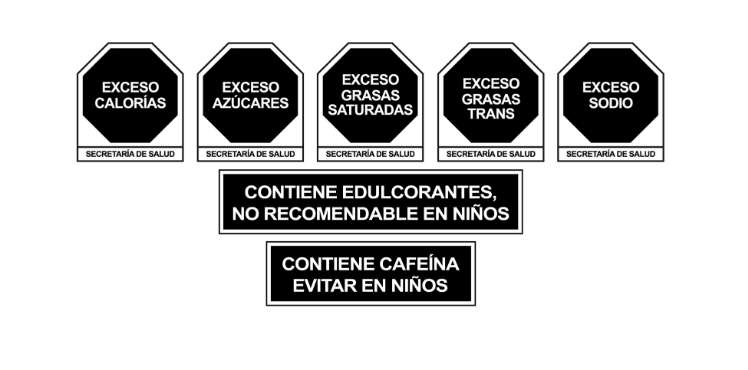
Food warning labels in Mexico. Translation: excess calories, excess sugar, excess saturated fat, excess trans-fat, excess sodium. Contains sweeteners—not recommended for children. Contains caffeine—avoid giving to children. Source: Norma Oficial Mexicana NOM-051-SCFI/SSA1-2010
- Color: The color needs to contrast with the package background. A black symbol with white text is generally placed on a white background.
- Language: Food warning labels typically use “high in” or “excess” to describe nutrients of concern (e.g., high in sodium, excess sodium). Using “excess” rather than “high in” has been found to garner greater perception of product unhealthfulness. Including an endorsement from the Ministry of Health or a similar trusted organization can add credibility.
- Location: Labels should be on the main panel of the product. This may not always be the front of a product package, but it is important to determine and specify the location of the label to prevent industry from manipulating packaging at the point-of-sale.
- Size: There should be minimum size requirements, and different sized labels should be produced for different sized packaging.
- Small packaging/multi-packs: These packages should have labels. A different set of labels can be designed for smaller packs.

Argentina’s smaller-size packages are permitted to present a single octagon that shows how many nutrients of concern the products has (1-7). The label must be 15% of the front of the package. In multi-packs, each individual package inside must also include a label.
Source: Law No. 27.642/2021 on Promotion of Healthy Eating, regulated in the Decree 151/2022 (Annex II). Global Health Advocacy Incubator. FOPWL regulations around the globe.
- Design checklists and best practices:
- P. 20 of UNICEF’s Front-of-Pack Nutrition Labelling: A ‘How-to’ Guide for Countries
- P. 22 of Vital Strategies, Global Health Advocacy Incubator and O’Neill Institute for National and Global Health Law’s What’s in Our Food? A guide to introducing effective front-of-package nutrient labels
- P. 19-21 of Global Health Advocacy Incubator’s Key Legal Factors For Developing Front-of-Package Warning Labeling Regulations
- Country examples with information on food warning label design, size and position: Global Health Advocacy Incubator’s FOPWL regulations around the globe
Public consultation process
The government may choose to have a public consultation process, where the public and other stakeholders can provide input on a draft regulation. Civil society can support the government in attracting public comments. Final decisions should prioritize public health evidence over other interests.
Final graphic design guidelines
Once the final label design is selected, graphic design guidelines should be developed to support implementation. These guidelines should specify how the label design appears on the packaging and describe size, placement and color.
- How to develop graphic design guidelines: P. 48-49 of Vital Strategies, Global Health Advocacy Incubator and O’Neill Institute for National and Global Health Law’s What’s in Our Food? A guide to introducing effective front-of-package nutrient labels
Industry Interference Examples:
- Propose alternative solutions, such as a voluntary rather than a mandatory policy or a label design that is less interpretive and less effective (e.g., Guideline Daily Amount)
- Push for longer consultation periods to delay policy
- Attack and attempt to undermine the label choice and nutrient thresholds (e.g., claim nutrient thresholds are too strict and all products will have labels)
- Claim there is not enough evidence to make a decision
- Argue the policy is too challenging to implement administratively
- Threaten or take legal action
- Lobby against policy development
Resources:
- Food Policy Hub: Case Studies
- Global Health Advocacy Incubator: FOPWL regulations around the globe
- Global Health Advocacy Incubator: Key Legal Factors For Developing Front-of-Package Warning Labeling Regulations
- Global Health Advocacy Incubator: Nutrient Profile Models: A valuable tool for developing healthy food policies
- UNICEF: Front-of-Pack Nutrition Labelling: A ‘How-to’ Guide for Countries
- Vital Strategies, Global Health Advocacy Incubator and O’Neill Institute for National and Global Health Law: What’s in Our Food? A guide to introducing effective front-of-package nutrient labels
- World Cancer Research Fund International: Building momentum: lessons on implementing a robust front-of-pack food label
Implementation, monitoring, evaluation and enforcement of front-of-package labeling policies should be considered throughout the policy process, including early planning phases.
Build a reasonable but firm implementation timeline
This is important since the industry often fights to extend the intended implementation period. It may also be advisable to incorporate adaptation mechanisms for manufacturers in the early phases of implementation, such as stickers instead of printed labels and phased implementation.
- Implementation schedules and examples: P. 30-33 of Global Health Advocacy Incubator’s Key Legal Factors For Developing Front-of-Package Warning Labeling Regulations
- Country implementation timelines: P. 15-16 of Global Health Advocacy Incubator’s FOPWL regulations around the globe
Inform the public that the policy is in effect
Implementation may be accompanied by mass media efforts to increase people’s understanding of the policy and how it can help them make healthier choices.
Monitor implementation
A government agency or independent group free from conflicts of interest should monitor implementation, with support from academia and civil society. Systems where consumers or civil society organizations can raise complaints and support monitoring can also be developed.
Develop an enforcement system
The system should have a range of penalties depending on the offense (e.g., one-time vs. repeat violations). Penalties could include fines, product recalls, cancellation of advertising permits, and may be accompanied by training on how to implement the policy.
- Country examples of monitoring agencies and penalties: P. 20 and 21 of Global Health Advocacy Incubator’s FOPWL regulations around the globe
Comply with due process and notification requirements
All mandatory government processes—both domestic and international—must be followed during and after policy development. This includes domestic due process requirements as well as regional and international trade and investment law obligations.
- International trade compliance: P. 25-26 of Global Health Advocacy Incubator’s Front-of-Package Labeling Preparing for International Trade Legal Arguments
- Legal challenge mitigation in implementation: P. 28-31 of World Cancer Research Fund International’s Building momentum: lessons on implementing a robust front-of-pack food label
Industry Interference Examples:
- Threaten or take legal actions based on trade law
- Lobby against bill to delay implementation
- Launch media campaigns to turn public and policymakers against policy
- Place other labels, such as health or environmental responsibility claims, on packaging that mimic or distract from front-of-package labels
- Design retail displays that hide front-of-package label
- Use child-targeted marketing that was banned from product packaging on other mediums (e.g., digital media)
- Promote products that did not receive a label as healthy, even if they are not
Resources:
- Global Health Advocacy Incubator: FOPWL regulations around the globe
- Global Health Advocacy Incubator: Front-of-Package Labeling Preparing for International Trade Legal Arguments
- Global Health Advocacy Incubator: Key Legal Factors For Developing Front-of-Package Warning Labeling Regulations
- World Cancer Research Fund International: Building momentum: lessons on implementing a robust front-of-pack food label
After introducing a front-of-package labeling policy, evaluate:
- Whether the policy is being executed as intended
- Effectiveness in achieving policy objectives
- Impact on longer-term goals
Evidence is important to:
- Identify policy loopholes exploited by industry
- Support enforcement
- Maintain support for the policy
- Showcase evidence of effectiveness should the food and beverage industry introduce legal challenges
Who should conduct evaluations
Evaluations should be conducted by governments or by independent groups of academic experts with no industry associations, clear terms of reference and public funding.
Setting realistic evaluation expectations
It is important to set stakeholder expectations of what outcomes can be evaluated within what timeframe. The food and beverage industry may use lack of short-term impact on rates of overweight and obesity to argue that the policy did not work. Academics and advocates should convey that these health outcomes can take many years to measure and that single regulations are contributing to healthier overall food environments and eating, which is why regulations should be as comprehensive as possible.
Evaluations may measure:
1. Is the labeling policy working as intended? (Process evaluation)
- Extent of implementation (proportion of manufacturers using labels, number/proportion of products displaying labels).
- Extent to which labels adhere to design requirements.
2. Is the labeling policy meeting objectives? (Outcome evaluation)
- Effect of front-of-package labels on consumer understanding of healthy/unhealthy ingredients and food.
- Effect of front-of-package labels on consumer purchasing behavior.
- Effect of front-of-package labels on the nutritional composition of food (reformulation).
- Effect of the policy on the economy (wages, prices, employment).
3. Is the labeling policy achieving longer-term goals? (Impact evaluation)
- Effect of front-of-package labels on population-level dietary intake, including targeted nutrients of concern (e.g., sugar).
- Monitoring and evaluation guidance: Appendix 3 in WHO’s Guiding principles and framework manual for front-of-pack labelling for promoting healthy diet
- Sample policy evaluations:
- The World Cancer Research Fund International’s NOURISHING database
- P. 16 of Vital Strategies, Global Health Advocacy Incubator and O’Neill Institute for National and Global Health Law’s What’s in Our Food? A guide to introducing effective front-of-package nutrient labels
Industry Interference Example:
- Fund research to try to prove the policy is ineffective, potentially including evidence of economic harm
Resources:
- World Health Organization: Guiding principles and framework manual for front-of-pack labelling for promoting healthy diet
- World Cancer Research Fund International: NOURISHING database
- Vital Strategies, Global Health Advocacy Incubator and O’Neill Institute for National and Global Health Law: What’s in Our Food? A guide to introducing effective front-of-package nutrient labels