
What is the evidence for fiscal policies for healthier diets? What is the evidence for fiscal policies for healthier diets?
Key Information:
- Shifting diets toward whole, minimally processed foods (fruits, vegetables, legumes and whole grains) and away from ultra-processed products significantly reduces the risk of diet-related chronic diseases and premature mortality.
- Fiscal policies for healthier diets focus on supply-side actors (e.g., farmers and producers) and demand-side points (e.g., retailers and consumers), or a combination of both, to improve affordability of and access to nutritious food.
- On the demand side, price subsidies, such as matching incentives and vouchers, as well as cash transfers, can increase access to vegetables and other nutritious foods, benefiting low-income households through improved dietary outcomes.
- On the supply side, procurement policies and targeted agricultural investment can expand the availability of healthy foods and support smallholder and family farmers.
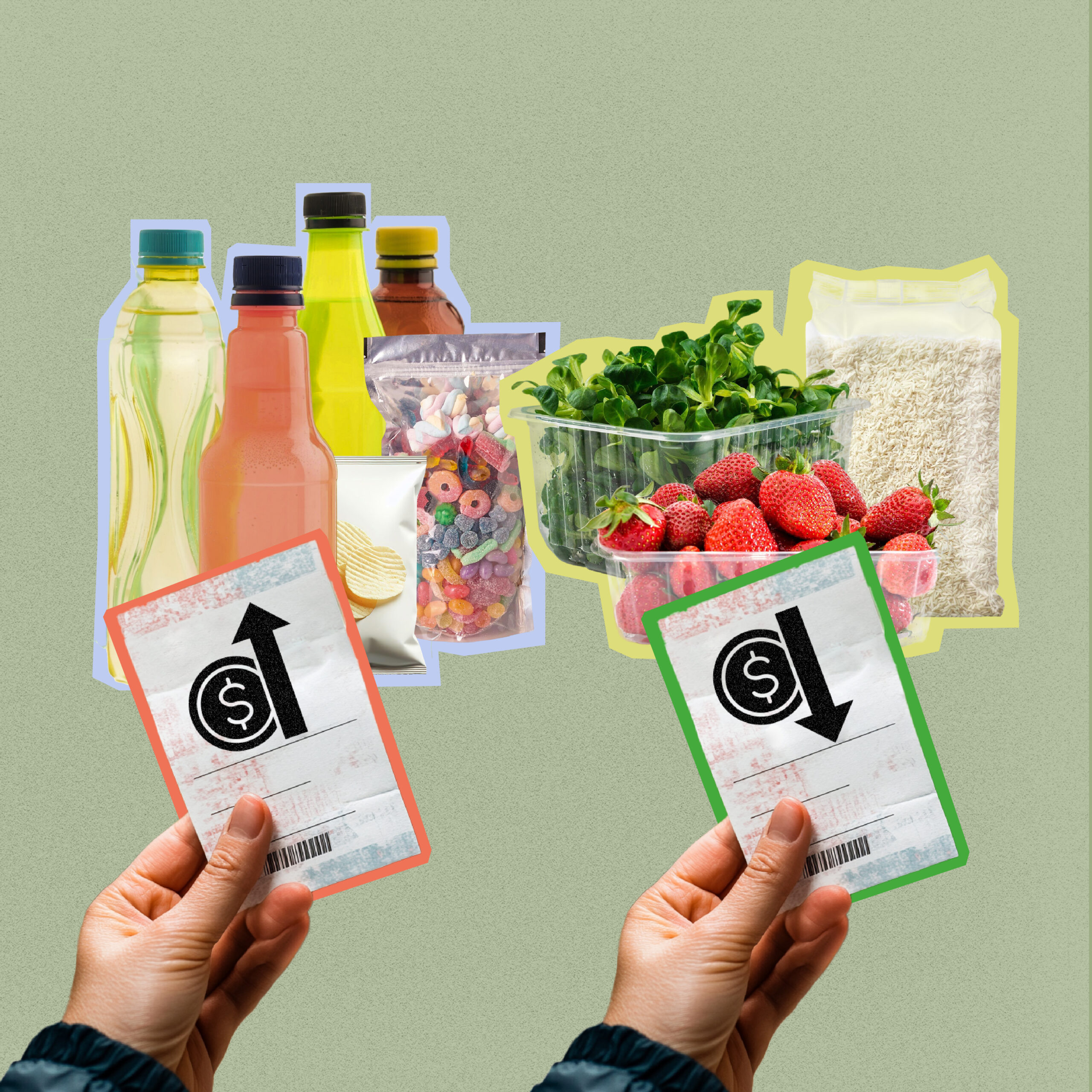
- Pairing price subsidies with taxes on unhealthy foods and sweetened beverages can enhance efficacy by incentivizing consumers to swap now-more-expensive unhealthy products for subsidized healthy alternatives.
A healthy diet helps prevent all forms of malnutrition and protect against diet-related noncommunicable diseases. A diet rich in fruits, vegetables, nuts and legumes can lower blood pressure, reduce risk of eye and digestive issues and protect against heart disease, stroke and some forms of cancer.
On the other hand, a diet high in ultra-processed products increases risk of overweight and obesity, and of diet-related chronic diseases, such as Type 2 diabetes and cardiovascular disease.
In many settings, healthy, nutritious and culturally appropriate foods are becoming more challenging to access than the ultra-processed products displacing these traditional foods (Box 1). This is especially true for people with lower income who dedicate a higher proportion of their income to purchasing food.
➔ Learn more: Food Policy Hub’s problem page
More than 50%
of calories consumed in the U.S. and U.K. are from ultra-processed products.
Global Food Research Program at UNC-Chapel Hill. Ultra-processed foods: a global threat to public health. 2023.
≈ 20–50%
of calories in other high- and middle-income countries are from ultra-processed products.
Global Food Research Program at UNC-Chapel Hill. Ultra-processed foods: a global threat to public health. 2023.
- A review of the risks of ultra-processed products found high consumption is associated with 32 harmful effects to health, including a 50% higher likelihood of cardiovascular disease and 21% greater risk of all-cause mortality.
- Consuming 10% or more of daily calories from ultra-processed products is associated with ≈3.4 million deaths annually across 45 countries.
- For each 200g/day increase in fruit and vegetable intake, there is a reduction in the relative risk of coronary heart disease (8-16%); stroke (13-18%); cardiovascular disease (8-13%); total cancer (3-4%); and all-cause mortality (10-15%).
- The risk of all-cause mortality decreases by 5%, and cardiovascular mortality by 4%, for each additional serving of fruits and vegetables.
- In 2021, global intake of vegetables was 40% below recommended servings, 60% for fruit and 68-74% for legumes and nuts.
- Research has revealed that healthy diets are more expensive than unhealthy alternatives across much of the world. In 2025, approximately 2.7 billion people—about one-third of the global population—could not afford a healthy diet.
The market favors unhealthy foods and beverages
As the agriculture and food processing sectors have become increasingly dominated by a small number of multinational corporations—a trend accelerated by foreign investment in food processing and retail—policies including agricultural subsidies, tax exemptions and preferential trade agreements have helped entrench their market advantage.
Policies have focused on providing the staple crops needed for processed and ultra-processed products. Rice, sugar and meat are the most heavily subsidized foods worldwide, while crops that support a healthier diet receive far less investment. The result is that ultra-processed products are cheaper and more widely available, while healthier options remain more expensive and less accessible. The production of ultra-processed products also carries a high carbon footprint, whereas a shift to healthier plant-based crops such as fruits and vegetables can significantly reduce dietary carbon emissions.
In the United States, producers of corn and soybeans, primary ingredients in processed foods and sweeteners, received $5.1 billion in direct subsidies in 2024, while producers of fruits and vegetables receive minimal support and are not eligible for direct subsidies. Similarly, major sweetened beverage producers in Brazil avoided approximately R$4 billion (roughly US $700 million) in taxes through benefits in the Manaus free trade zone.
These structural advantages can directly undermine fiscal policies aimed at improving public health, including taxes on unhealthy products, by offsetting their effect and reducing political appetite for reform.
- Agenda to repurpose agricultural investments: Reeve et al.’s article Health sector advocacy for repurposing agricultural investments affecting fruits, vegetables and legumes
Guiding questions to collect local evidence:
- What proportion of people’s diets consists of healthier foods (fruits, vegetables, legumes) and what proportion consists of ultra-processed products?
- Are people consuming the daily recommended servings of fruits and vegetables?
- How affordable are healthier foods relative to household income?
- How affordable are ultra-processed products relative to household income?
- What fiscal policies have contributed to the growth of the food and beverage industry?
- Can these policies be leveraged or reformed to promote healthier food access?
Food affordability and accessibility, determined by price, income and the availability of healthy options, shape what people buy and eat. Fiscal policies offer governments a powerful lever to correct imbalances in food environments by raising the cost of unhealthy products, lowering the cost of nutritious ones and strengthening the systems that produce and distribute them.
Fiscal policies for healthier diets can focus on supply-side actors (e.g., smallholder farmers and producers) and demand-side points (e.g., retailers and consumers), or a combination of both, to improve affordability of and access to nutritious food
Supply-side examples to improve healthy food availability and farmer outcomes
Support for smallholder and family farms
Governments can direct agricultural infrastructure spending—roads, rural electrification, irrigation—toward small and medium-sized farms growing healthier foods, building food system and climate resilience. Through public investment and planning policies, governments can also strengthen territorial and local markets where smallholder farmers sell directly.
Policy example: The Ethiopian government’s Universal Rural Road Access Program prioritized rural road construction to connect farmers to markets. The program doubled rural people’s access to all-weather roads, reducing transport burdens and improving agricultural income.
- A systematic review of 28 studies across 14 low- and middle-income countries–most of them from Ethiopia–found that improved market access for smallholder farmers was generally associated with greater household dietary diversity.
- A study spanning 26 countries found that irrigation expansion was associated with improved child dietary diversity, with the the strongest effect observed in water-stressed regions.
Subsidized agricultural input
Governments can mandate subsidized access to seeds, equipment and technical assistance for farmers growing nutritious crops, lowering barriers to expanding healthy food production.
Policy example: India’s Mission for Aatmanirbharta in Pulses, with a budget of ₹11,440 crore (US$1.37 billion), subsidizes seed distribution to farmers growing pulses, protein-rich legumes that make up nearly a quarter of total protein intake in Indian diets.
- A nationally representative study in Malawi found that subsidizing legume seeds increased the area planted with legumes, yields and crop value. It also improved households’ dietary diversity and micronutrient consumption, and was positively associated with child and adolescent weight-for-age–though not height-for-age.
- This aligns with modeling at a global scale, which found that redirecting agricultural subsidies toward fruits, vegetables, legumes and nuts could increase their consumption by 5–10% and prevent an estimated 444,000 diet-related deaths by 2030.
Supply- and demand-side examples to improve healthy food availability, accessibility and farmer outcomes
Procurement policies for public institutions
Governments can require that public institutions—schools, hospitals, etc.—source a defined share of food from family farms or specific healthy food groups, stimulating demand and supporting local small-scale producers.
Policy example: Brazil’s National School Feeding Program (PNAE) mandates that 45% of food purchasing be sourced directly from family farming, and that 90% of funds be used for unprocessed or minimally processed foods, with ultra-processed products avoided entirely.
- PNAE evaluations show family farmer income increased by approximately US$12 million following the procurement mandate, and students who regularly consumed school meals had significantly better overall diet quality than those who did not.
- A review of 34 studies found healthy food procurement policies in hospitals, schools and other public institutions effective in increasing the availability and purchases of healthy foods and decreasing purchases of unhealthy foods in all settings evaluated.
VAT reduction or exemption on healthy foods
Removing or lowering taxes on healthy foods—especially alongside levying or raising taxes on foods high in nutrients of concern that are often ultra-processed—serves as a combined supply-side and demand-side intervention. It incentivizes greater production and sales of healthier options while lowering the price consumers pay at checkout.
Policy example: Latvia’s 2018 tax reform reduced the VAT rate on fruits and vegetables from 21% to 5% (later adjusted to 12%).
- An evaluation of Latvia’s reform found retail prices on targeted products fell by 11.7 percentage points, but pass-through was not complete (88%).
- A study found Costa Rica’s 2023 tax basket reform—unique in mandating that nutritional criteria be considered in determining VAT rates on food—was undermined by unclear nutritional standards. This allowed processed foods onto the discounted list alongside healthier foods, increasing household purchases of calories, sugar and saturated fat. Modeling shows using PAHO’s evidence-based nutrient profile model instead could reduce the calories, sodium and saturated fat purchased, with the largest gains for lower-income households.
Demand-side examples to improve healthy food accessibility
Conditional cash transfer programs
Governments can provide low-income households with cash, conditional on meeting defined requirements such as school attendance or health clinic visits, with evidence showing improvements in dietary diversity and nutrition outcomes.
Policy example: Launched by Mexico’s federal government in 1997, Mexico’s PROGRESA (later called Oportunidades then PROSPERA until it ended in 2019) established a national conditional cash transfer framework, providing payments to low-income families conditional on school attendance and regular health clinic visits.
Unconditional cash transfers
Governments can provide low-income households with regular cash payments, with no conditions attached, to alleviate poverty and food insecurity. Evidence shows improvements in dietary diversity and nutrition-related birth outcomes.
Policy example: South Africa’s Child Support Grant, introduced in 1998 and grounded in a constitutional right to social security, provides monthly cash payments to primary caregivers of children under 18 who meet an income threshold, with no behavioral conditions attached. Reaching 13 million children, the grant has been found to reduce child hunger and, when received early, improve height-for-age among children under five.
- A systematic review and meta-analysis of 129 estimates on the impacts of cash transfer programs found significant improvements in child nutrition, including: reductions in stunting (-1.4%) and wasting (-1.3%), increases in dietary diversity (0.55 additional food groups) and in consumption of animal-source foods (6.7%).
Food voucher policies
Governments can provide vouchers (or coupons) redeemable for healthy foods, enabling low-income households to access nutritious food while directing demand toward specific food groups.
Policy example: Mongolia introduced a food stamp program in 2008, formalized under the Social Welfare Law in 2012, providing targeted food vouchers to the poorest 5% of households for the purchase of basic food staples. Now reaching about 200,000 Mongolians every year, evaluations have shown the program has been effective in addressing food insecurity and improving diversity of foods consumed by recipients.
- Evidence from the Special Supplemental Nutrition Program for Women, Infants and Children (WIC) in the U.S., which provides vouchers for specific nutritious foods, found that participating women had 10% to 20% increases in consumption of targeted nutrients and foods, and experienced a small increase in the average birth weight of their babies, though more evidence is needed.
Other subsidy types
Governments can fund programs that:
Match a portion or the total amount a low-income household spends on specific healthy foods, providing the match as a voucher or token during the shopping trip.
Policy example: The Gus Schumacher Nutrition Incentive Program (U.S.), created under the Farm Bill, provides grants to organizations offering matching incentives on fruits and vegetables at participating retailers and farmers markets, increasing the purchasing power of low-income food assistance recipients for healthy foods. A national evaluation found that participants enrolled in the program for more than six months had higher fruit and vegetable intake (cups per day=2.91) and lower odds of food insecurity compared to shorter-term (cups per day=2.76) or first-time participants (cups per day=2.73).
Discount the price of specific healthy products at the point of sale, typically by a set percentage.
Example: A randomized trial in Australia found a 20% discount on fruits and vegetables led participants to purchase 233 more grams of vegetables and 364 more grams of fruit per week than those without the discount.
Rebate a percentage of what consumers spend on healthy foods, repaid after purchase.
Example: In South Africa, Discovery health insurance members received up to a 25% rebate on healthy food purchases, with participating households in the 25% tier increasing their fruit and vegetable purchases by 8.5% between 2009 and 2012.
General subsidy evidence:
- Systematic reviews and meta-analyses show that 10% price subsidies on fruits and vegetables increase sales by approximately 6–8%, with some studies finding 12–14% increases in consumption.
- A meta-analysis found 20% price subsidies resulted in approximately a 17% increase in fruit and vegetable purchases. For context, in the U.K., where average consumption is 3.8 portions per day, a 17% increase would mean an additional 0.6 servings per day.
- A meta-analysis found that subsidies that reduced healthier food prices by 10% increased consumption by 12%, with each 10% decrease in prices of fruits and vegetables associated with 0.4 kg/m2 lower BMI.
Additional examples: Global Food Research Program at UNC-Chapel Hill’s Fiscal policies and programs to improve access to and demand for healthy foods
Guiding questions to collect local evidence:
- What fiscal policies are designed to increase access to and supply of healthier foods?
- What supply- or demand-side policies would be most feasible and impactful?
- Which groups or individuals would benefit the most from increased access to healthier food?
- Are there studies on fiscal policies for healthier food, including modeling studies?
- How can existing evidence be used to make the case for such policies?
Modeling studies show that combining taxes on unhealthy foods with subsidies on healthier foods produces greater shifts toward healthier food purchases, and larger gains in welfare and health outcomes, than either policy alone. In general, evidence supports implementing fiscal policies as part of a coordinated package of reinforcing measures to create more meaningful shifts in food environments and consumer behavior.
“Taxation and subsidy strategies can redistribute the relative costs of foods, promoting equity and empowering decision-making.”
- A study in Chile found that combining taxes on unhealthy foods and beverages with removal of the existing VAT on fruits and vegetables would lead to an increase of 5.3 kg of fruits and vegetables per household per month.
- A study in New Zealand found that a fruit and vegetable discount of 20% and a tax on sugar (set to increase the total food price by the same decrease as the fruit and vegetable discount) would lead to a gain of 751 health-adjusted life years per 1,000 people.
Guiding questions to collect local evidence:
- Does your setting have a tax on unhealthy foods and sweetened beverages that could be paired with fiscal policies for healthier foods (e.g., price subsidies)?
- What is the potential for implementing combined fiscal policies?
- Global Food Research Program at UNC-Chapel Hill’s fact sheet Fiscal policies and programs to improve access to and demand for healthy food