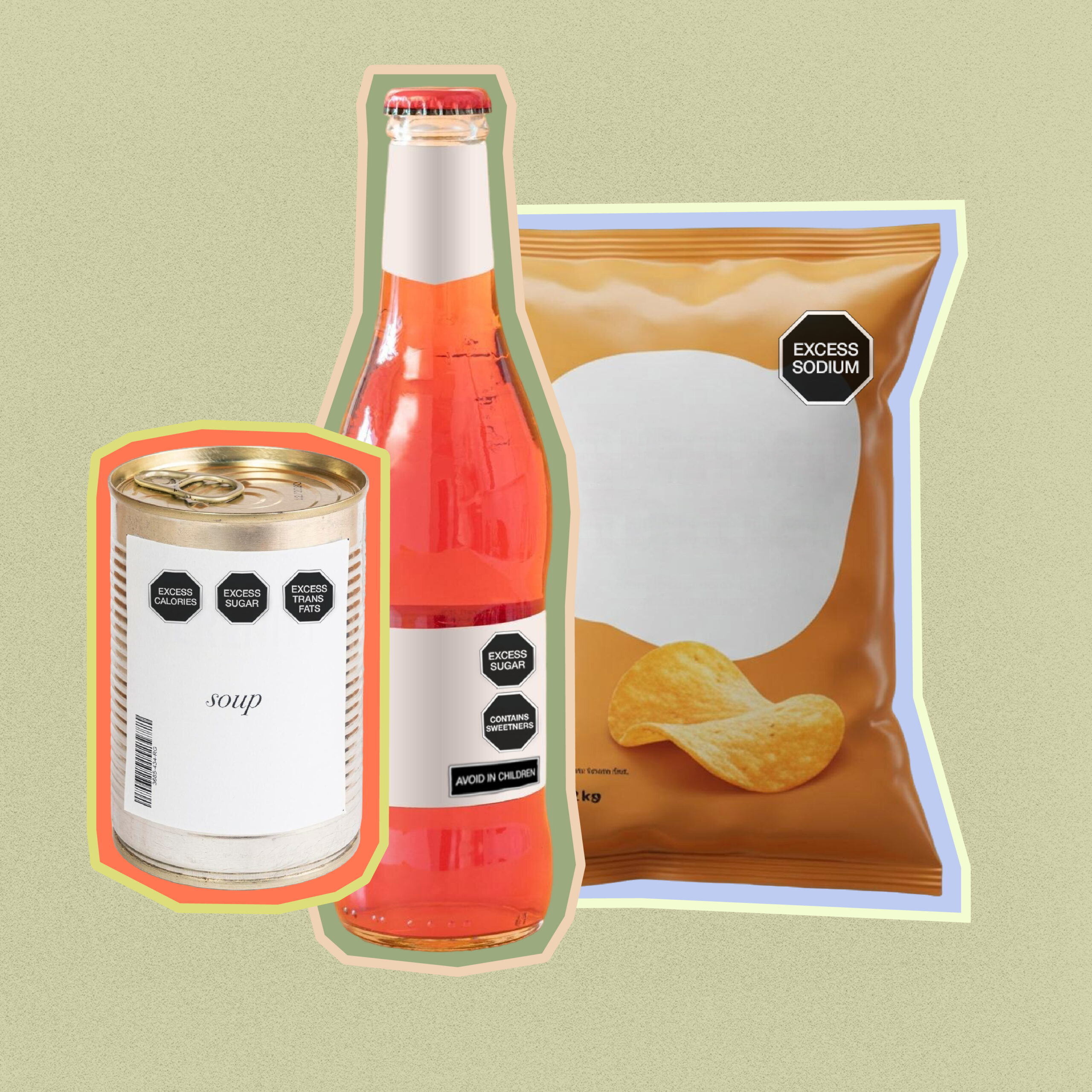
What is the evidence for front-of-package labeling? What is the evidence for front-of-package labeling?
Key Information:
- Front-of-package labeling is a World Health Organization “best buy” policy for healthier diets, backed by well-established research free of conflict of interest.
- Front-of-package labeling is necessary because food environments have become increasingly crowded with unhealthy food and beverages high in sugar, sodium or fats, which are often ultra-processed.
- These unhealthy products are often heavily marketed and feature misleading claims that appeal to and confuse consumers (e.g., “fat free,” “natural”), leading to poorer diets.
- Enabling consumers to identify and reduce purchases of unhealthy foods is important to help them avoid excess intake of harmful nutrients and ingredients and make healthier choices.
- Evidence shows mandatory nutrient warning labels, grounded in a robust nutrient profile model, are most effective at reducing purchases of unhealthy products because they clearly convey when products are high in nutrients or ingredients of concern.
This page provides global evidence and guiding questions to help collect local evidence. Where resources are limited, global, regional and comparable-country evidence may be used.
Front-of-package labeling is an evidence-based tool and a World Health Organization “best buy” policy for healthier diets, backed by well-established research free from conflicts of interest. Front-of-package labels inform consumers about the healthfulness of food products, shaping purchasing decisions. Various approaches and label designs are used globally.
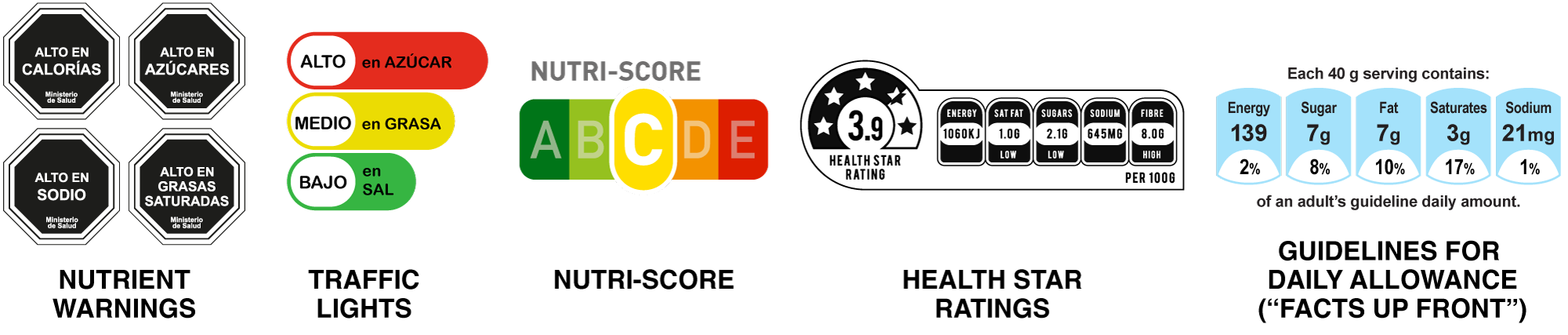
Examples of select front-of-package labels. Source: Global Food Research Program at University of North Carolina-Chapel Hill.
Pre-packaged foods and beverages high in sugar, sodium or fat, which are often ultra-processed, are now available in virtually every community around the globe. The ubiquity and heavy marketing of these products have changed how people eat, resulting in less healthy diets and increasing risk of health harms. Once concentrated in high-income countries, these products are increasingly common in low- and middle-income countries.
Ultra-processed products are foods and drinks that use ingredients or additives never or rarely found in home kitchens. Ingredients have often been chemically and/or physically transformed using industrial processes. These packaged products are typically ready-to-eat or ready-to-heat and contain additives that increase their appeal and palatability.
More than 50% of calories consumed in the U.S. and U.K. are from ultra-processed products.
Source
Global Food Research Program at UNC-Chapel Hill. Ultra-processed foods: A global threat to public health. 2021 May.
≈ 20-50% of calories in other high- and middle-income countries are from ultra-processed products.
Source
Global Food Research Program at UNC-Chapel Hill. Ultra-processed foods: A global threat to public health. 2021 May.
- In 2019, ultra-processed product sales were 3 to 11-fold higher in high-income countries than in low- and upper-middle-income countries. However, sales in low- and upper-middle-income countries grew at annual rates of 7% and 2% respectively, versus 0.1% in high-income countries.
- The most comprehensive review on ultra-processed product risks to date, analyzing data from nearly 10 million participants, found that high consumption is associated with 32 harmful health effects, including:
- 50% higher likelihood of cardiovascular disease
- 12% higher risk of diabetes
- 22% increased risk of depression
- 21% greater risk of death from any cause.
Guiding questions to collect local evidence:
- How and where do people shop for food?
- Is healthy food easily accessible and affordable?
- How accessible are foods high in fat, salt and sugar (typically ultra-processed)?
- How often do people consume these products?
- How does consumption vary by demographic group (age, income, race/ethnicity)?
- How have consumption rates and sales trends changed in recent years?
Many countries now mandate at least some form of nutrition information (e.g., nutrient declarations, ingredients lists);* however, some formats are complicated to understand and apply to purchasing decisions. In addition, the increasing variety of food options in retail settings, appealing marketing and misleading claims that frame products as healthier than they are (e.g., “low-fat,” “natural”), makes it more challenging for consumers to choose healthy options.
*Back-of-package nutrient information is a prerequisite to pursuing front-of-package labeling.
- Shoppers take just seconds to choose grocery items—not enough time to read and interpret dense nutrition information.
- A study of 20 countries found low consumer comprehension of back-of-package labels and nutrition facts tables. In Mexico, while more than half of consumers reported understanding the nutrition facts table, only 1.2% correctly understood the information when surveyed.
- A study found that 97% of fruit drinks purchased by U.S. households with infants and young children had nutrition-related claims, with one-third referencing Vitamin C content. Juices making vitamin C claims were more likely to be high in calories and sugar.
- A randomized trial with more than 2,000 adults and children found that people were most likely to avoid unhealthy products when packages had front-of-package labels without other health claims.
Guiding questions to collect local evidence:
- What nutrition labels do products include? Are back-of-package nutrition labels mandatory? What nutrients do they include?
- Are there studies about how consumers interpret the food labeling system?
- What types of claims do manufacturers make on products?
- Have studies examined how consumers respond to these claims?
Enabling consumers to identify unhealthy foods at point of purchase can help reduce their intake of harmful nutrients. While label designs like traffic light systems or Nutri-Score may attempt to positively position healthier choices, mandatory nutrient warning labels are most effective at discouraging and reducing purchases of unhealthy products. Warning labels should be based on a strong nutrient profile model.
–> View best practices for front-of-package labeling
Why mandatory policies?
Mandatory labels are required across the food supply, whereas voluntary labels are applied at manufacturers’ discretion. Mandatory front-of-package labels create legal obligations and provide oversight and accountability mechanisms, resulting in much higher uptake and better helping consumers make healthier choices.
- A 2020 evaluation of Chile’s mandatory nutrient warning label policy found 94% compliance for “high in” products in supermarkets.
- In Australia in 2023, only 39% of eligible products used the voluntary Health Star Rating label, while 93% used mandatory country-of-origin labeling.
16
countries have mandatory front-of-package labeling policies.
Source
Global Food Research Program at UNC-Chapel Hill. Front-of-package labeling policies around the world: Maps. 2025 March.
35
countries have voluntary front-of-package labeling policies.
Source
Global Food Research Program at UNC-Chapel Hill. Front-of-package labeling policies around the world: Maps. 2025 March.
Why nutrient warning labels?
Nutrient warning labels warn consumers when products contain high amounts of nutrients of concern (e.g., salt, sugar or saturated fat), often using an octagonal stop-sign shape. Warning labels are easier for consumers to notice than other label designs because they only appear on products with the greatest health risk, use a black-and-white design distinguishable from other package elements and are easy to interpret.
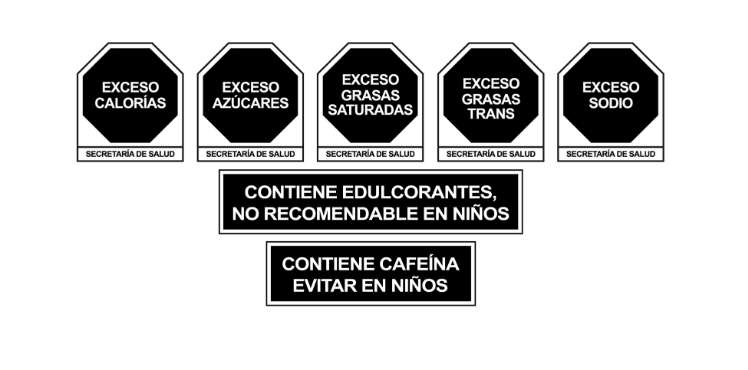
Example of warning labels from Mexico. Translation: excess calories, excess sugar, excess saturated fat, excess trans-fat, excess sodium. Contains sweeteners—not recommended for children. Contains caffeine—avoid giving to children. Source: Norma Oficial Mexicana NOM-051-SCFI/SSA1-2010
- A meta-analysis of eight studies found nutrient warning labels were more effective than other systems at discouraging purchases of unhealthy products and reducing calories and saturated fat purchased.
- Studies using eye-tracking data found that nutrient warning labels best attract attention and help consumers quickly interpret a product’s healthfulness.
- A meta-analysis of 23 studies found nutrient warning labels on sugar-sweetened beverages reduced the odds of customers choosing the beverage by 51% compared to beverages with no labels.
- A modeling study in Barbados found nutrient warning labels could help avert 16% of deaths from noncommunicable diseases and save the country more than US $700 million.
- In Chile, a policy package including nutrient warning labels on unhealthy foods and marketing restrictions to children led to reduced purchases of “high in” products, with notable declines in sugar (37%), calories (23%), sodium (22%) and saturated fat (16%) purchased from labeled products.

Nutrients and calories purchased during Phase 2 of Chile’s laws vs. hypothetical expected purchases with no policies. Source: Global Food Research Program at UNC-Chapel Hill. Front-of-package labeling to empower consumers and promote healthy diets. 2025. Original data from: Paraje G, Montes de Oca D, Corvalán C, Popkin B. Socioeconomic Patterns in Budget Share Allocations of Regulated Foods and Beverages in Chile: A Longitudinal Analysis. Nutrients. 2023 Jan 29;15(3):679.
10
countries use mandatory nutrient warning labels as their front-of-package labeling approach.
Source
Global Food Research Program at UNC-Chapel Hill. Front-of-package labeling policies around the world: Maps. 2025 March.
9
countries are developing policies to adopt nutrient warning labels.
Source
Global Food Research Program at UNC-Chapel Hill. Front-of-package labeling policies around the world: Maps. 2025 March.
Why use a strong nutrient profile model?
The goal of a nutrient profile model is to classify food and beverage products according to their nutritional composition. By identifying those with excess nutrients or ingredients of concern, these models provide a scientific basis for policies aimed at reducing consumption of nutritionally poor products. Strong nutrient profile models—based on World Health Organization recommendations, free from conflicts of interest and following other best practices—apply to more such products.
- A study in Mexico found that nutrient profile models developed with the food and beverage industry had less strict criteria than those developed independently.
- Studies in India and Brazil identified WHO regional models as most appropriate for their settings: the WHO SEARO model would apply warning labels to 68% of foods studied in India, while the WHO PAHO model would apply labels to 62% of foods in Brazil.
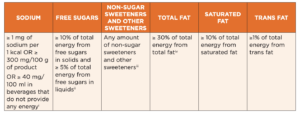
Recommended criteria for identifying food and drinks excessive in nutrients and ingredients of concern curated from PAHO, SEARO and AFRO regional nutrient profile models. Source: Global Health Advocacy Incubator’s Position Paper Nutrient Profile Models: A valuable tool for developing healthy food policies
Guiding questions to collect local evidence:
Does your country have a front-of-package labeling policy?
If yes:
- Which best practices does it use or not use?
- What are the advocacy opportunities?
If no:
- What are the opportunities to pursue a best practice policy?
- Global Food Research Program at UNC-Chapel Hill’s fact sheet on ultra-processed products
- Global Food Research Program at the UNC-Chapel Hill’s fact sheet on front-of-package labeling
- Vital Strategies, Global Health Advocacy Incubator and O’Neill Institute for National and Global Health Law’s guide to introducing front-of-package nutrient labels
- Global Health Advocacy Incubator’s evidence sheet on front-of-package labeling
- Pan American Health Organization’s report on trends, effects and policy implications of ultra-processed food and drinks in Latin America