Case Study
What can be learned from others about sweetened beverage taxes and taxes on unhealthy food? What can be learned from others about sweetened beverage taxes and taxes on unhealthy food?
Policy Snapshot
In 2018, South Africa became the first Sub-Saharan African country to implement a sugary beverage tax (called Health Promotion Levy)—a victory that came after years of research, coalition-building and strategic media advocacy to counter intense industry opposition.
Policy Timeline
2013: Research Identifies Tax as Cost-Effective Solution
- PRICELESS SA (Priority Cost-Effective Lessons for System Strengthening South Africa), a research-to-policy unit at the University of Witwatersrand, identified a sugary beverage tax as a “best buy” to address rising rates of obesity and diet-related chronic diseases.
- PRICELESS SA engaged government and civil society stakeholders to build the case for action.
Read more: Manyema et al.’s The Potential Impact of a 20% Tax on Sugar-Sweetened Beverages on Obesity in South African Adults: A Mathematical Model
2016: Coalition Forms and Government Signals Intent to Tax Sugary Beverages
- Civil society organizations formed the Healthy Living Alliance (HEALA) coalition to campaign for a tax of 20% or higher.
- The finance minister announced plans to introduce a sugary beverage tax, releasing a policy paper reflecting PRICELESS SA’s proposal.
- HEALA launched widespread mass media campaigns highlighting health harms of sugary beverages. Evaluations showed the campaigns increased public understanding and boosted tax support by nearly 10%.
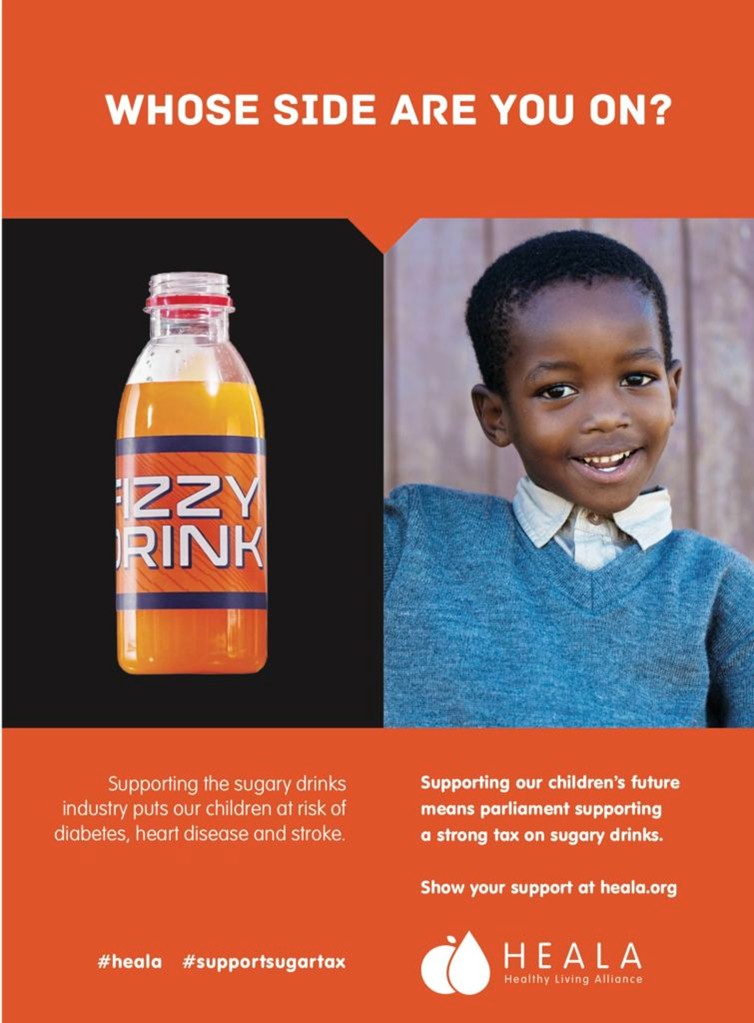
An ad in support of the sugary drink tax by HEALA. Learn more at heala.org.
Read more:
- National Treasury’s Taxation of Sugar Sweetened Beverages: Policy Paper
- View the “Are you drinking yourself sick?” and “Journey: what sugary drinks did to me” mass media campaigns
- View an evaluation of the campaigns
2016-2017: Building a Multi-Faceted Campaign
- HEALA members spoke at public hearings and voiced support to decision-makers.
- Advocates mobilized grassroots support through social media and delivered 2,000 petition signatures to Parliament.
- Industry launched opposition campaign claiming the tax would not work and would cost jobs, while privately threatening decision-makers.
- Advocates countered with scientific evidence from other countries demonstrating taxes reduced consumption without hurting employment.
December 2017: Parliament Passes Tax
- Parliament passed the sugary beverage tax and the president signed it into law.
April 2018: Tax Takes Effect but With Reduced Rate
- The Health Promotion Levy took effect at 11%—nearly half the evidence-based 20% recommendation—due to industry claims about economic losses.
2025: Advocacy Continues
- HEALA and partner organizations continue advocating to increase the tax to 20%.
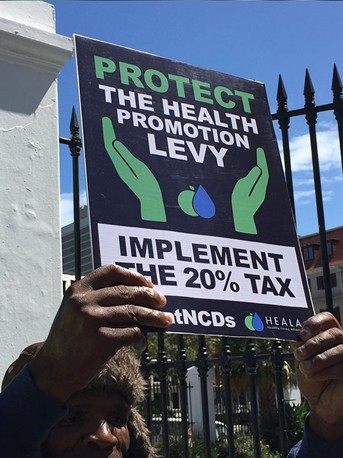
Protestors call for a 20% tax on sugary beverages outside parliament in Johannesburg. Learn more at heala.org.
Key Success Factors:
- Strong scientific foundation demonstrating the tax as a cost-effective intervention to address obesity and diet-related chronic diseases
- Unified coalition approach that coordinated campaigns, grassroots mobilization, parliamentary testimony and consistent messaging against industry opposition
- Sustained advocacy beyond implementation to help ensure policy aligns with best practices
Additional Resources:
Read the case studies that were summarized here:
- Vital Strategies. Lessons From South Africa’s Campaign for a Tax on Sugary Beverages. 2020
- Global Health Advocacy Incubator. Reducing Sugary Drink Consumption in South Africa
View the regulation in English and Afrikaans
View key takeaways and lessons learned from tax advocacy
Read about the food and beverage industry’s interference in the policy process
View Food Policy Hub’s recommendations for best practice healthy food and beverage taxes
Policy Snapshot
In 2023, Colombia became one of the first countries worldwide to tax both sweetened beverages and ultra-processed products. It was not an easy path: The victory that came after multiple failed legislative attempts, years of civil society advocacy and successful navigation of legal challenges from the food and beverage industry.
Policy Timeline
2014-2015: First Tax Attempts Made
- The Health Minister announced his intention to include a sugar-sweetened beverage tax alongside tobacco tax increases in the National Development Plan.
- The proposal failed to advance due to a strong industry lobby.
2015-2016: Industry Censorship and Failed Legislative Attempt
- Postobón, the country’s largest beverage company, filed a legal complaint against an evidence-based, public health information campaign about sugary beverages developed by the civil society organization Educar Consumidores, timed with a 20% tax being considered by congress.
- A government agency sided with the industry, pulled the ad and prohibited public discussion, threatening fines for violations.
- Educar Consumidores and allies launched legal challenges.
- The sugar-sweetened beverage tax proposal was dropped from a larger tax reform package due to industry pressure, while tobacco taxes successfully increased.
Read more: Global Health Advocacy Incubator’s A Victory for Public Health Information Campaigns in Colombia: The Role of Legal Strategies for Health Promotion
2017: Another Legislative Rejection and Constitutional Court Victory
- A tax reform package with an 18% tax on sugar-sweetened beverages was debated in Congress but was rejected due to industry pressure.
- The Court ruled consumers have the right to public health information, removing the legal threat intended to silence advocates.
2017-2022: Sustained Advocacy and Political Will
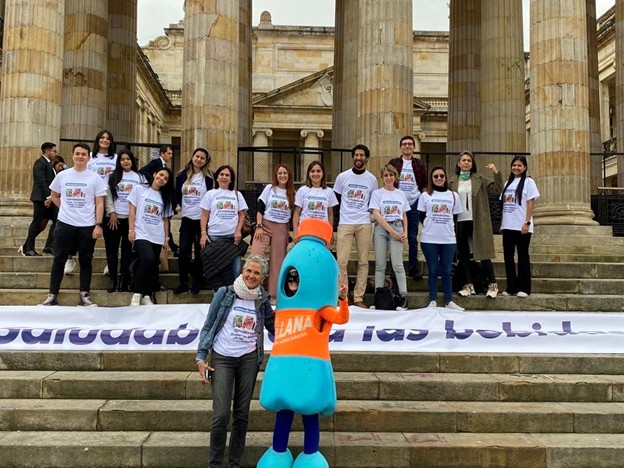
- Civil society organizations (Red PaPaz, CAJAR and others) conducted advocacy to build support, including seven media campaigns reaching ~14 million people, secured 70+ Congressional signatures and gathered 10,000+ signatures from the public.
- New president Gustavo Petro introduced a tax reform to raise billions for social programs to address inequality; sweetened beverage and ultra-processed food taxes comprised about 10% of projected revenue. Most Colombians (65%) approved the reform.
2022: Tax Reform Approved
- Congress approved the tax reform—making Colombia one of the first countries globally to tax ultra-processed products.
- The food and beverage industry launched legal challenges claiming procedural irregularities and violation of principles of equality, economic freedom and free competition.
Read more: Global Health Advocacy Incubator’s Colombia Enacts Two Major Healthy Food Policies
2023: Tax Survives Constitutional Challenge
- Academic and civil society organizations across the region submitted amicus briefs supporting the decision.
- The Constitutional Court unanimously declared the tax constitutional, concluding it reasonably served public health objectives and proportionately limited free enterprise rights. The tax took effect Nov. 1, 2023.
Read more: Global Health Advocacy Incubator’s Sweet Success: How Colombia’s Landmark Sugary Beverage Tax Rose Above Legal Challenges
Key Success Factors:
- Six+ years of strategic civil society advocacy combining legal action, sustained strategic communication, and more
- Clear articulation of policy objectives that framed the tax as serving the public interest and guided the Court’s proportionality analysis
- Regional solidarity through amicus briefs highlighting the decision’s importance across Latin America
- Persistence after multiple failed attempts—each attempt helped build public awareness and establish legal precedent
- Political opportunity where taxes were introduced by a new government as part of a comprehensive progressive taxation reform to address inequality that had strong public support
Source: