
Case Study
What can be learned from others about sweetened beverage taxes and taxes on unhealthy food? What can be learned from others about sweetened beverage taxes and taxes on unhealthy food?
Policy Snapshot
In 2018, South Africa became the first Sub-Saharan African country to implement a sugary beverage tax (called Health Promotion Levy)—a victory that came after years of research, coalition-building and strategic media advocacy to counter intense industry opposition.
Policy Timeline
2013: Research Identifies Tax as Cost-Effective Solution
- PRICELESS SA (Priority Cost-Effective Lessons for System Strengthening South Africa), a research-to-policy unit at the University of Witwatersrand, identified a sugary beverage tax as a “best buy” to address rising rates of obesity and diet-related chronic diseases.
- PRICELESS SA engaged government and civil society stakeholders to build the case for action.
Read more: Manyema et al.’s The Potential Impact of a 20% Tax on Sugar-Sweetened Beverages on Obesity in South African Adults: A Mathematical Model
2016: Coalition Forms and Government Signals Intent to Tax Sugary Beverages
- Civil society organizations formed the Healthy Living Alliance (HEALA) coalition to campaign for a tax of 20% or higher.
- The finance minister announced plans to introduce a sugary beverage tax, releasing a policy paper reflecting PRICELESS SA’s proposal.
- HEALA launched widespread mass media campaigns highlighting health harms of sugary beverages. Evaluations showed the campaigns increased public understanding and boosted tax support by nearly 10%.
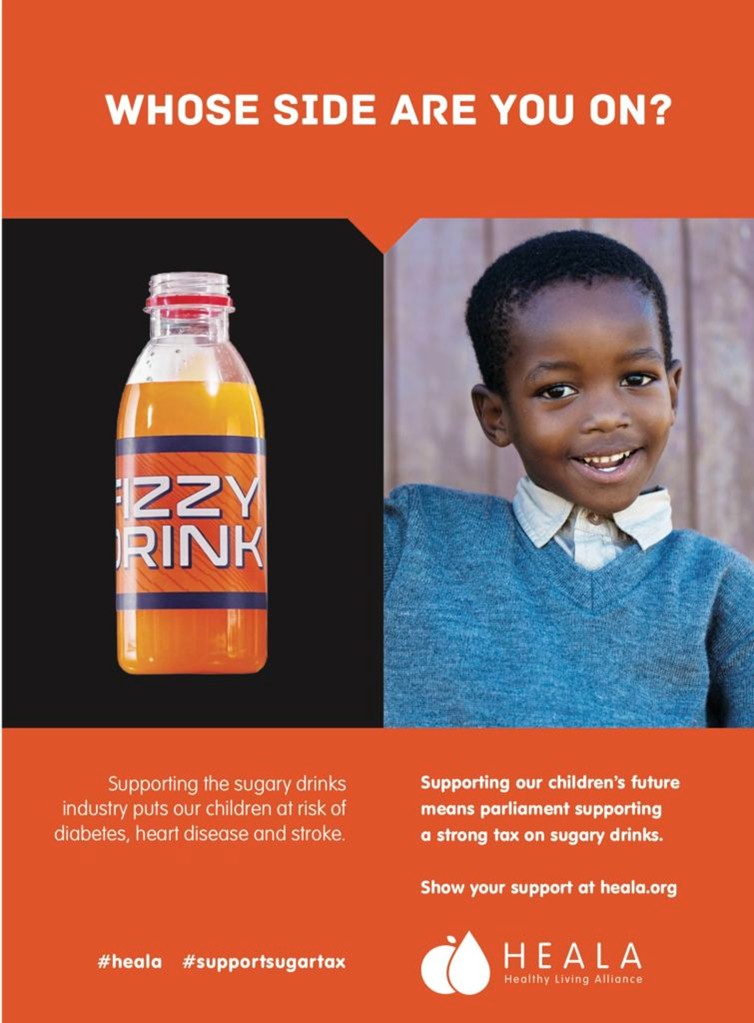
An ad in support of the sugary drink tax by HEALA. Learn more at heala.org.
Read more:
- National Treasury’s Taxation of Sugar Sweetened Beverages: Policy Paper
- View the “Are you drinking yourself sick?” and “Journey: what sugary drinks did to me” mass media campaigns
- View an evaluation of the campaigns
2016-2017: Building a Multi-Faceted Campaign
- HEALA members spoke at public hearings and voiced support to decision-makers.
- Advocates mobilized grassroots support through social media and delivered 2,000 petition signatures to Parliament.
- Industry launched opposition campaign claiming the tax would not work and would cost jobs, while privately threatening decision-makers.
- Advocates countered with scientific evidence from other countries demonstrating taxes reduced consumption without hurting employment.
December 2017: Parliament Passes Tax
- Parliament passed the sugary beverage tax and the president signed it into law.
April 2018: Tax Takes Effect but With Reduced Rate
- The Health Promotion Levy took effect at 11%—just over half the evidence-based 20% recommendation—due to industry claims about economic losses.
2025: Advocacy Continues
- HEALA and partner organizations continue advocating to increase the tax to 20%.
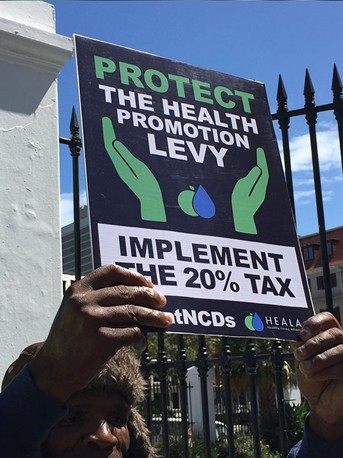
Protestors call for a 20% tax on sugary beverages outside parliament. Source: HEALA. Learn more at heala.org.
Key Success Factors:
- Strong scientific foundation demonstrating the tax as a cost-effective intervention to address obesity and diet-related chronic diseases
- Unified coalition approach that coordinated campaigns, grassroots mobilization, parliamentary testimony and consistent messaging against industry opposition
- Sustained advocacy beyond implementation to help ensure policy aligns with best practices
Additional Resources:
Read the case studies that were summarized here:
- Vital Strategies. Lessons From South Africa’s Campaign for a Tax on Sugary Beverages. 2020.
- Global Health Advocacy Incubator. Reducing Sugary Drink Consumption in South Africa.
View the regulation in English and Afrikaans
View key takeaways and lessons learned from tax advocacy
Read about the food and beverage industry’s interference in the policy process
View Food Policy Hub’s recommendations for best practice healthy food and beverage taxes
Policy Snapshot
In 2023, Colombia became one of the first countries worldwide to tax both sugar-sweetened beverages and ultra-processed products. It was not an easy path: The victory came after multiple failed legislative attempts, years of civil society advocacy and successful navigation of legal challenges from the food and beverage industry.
Policy Timeline
2014-2015: First Tax Attempts Made
- The Health Minister announced his intention to include a sugar-sweetened beverage tax alongside tobacco tax increases in the National Development Plan.
- The proposal failed to advance due to a strong industry lobby.
2015-2016: Industry Censorship and Failed Legislative Attempt
- Postobón, the country’s largest beverage company, filed a legal complaint against an evidence-based, public health information campaign about sugary beverages developed by the civil society organization Educar Consumidores, timed with a 20% tax being considered by congress.
- A government agency sided with the industry, pulled the ad and prohibited public discussion, threatening fines for violations.
- Educar Consumidores and allies launched legal challenges.
- The sugar-sweetened beverage tax proposal was dropped from a larger tax reform package due to industry pressure, while tobacco taxes successfully increased.
Read more: Global Health Advocacy Incubator’s A Victory for Public Health Information Campaigns in Colombia: The Role of Legal Strategies for Health Promotion
2017: Another Legislative Rejection and Constitutional Court Victory
- A tax reform package with an 18% tax on sugar-sweetened beverages was debated in Congress but was rejected due to industry pressure.
- The Court ruled consumers have the right to public health information, removing the legal threat intended to silence advocates.
2017-2022: Sustained Advocacy and Political Will
- Civil society organizations (Red PaPaz, CAJAR and others) conducted advocacy to build support, including seven media campaigns reaching ≈14 million people, secured 70+ Congressional signatures and gathered 10,000+ signatures from the public.
- New president Gustavo Petro introduced a tax reform to raise billions for social programs to address inequality; sugar-sweetened beverage and ultra-processed food taxes comprised about 10% of projected revenue. Most Colombians (65%) approved the reform.
2022: Tax Reform Approved
- Congress approved the tax reform—making Colombia one of the first countries globally to tax ultra-processed products.
- The food and beverage industry launched legal challenges claiming procedural irregularities and violation of principles of equality, economic freedom and free competition.
Read more: Global Health Advocacy Incubator’s Colombia Enacts Two Major Healthy Food Policies
2023: Tax Survives Constitutional Challenge
- Academic and civil society organizations across the region submitted amicus briefs supporting the decision.
- The Constitutional Court unanimously declared the tax constitutional, concluding it reasonably served public health objectives and proportionately limited free enterprise rights. The tax took effect Nov. 1, 2023.
Read more: Global Health Advocacy Incubator’s Sweet Success: How Colombia’s Landmark Sugary Beverage Tax Rose Above Legal Challenges
Key Success Factors:
- Six+ years of strategic civil society advocacy combining legal action, sustained strategic communication, and more
- Clear articulation of policy objectives that framed the tax as serving the public interest and guided the Court’s proportionality analysis
- Regional solidarity through amicus briefs highlighting the decision’s importance across Latin America
- Persistence after multiple failed attempts—each attempt helped build public awareness and establish legal precedent
- Political opportunity where taxes were introduced by a new government as part of a comprehensive progressive taxation reform to address inequality that had strong public support
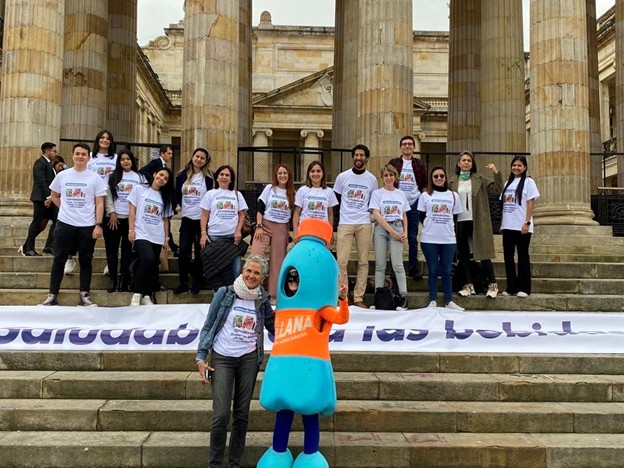
The United States offers an example of the potential for taxing sweetened beverages at the local level, with eight local jurisdictions successfully adopting such taxes. A common theme: Taxes that succeeded were built around community values and priorities, and grassroots coalitions were heavily involved in the process.
BERKELEY, CALIFORNIA AT A GLANCE
Tax: 1 cent per ounce on sugar-sweetened beverages
Passed: November 2014, with 76% of public referendum vote; effective January 2015
Primary Frame: Health equity, Big Soda accountability, community investment
Revenue: $9 million+ between 2015 and 2021
Outcome: In year one, sugar-sweetened beverage sales fell 9.6% in Berkeley stores and rose 6.9% in adjacent cities; water sales increased 15.6%
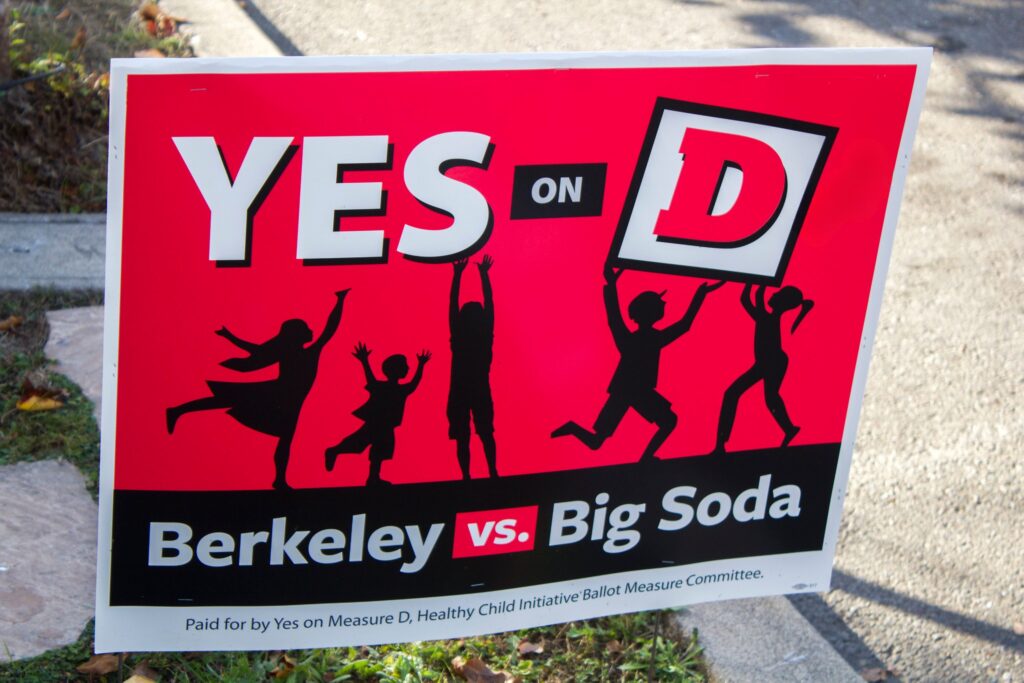
Source: “Yes on Dale” by Quinn Dombrowski / quinn.anya, adapted by Food Policy Hub. Original: https://www.flickr.com/photos/quinnanya/15460942958 © Quinn Dombrowski. Licensed under CC BY-SA 2.0. This adaptation is shared under the same license.
Framing and coalition:
Berkeley was the first U.S. city to pass a sugar-sweetened beverage tax, with a broad community coalition advocating for the tax from the start under the campaign banner “Berkeley vs. Big Soda.” Facing heavy industry counter-funding, the campaign framed the tax as a fight between community health and corporate exploitation, focusing on the beverage industry’s predatory marketing to historically underserved communities, high rates of diabetes and obesity in affected neighborhoods, and the opportunity to reinvest in community health programs. The grassroots coalition organized thousands of volunteers, held community meetings and went door-to-door speaking with neighbors.
Revenue governance:
The measure established an expert advisory panel to recommend how the city should fund programs to reduce sugar-sweetened beverage consumption. This built-in accountability mechanism—and the fact that funds were visibly reinvested in programs like school gardening, cooking education and community health outreach—sustained public support.
PHILADELPHIA, PENNSYLVANIA AT A GLANCE
Tax: 1.5 cents per ounce on sweetened beverages
Passed: June 2016, City Council; effective January 2017
Primary Frame: Revenue for expanded Pre-K and community investment
Revenue: $518 million total through 2024
Outcome: In year two, 1.02 cents per ounce price increase for taxed beverages and 50% decrease in taxed beverage sales (35% after accounting for cross-border shopping)
Framing
Philadelphia had failed two times to pass a sweetened beverage tax when proposals focused solely on health outcomes. The defining strategic shift was reconceptualizing the tax as a revenue measure anchored to a popular local priority: investment in youth, and specifically pre-K education. A citywide poll found that 84% of Philadelphians considered pre-K education “very important.”
This underscores the importance of understanding local priorities.In some cases, prioritizing them over health outcomes alone can make the difference between a policy passing or failing, while still delivering meaningful public health benefits.
Revenue and transparency
Between 2017 and 2022, nearly 40% of the tax’s total revenue ($158 million) funded pre-K, opening thousands of seats across the city. The City Controller released quarterly data updates and a fully searchable database of all revenue and expenditures, broken down by fiscal year and program, creating a public record of how funds were spent.
SEATTLE, WASHINGTON AT A GLANCE
Tax: 1.75 cents per ounce on sugar-sweetened beverages
Passed: June 2017, City Council; effective January 2018
Primary Frame: Food equity, healthy food access, early childhood investment
Revenue: $17.3 million-$22.9 million per year; dipped during COVID-19
Outcome: 1.2% reduction in BMI among Seattle children compared to peers in nontaxed areas.
Framing
Seattle’s campaign framed the tax around two priorities with strong cross-community support: food equity and early childhood development. Community advocacy organizations successfully secured ordinance-level requirements directing revenue toward food and nutrition security programs in communities most impacted by sweetened beverages, chronic disease and health inequities.
Revenue governance
A key innovation was the Sweetened Beverage Tax Community Advisory Board, which was given authority to advise on revenue allocation. This board—combining public health and food access experts with community representatives from populations most affected by diet-related chronic disease—helped ensure funds went where the community said it should go.
Evaluation and transparency
Seattle committed to a five-year independent evaluation of the tax’s impacts, publishing 13 reports and five peer-reviewed publications from 2017 to 2023, openly acknowledging both what worked and what remained uncertain. The evaluation found that prices of taxed beverages increased by almost the full amount of the tax, with no detectable impact on food prices, small business revenues or store closures.
Additional resources:
Read fact sheets about each city’s tax
Learn more about community engagement, including community advisory boards
Learn more about successful local sugary drink tax campaigns
In 2014, Mexico became the first country in the Americas to implement a national health-motivated tax on sugar-sweetened beverages, adopting a 1-peso-per-liter excise tax (approximately 10%) on nonalcoholic beverages with added sugar. In the years that followed, researchers published a series of peer-reviewed evaluations of the tax’s impact on household purchases.
The Research
When Mexico passed the tax in October 2013, researchers recognized a critical gap: no rigorous evaluations had yet assessed changes in consumption, purchases or sales following implementation of a national sugar-sweetened beverage tax.
Researchers first confirmed the tax was passing through to retail prices: sugar-sweetened beverage prices rose by roughly the size of the tax, with an even bigger jump for carbonated beverages. They also found that lower-income households were the most price-sensitive, which helps explain why purchase reductions were largest in that group.
A team led by researchers at Mexico’s Instituto Nacional de Salud Pública (INSP) published a series of peer-reviewed papers that drew on a variety of data and methods. The studies all arrived at the same conclusion: purchases and sales of taxed beverages fell after the tax, with the largest reductions observed among lower-income households. Research findings also directly countered efforts to undermine the tax, including claims that it had stopped working, which relied on raw sales data that had not been adjusted for confounding factors.
| Study | Data | Methods | Key Finding |
| Colchero et al. BMJ. 2016 | Nielsen Consumer Panel (≈6,250 urban households tracking food and beverage expenditures) | Modeled expected purchasing trends based on pre-2014 data, then compared actual post-tax purchases to that projected baseline | 6–12% reduction in taxed beverage purchases in year one; largest reductions among low-income households (9–17%); 4% increase in untaxed beverage purchases (bottled water) |
| Colchero et al. PLOS ONE. 2016 | National manufacturing industry survey | Regression comparing per-capita sales before (2007–2013) and after (2014–2015) the tax, while controlling for seasonality and economic activity | 7.3% drop in per-capita sugar-sweetened beverage sales; 5.2% rise in per-capita plain water sales |
| Colchero et al. Health Affairs. 2017 | Same Nielsen Consumer Panel, extended to include 2015 data (≈6,650 urban households tracking food and beverage expenditures) | Same approach as the original BMJ study, extended to test whether the first-year effect persisted or faded over time | 5.5% drop in taxed beverage purchases in year one and 9.7% drop in year two, meaning effects were sustained and grew; largest reductions among lowest-income households (9% drop in year one, 14.3% drop in year two) |
| Colchero et al. Journal of Nutrition. 2017 | National Income and Expenditure Survey (Mexico’s nationally representative household income and expenditure survey, which covers rural areas) | Models comparing 2014 observed purchases to expected purchases based on 2008–2012 trends, stratified by income level, urban/rural location and household composition | 6.3% drop overall—largest reductions among low-income, urban households and households with children |
Global Influence
The successful implementation and evaluation of Mexico’s sugar-sweetened beverage tax have been described as a tipping point for global sweetened beverage taxes. In the five years after Mexico’s tax, 30 countries enacted new taxes.
A comparative policy analysis of 16 countries found that Mexico’s sugar-sweetened beverage tax experience and evidence were frequently cited by countries building their policy cases, including in formal policy documents in the Philippines and South Africa.
“Recent evidence from Mexico and Berkeley, California in the USA show that taxing sugary drinks lowers the consumption of these unhealthy beverages, increases the sales and consumption of healthier alternatives, and does not result in revenue losses for businesses or job losses." ”
Policy Amendment
Effective Jan. 1, 2026, Mexico nearly doubled its existing tax on sugar-sweetened beverages from 1.64 to 3.08 pesos per liter (≈US$0.10 to US$0.18 per liter) and introduced a tax on flavored beverages with nonsugar sweeteners, including “light” and “zero” products, at 1.5 pesos per liter (≈US$0.09/liter).
Key Takeaways
- Proactively publishing rigorous analyses helped sustain the policy’s credibility, particularly in the face of efforts to undermine it.
- Multiple studies using independent data sources and methodologies converged on the same findings, making results difficult to dismiss.
- Evaluation findings helped other countries strengthen their policy cases, showing how rigorous local evidence can travel across policy contexts.