

How can healthier school food policies be adopted? How can healthier school food policies be adopted?
A national school food policy is an effective tool governments can use to secure better health and futures for upcoming generations. These policies can create consistent, healthy food environments across schools, providing children the nutrition they need to feel good, to learn and to later earn. Children’s rights, including the rights to health, to adequate food and having their best interests considered as a primary factor, should anchor policies as legal obligations.
The strongest policies are comprehensive and mandatory, covering multiple intervention areas: banning unhealthy foods, beverages and brands from being offered or marketed in schools, and prioritizing nutritious options.
Effective policies are written, mandatory measures that may include:
- Nutrition standards for school meals
- Public procurement standards that dictate where school food comes from
- Bans on the offer or sale of unhealthy food in and around schools
- Bans on the marketing, advertising or sponsorship of unhealthy food in and around schools
- Access to healthier alternatives (drinking water, school feeding programs)
- Nutrition education
➔ See Food Policy Hub’s best practice recommendations to learn more.
Build the policy rationale
Gather local evidence on the problems that healthier school food policies are needed to address. This includes health and nutrition data (e.g., school-aged children’s rates of malnutrition) and the status of school food environments (e.g., how many children rely on school meals). It may be helpful to also make the case for why schools are important settings for intervention.
- Identify data indicators: UNICEF’s Analysis Tool (Worksheets)
- Review global and local surveys:
- Global Child Nutrition Foundations’ School Meal Programs Around the World
- World Food Program’s State of School Feeding Worldwide
- UNICEF’s Monitoring the situation of children and women
- WHO’s Global-school based student health survey
- Assess data gaps: pp. 8-14 of the Food and Agricultural Organization of the United Nations’ Capacity needs assessment tool – School-based food and nutrition education
- Build the case: The Food and Agricultural Organization of the United Nations’ Strengthening Sector Policies for Better Food Security and Nutrition Results includes:
- Why schools are critical intervention settings (pp. 4-5)
- Data types and sources for school-age nutrition (p. 11)
- Policy coherence rationale, challenges and opportunities (Table 1, pp. 22-25)
Use global evidence to support local data, or in its place when local data and resources are not available. Collect information on policies implemented elsewhere to support the case for the policy and its design. If strengthening existing regulations to better align with best practices, collect evidence that relates to the proposed policy change.
➔ See Food Policy Hub’s evidence page for data and additional resources
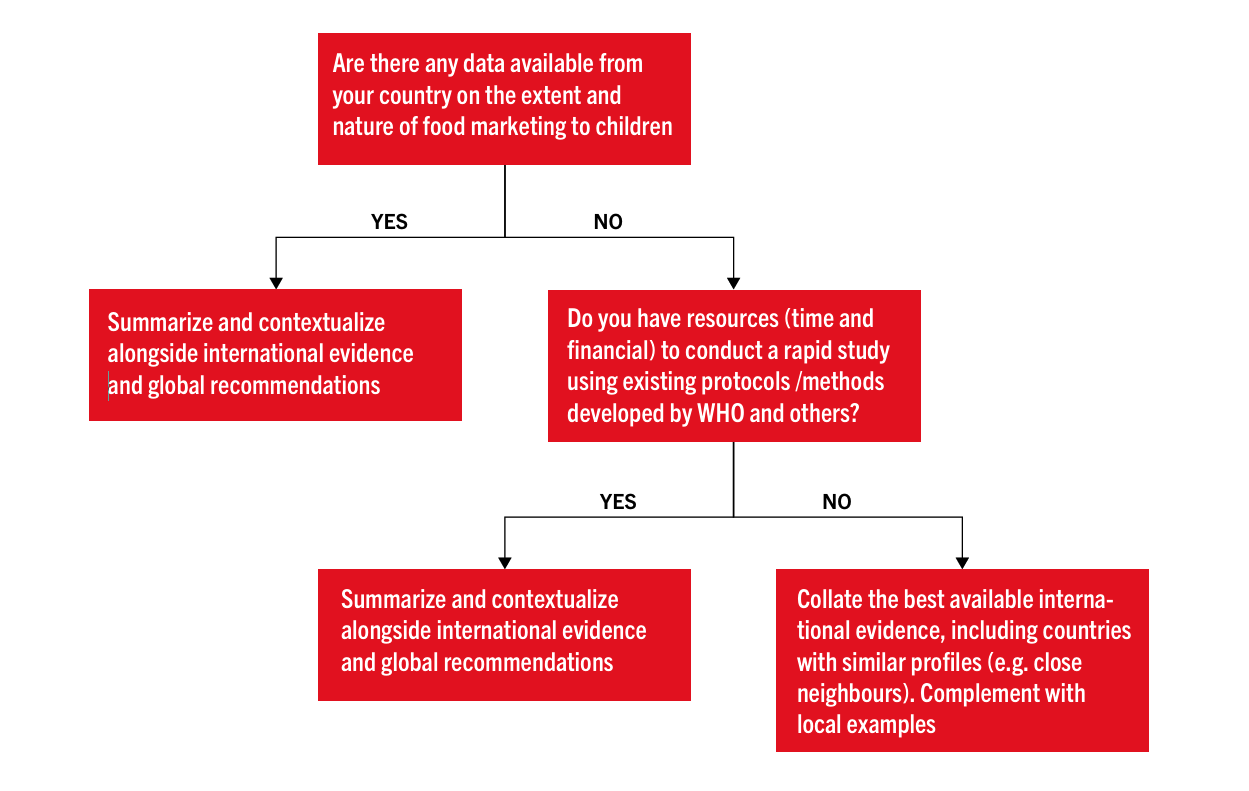
Source: UNICEF and the World Health Organization’s Taking action to protect children from the harmful impact of food marketing A child rights-based approach.
This information should be used to:
- Craft evidence-based policies
- Justify their introduction
- Provide baseline data to evaluate policy change
- Offer a sound evidence base should there be legal or other challenges from the food and beverage industry
The data should be collected, summarized and publicized to build policy support.
View these documents to build the case for action:
- p. 5 of the Food and Agricultural Organization of the United Nations’ Strengthening Sector Policies for Better Food Security and Nutrition Results
- pp. 30-31 of the Food and Agricultural Organization of the United Nations’ Legal Guide on school food and nutrition – Legislating for a healthy school food environment
International frameworks and guidelines require governments to take action to improve children’s nutrition and protect their health.
Governments have obligations under human rights and child rights law—including the UN Convention on the Rights of the Child—as well as under relevant national laws and policies regulating school environments. These obligations can be used to support the case for school-based nutrition policies and should be used to frame objectives.
Learn more:
- Global Health Advocacy Incubator’s Right to Health Policy Hub
- Global Health Advocacy Incubator and O’Neill Institute for National and Global Health Law’s FULL database
- pp. 16-17 of the World Health Organization’s Implementing school food and nutrition policies: a review of contextual factors
- pp. 25-29 of the Food and Agricultural Organization of the United Nations’ Legal Guide on school food and nutrition – Legislating for a healthy school food environment
Develop measurable policy objectives
Policy objectives should be clear, evidence-based and measurable in the short-term.
This may include increasing the offer and consumption of healthy foods among schoolchildren (e.g., water, fruits, vegetables, legumes, whole grains) and reducing the offer and consumption of unhealthy products (sweetened beverages, ultra-processed foods high in fat, salt and sugar).
Other objectives may include increasing school attendance via school meal availability or improving nutrition knowledge and changing attitudes around healthier eating through nutrition education.
- Sample objectives for school feeding programs: Table 4 on pp. 26-28 of the Food and Agricultural Organization of the United Nation’s Nutrition guidelines and standards for school meals: a report from 33 low and middle-income countries
Research the policy environment
It is important to understand what nutrition regulations and laws currently exist—such as marketing restrictions—to position proposed school food actions as part of a package geared toward addressing the issues outlined in the policy rationale.
This also promotes alignment between nutrition policies to create a clear environment that enables healthier food choices. For example, Chile has a single law that regulates food and beverage marketing, requires front-of-package warning labels and bans the sale and marketing of labeled products in school food environments.
➔ See Food Policy Hub’s case study: How Chile Created Synergy Between Healthy Food Policies to Improve Children’s Diets
Understand the legal context
Review laws to see where the legal entry point is and to understand the relevant national and institutional legal frameworks.
- More on conducting a legal analysis:
- pp. 41-48 of the Food and Agricultural Organization of the U.N.’s Legal Guide on school food and nutrition – Legislating for a healthy school food environment
- pp. 5-8 of Global Health Advocacy Incubator’s Legal Advocacy Action Guide Legal Strategies for Public Health and Industry Accountability
- Tool to identify existing policies, legislation and gaps: pp. 10-15 of the Food and Agricultural Organization of the U.N.’s Capacity needs assessment tool – School-based food and nutrition education
- Reviewing other school food environment legislation: Global Health Advocacy Incubator and O’Neill Institute for National and Global Health Law’s FULL database
Map potential stakeholders
Many actors can influence the success of healthy school food policies, including:
- Policymakers from different government departments (Ministry of Health, Ministry of Education, Ministry of Agriculture)
- Food and beverage industry
- Local agricultural producers
- School boards
- Parents and students
Mapping these stakeholders can help provide an understanding of their influence and position as well as if, when and how to engage them throughout the policy process. Allies can join forces in coalitions to advance the policy.
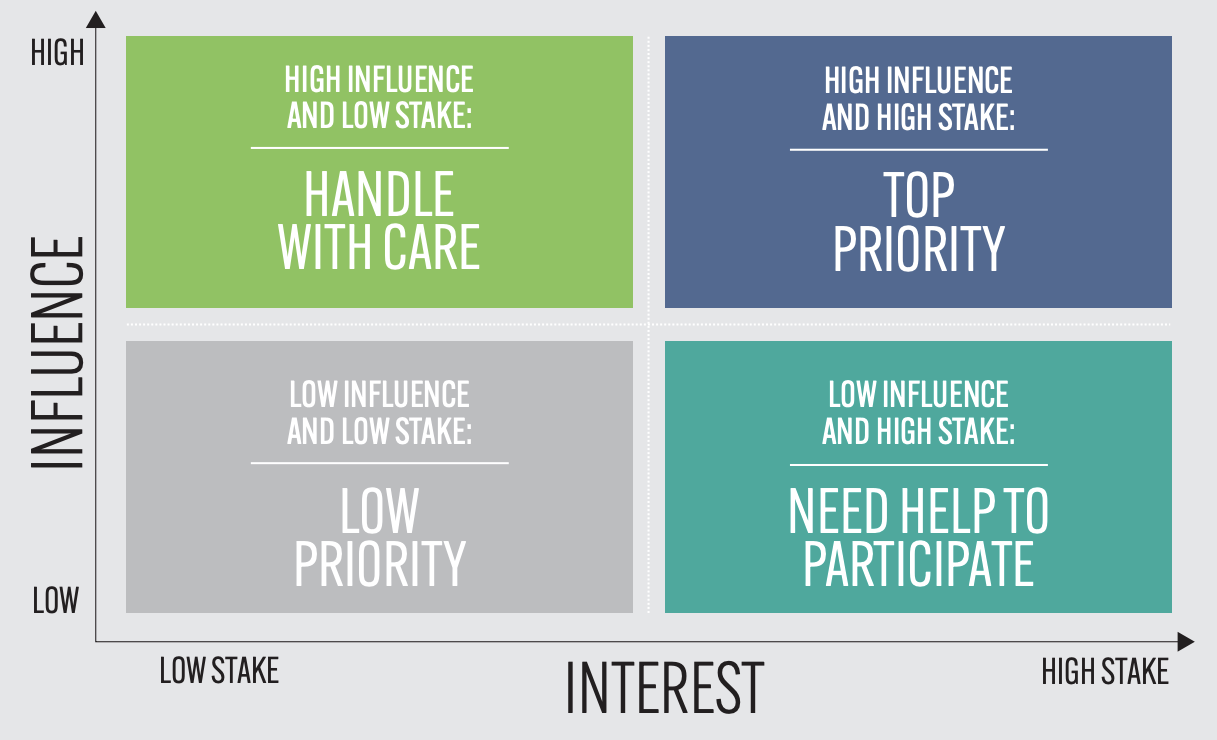
Source: Toolbox 2 on p. 21 of the World Health Organization’s and United Nation Development Program’s Action for health taxes from policy development to implementation.
Guidance on conducting a stakeholder analysis:
- pp. 7-9 of Global Health Advocacy Incubator’s Advocacy Action Guide Four Phases to Health Policy Success
- p. 9 of Global Health Advocacy Incubator’s Legal Advocacy Action Guide Legal Strategies for Public Health and Industry Accountability
- Toolbox 2 on p. 21 of the World Health Organization’s and United Nation Development Program’s Action for health taxes from policy development to implementation
- pp. 23-26 of the United Nation Development Program’s Institutional and Context Analysis for the Sustainable Development Goals
For school feeding programs, consider conducting a food system assessment of smallholder farmers and other local businesses that could be involved in value chains.
- Food system assessment considerations: Table 1 on p. 10 of the World Food Programme’s and the Food and Agriculture Organization of the UN’s Home-Grown School Feeding Resource Framework Synopsis
Industry Interference Tactics to Anticipate:
- Shift blame to individuals, parents or lack of physical activity rather than corporate practices and products
- Claim nutrition education alone is sufficient and other interventions are unnecessary
- Tie financial support to marketing through sports sponsorships, vending machines or other forms of product promotion in schools
- Promote disinformation via media
- Use corporate-washing and lobbying to develop political allies
Resources:
- Global Child Nutrition Foundations: School Meal Programs Around the World
- Global Health Advocacy Incubator: Advocacy Action Guide Four Phases to Health Policy Success
- Global Health Advocacy Incubator: Legal Advocacy Action Guide Legal Strategies for Public Health and Industry Accountability
- Global Health Advocacy Incubator: Right to Health Policy Hub
- Global Health Advocacy Incubator and O’Neill Institute for National and Global Health Law: FULL database
- Food and Agricultural Organization of the United Nations: Capacity needs assessment tool – School-based food and nutrition education
- Food and Agricultural Organization of the United Nations: Legal Guide on school food and nutrition – Legislating for a healthy school food environment
- Food and Agricultural Organization of the United Nations: Nutrition guidelines and standards for school meals: a report from 33 low and middle-income countries
- Food and Agricultural Organization of the United Nations: Strengthening Sector Policies for Better Food Security and Nutrition Results
- Food Policy Hub: healthier school food evidence page
- UNICEF: Landscape Analysis Worksheets 2022
- UNICEF: Monitoring the situation of children and women
- United Nations Development Program: Institutional and Context Analysis for the Sustainable Development Goals
- World Food Programme and the Food and Agriculture Organization of the United Nations: Home-Grown School Feeding Resource Framework Synopsis
- World Food Programme: State of School Feeding Worldwide
- World Health Organization and United Nation Development Program: Action for health taxes from policy development to implementation
- World Health Organization: Global-school based student health survey
- World Health Organization: Implementing school food and nutrition policies: a review of contextual factors
Building strong multi-sectoral government and civil society coalitions is crucial for policy success. Coalitions should provide clear, consistent and sustained messaging on the policy rationale and be prepared to confront industry interests and lobbying. Every coalition member should be free from food and beverage industry affiliation.
Government partnerships
The government should lead policy development while engaging civil society, academia and school stakeholders, all free of conflicts of interest. Stakeholder working groups can deliver recommendations to government. Multiple ministries should collaborate (e.g., Ministry of Health, Ministry of Education), potentially through a government-led working group.
Civil society and academic partnerships
Civil society organizations, including nongovernmental organizations and academia, free from conflict of interest, play crucial roles in supporting government efforts.
They can:
- Survey public opinion
- Build support via the media and community outreach
- Develop and publicize local evidence
- Expose and counter industry interference
- Engage and represent stakeholders including parents, children, principals and other affected parties
- Monitor implementation
- Advocate for the highest standards and engage decision-makers
- More on coalition-building for public health advocacy campaigns: Global Health Advocacy Incubator’s webinar Building Effective Coalitions for Public Health Advocacy Campaigns
Industry Interference Tactics to Anticipate:
- Attempt to influence working groups
- Criticize, infiltrate and monitor public health advocates and groups
Resources:
- Global Health Advocacy Incubator: Building Effective Coalitions for Public Health Advocacy Campaigns
The food and beverage industry employs a range of deliberate tactics to place its brands and products inside schools and to weaken efforts to regulate them, often taking advantage of schools’ need for more funding.
Investing in schools as a marketing tool
Companies may sponsor school activities—sports teams, events, infrastructure—to present themselves as community-minded and to link their brands with healthy lifestyles. In practice, this functions as a targeted marketing strategy: It builds not just brand visibility, but brand loyalty, cultivating a new generation of consumers during children’s most formative, trust-building years.
Lobbying against mandatory policy
The industry actively lobbies policymakers to block mandatory, government-led healthy school food policies, often pushing for voluntary self-regulation as an alternative. However, the evidence is clear that voluntary industry pledges are consistently less effective than rigorously enforced mandatory policies.
- Fact sheet on industry self-regulation: Global Food Research Program at UNC-Chapel Hill’s Industry Self-regulation: Empty pledges
Delaying and obstructing implementation
Even when policies succeed, the industry may push for extended implementation timelines, claiming that products need time to be reformulated. It may also attempt to leverage existing relationships with schools, including financial support, to slow or block policy from taking effect.
Undermining nutrition standards through reformulation and policy influence
Finally, manufacturers may reformulate products to technically meet school nutrition standards, but sell noncompliant look-alike versions in stores, confusing consumers into thinking both versions are the same and undermining the policy’s intent Even when reformulated products meet nutrient limits, they often remain ultra-processed, still formulated with artificial colors, flavors and other additives. Beyond reformulation, industry actors may also seek to influence school nutrition guidelines directly so their brands and products continue to be available.
Civil society can play a key role in exposing industry tactics and pushing for policy safeguards. Policymakers can counter interference by establishing transparent, evidence-based processes and policy designs that limit industry influence.
➔ See Food Policy Hub’s countering industry interference adoption page to learn more
Resources:
- Food Policy Hub: countering industry interference adoption page
- Global Food Research Program at UNC-Chapel Hill: Industry Self-regulation: Empty pledges
Demonstrating widespread public support for healthy school food policies—including among school boards, principals, parent-teacher associations, students, vendors and policymakers—is essential to successful adoption and implementation. Securing early support from key stakeholders and identifying political champions are critical. These engagements should occur under rules requiring disclosure of real or potential conflicts of interest.
- Review stakeholder acceptability for school-based nutrition policies: 23-38 of the World Health Organization’s Implementing school food and nutrition policies: a review of contextual factors
How civil society can build public and policymaker support
Media campaigns and public communication
Civil society should engage the media to help lift healthy school food policies on the agenda and develop a comprehensive framework for communication with the public and policymakers.
Communication should be structured in key phases:
- Identify the cause of the problem that the proposed solution will help solve
- Build the case for why the policy is needed
- Articulate the solution and how supporters can help
- Guide to public health communication and media advocacy: See Global Health Advocacy Incubator’s Communications & Media Advocacy Action Guide
Build broader stakeholder support
Civil society can use the following strategies to build broader stakeholder support:
- Produce resources that support policy advocacy and implementation (e.g., toolkits, reports)
- Reach decision-makers through open letters or by organizing a petition and/or letter-writing campaigns
- Set up meetings with policymakers
- Organize public conferences/debates and rallies that engage allied policymakers
- More details: 11-13 of Slow Food’s toolkit: From Plate to Politics
Youth and parent engagement
Children who benefit from healthy school food policies should be engaged in advocacy, as should parents who often make decisions on behalf of their children.
- Examples of campaigns that engaged youth:
- UNICEF’s Fix My Food Campaign
- Healthy Caribbean Coalition’s #ActOnFacts – The Food in Schools Matters and Make it Make Sense
- Heart and Stroke Foundation of Barbados: Out of Our Schools, Protect Us, and Enough! campaigns
- BiteBack’s (U.K.) school food campaigns
- Engaging parents in digital advocacy campaigns: Global Health Advocacy Incubator’s How to Use Parents as Part of a Digital Advocacy Campaign to Get Sugary Drinks Out of Schools
How policymakers can build support
Policymakers who support healthy school food policies can play a critical role in building momentum for adoption. This includes publicly championing the policy, securing cross-ministerial support (e.g., between Ministries of Health and Education) and building coalitions with allied legislators. Identifying and engaging political champions early in the process is key to sustaining political will through to adoption.
Holding public consultations
The government may choose to have a public consultation where the public and other stakeholders can opine on a draft regulation. Civil society can submit comments and encourage community members to participate, helping to ensure that a broad range of voices beyond industry are represented in the process. The government’s final decisions should prioritize public health evidence over other interests.
- Guidance on submitting an effective public comment: Global Health Advocacy Incubator’s Effective Advocacy Through Public Comments to Agencies
Industry Interference Tactics to Anticipate:
- Build relationships with the public, media and policymakers, using them as spokespeople for the industry’s messaging
- Develop media campaigns against policy, countering public health messaging
Resources:
- Global Health Advocacy Incubator: Communications & Media Advocacy Action Guide
- Global Health Advocacy Incubator: Effective Advocacy Through Public Comments to Agencies
- Global Health Advocacy Incubator: How to Use Parents as Part of a Digital Advocacy Campaign to Get Sugary Drinks Out of Schools
- Slow Food’s toolkit: From Plate to Politics
- World Health Organization: Implementing school food and nutrition policies: a review of contextual factors
There are several global initiatives that are supporting governments to implement school-based nutrition policies. These include:
- WHO: Nutrition Friendly Schools Initiative
- WHO and UNESCO: Making Every School a Health Promoting School
- Food and Agriculture Organization of the UN: Home-Grown School Feeding
- Government-led, with World Food Programme as Secretariat: The School Meals Coalition
A national school food policy or law is an effective tool governments can use to create consistent, healthier food environments across schools. The goal should be a comprehensive, mandatory policy package—covering multiple intervention areas and aiming to ban unhealthy foods, beverages and their associated brands from being offered or marketed in schools, while prioritizing nutritious options.
Effective policies are written, mandatory measures that may include:
- Establishing school nutrition guidelines for food served in and around schools, as part of a comprehensive, mandatory policy, based on a robust nutrient profile model that removes ultra-processed and other unhealthy foods and prioritizes nutrient-rich, culturally relevant options.
- Adopting public procurement standards for school food, mandating a set percentage from sustainably and locally sourced producers, including smallholder farmers and traditional communities.
- Banning the sale of ultra-processed products and their associated brands in and around schools based on a robust nutrient profile model.
- Banning the marketing, advertising and sponsorship of ultra-processed products and their associated brands across media, in and around schools, based on a robust nutrient profile model.
- Providing nutritious school meals and snacks, with attention to local procurement from smallholder farmers, waste management and food safety standards.
- Offering nutrition education as part of the curriculum.
- Implementing pricing policies to encourage healthier eating, such as subsidizing healthy options in schools and using sweetened beverage or ultra-processed food tax revenue to fund affordable, locally sourced school food.
- Program design and implementation guidance: pp. 14-22 of the Food and Agriculture Organization of the United Nations and World Food Programme’s Home-Grown School Feeding. Resource Framework. Synopsis
- Global school meal policies and technical resources: Food and Agricultural Organization of the UN’s School Food Global Hub
- View existing policies:
- World Cancer Research Fund International’s NOURISHING policy database
- Global Health Advocacy Incubator and O’Neill Institute for National and Global Health Law’s FULL database
- Food Policy Hub’s healthier school food environments case studies page
When developing healthy school food policies, there are five main questions that should be addressed:
- What should the regulatory approach be?
- What is the scope of the policy and who will it protect?
- What is the target area of the policy?
- Which foods and beverages should the policy apply to?
- What is the budget?
1. What should the regulatory approach be?
Governments should adopt written, mandatory laws or policies with clear standards. Legislation offers greater durability across changes in government. Whether through legislation or policy, the regulatory framework should ideally bring together the different instruments relevant to the wider ecosystem of health and nutrition in schools—for example, food safety and public procurement, which may be regulated separately, should be coordinated within this framework. Industry self-regulation should be avoided, as it has consistently failed to protect children’s health since companies prioritize profit over public health outcomes.
- Guide to drafting a school food and nutrition law: pp. 59-139 of the Food and Agriculture Organization of the UN’s Legal Guide on school food and nutrition – Legislating for a healthy school food environment
- Possible provisions of a school food and nutrition law: Food and Agriculture Organization of the UN’s Legislating for Adequate Food and Nutrition in Schools
- Fact sheet on industry self-regulation: Global Food Research Program at UNC-Chapel Hill’s Industry Self-regulation: Empty pledges
2. What is the scope of the policy and who will it protect?
Policymakers must determine which types of schools and education levels the policy will cover. Ideally, the policy should apply to both public and private schools, and span from pre-primary through secondary education. This helps ensures comprehensive protection for all children during their formative years, regardless of where they attend school.
3. What is the target area of the policy?
School food environments are complex and include much more than just the physical spaces within schools. Policymakers must determine how regulations will apply to:
- Physical areas around schools: businesses selling food near campuses (marketing bans, school nutrition guidelines)
- Digital environments: online marketing and digital advertising on school-issued devices and networks (marketing bans)
- Home environment: snacks and foods brought from home (school nutrition guidelines)
- Timing: regular school day, extended day programs, after-school activities (school nutrition guidelines)
- Off-campus events: field trips, sports events, school-sponsored activities (marketing bans, school nutrition guidelines)
To maximize effectiveness, policies should comprehensively address as many of these areas as possible.
4. Which foods and beverages should the policy apply to?
Use nutrient profile models to classify foods
Evidence supports using nutrient profile models to systematically determine which foods to restrict and which to promote. These models categorize products based on nutritional composition (e.g., sugar, nonsugar sweetener, sodium and saturated fat), rather than broad food categories, which means policies can target underlying nutrients of concern instead of banning entire food groups outright. Using these models can help secure synergy between healthy food policies. For example, if a setting requires front-of-package warning labels based on a nutrient profile model, schools can restrict products that carry those warnings.
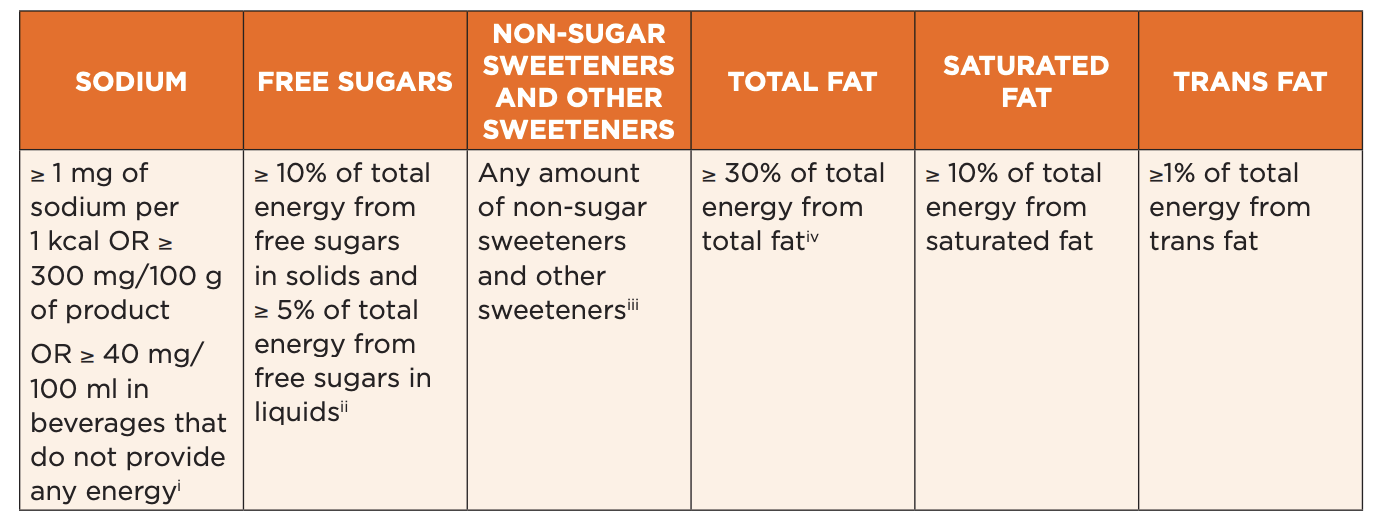
Recommended criteria for identifying food and drinks excessive in nutrients and ingredients of concern curated from PAHO, SEARO and AFRO regional nutrient profile models. Source: Global Health Advocacy Incubator’s Position Paper Nutrient Profile Models: A valuable tool for developing healthy food policies
Promote healthy alternatives
Policies should ideally actively promote healthy options by requiring:
- Water drinking fountains in schools
- Vending machines that only provide water
- Improved accessibility and appealing presentation of fruits, vegetables and other healthier foods
Engage students in the process
Affected communities, which especially includes students themselves, should help shape program design, including menu planning and food procurement decisions.
5. What is the budget?
Not all components require budget. Banning marketing or restricting competitive unhealthy food sales can often happen immediately, at low or no cost, meaning governments can act on these quickly regardless of fiscal constraints.
School feeding programs, however, are highly budget-dependent. Policies frequently lack costing estimates or credible financing strategies, making it important for policymakers to build realistic medium- and long-term financial plans. Legislation offers the strongest foundation for sustainability by creating dedicated funding streams and legal procedures for implementation.
Alternative Funding Strategies for School Meals
A post-COVID-19 shrinking fiscal space is constraining governments’ school meal financing. Expanding this space through increased revenue collection is a strong strategy to ensure expanded access to nutritious school meals for health and poverty reduction. Increasing attention is being paid to how revenue from health taxes on tobacco, alcohol or ultra-processed products can help close funding gaps, including for school meals. Simulations of what this could look like for several countries found that in:
- Burundi, a three-phase reform equivalent to about 1% of GDP could close 76% of the school meal coverage gap and reach an additional 1.1 million children.
- The Philippines, raising volumetric tax rates on sweetened beverages, equivalent to 0.2% of GDP in the first year, could meet 75% of the universal primary school coverage requirement.
- Case studies of how countries fund school feeding programs: pp. 46-64 of the Education Commission and Sustainable Financing Initiative for School Health and Nutrition’s School Meal Programmes and the Education Crisis A Financial Landscape Analysis
- Toolkit on using health taxes to fund school meals: A toolkit developed for the Sustainable Finance Initiative for School Health and Nutrition of the School Meals Coalition
- Brief on a global financing coordination mechanism for school meals: Brookings Institution and the Sustainable Financing Initiative for School Health and Nutrition of the School Meals Coalition’s Building a global financing coordination mechanism for sustainable school meals
- Report and model policy from the Caribbean region:
- Health Caribbean Coalition’s Regulating the Availability and Marketing of Unhealthy Beverages and Food Products in and around Schools in the Caribbean
- Healthy Caribbean Coalition’s Model Policy and Legislative Guidance for Regulating the Availability and Marketing of Unhealthy Beverages and Food Products in and around Schools in the Caribbean
➔ Food Policy Hub’s tax adoption page
Industry Interference Tactics to Anticipate:
- Propose self-regulation or voluntary policies instead of mandatory regulation
- Attack and attempt to undermine the regulation or nutrient thresholds in the nutrient profile model
- Withdraw financial support for sports or other school activities
- Claim insufficient evidence exists to justify policy action
- Threaten or take legal action
- Lobby government officials to weaken or block policy development
- Use media spokespeople to promote alternative narratives (e.g., education and physical activity programs are better solutions than regulation)
Resources:
- Brookings Institution and Sustainable Financing Initiative for School Health and Nutrition of the School Meals Coalition: Building a global financing coordination mechanism for sustainable school meals
- Education Commission and Sustainable Financing Initiative for School Health and Nutrition of the School Meals Coalition: School Meal Programmes and the Education Crisis A Financial Landscape Analysis
- Food and Agricultural Organization of the United Nations: Legal Guide on school food and nutrition – Legislating for a healthy school food environment
- Food and Agriculture Organization of the United Nations: Legislating for Adequate Food and Nutrition in Schools
- Food and Agricultural Organization of the United Nations: School Food Global Hub
- Food and Agriculture Organization of the United Nations and World Food Programme: Home-Grown School Feeding. Resource Framework. Synopsis
- Food Policy Hub: Tax adoption page
- Global Food Research Program at UNC-Chapel Hill: Industry Self-regulation: Empty pledges
- Parekh et al., prepared for the Sustainable Finance Initiative for School Health and Nutrition of the School Meals Coalition: Health Taxes for School Meals A Global Toolkit for Financing a Healthy Future
- Health Caribbean Coalition: Regulating the Availability and Marketing of Unhealthy Beverages and Food Products in and around Schools in the Caribbean
- Healthy Caribbean Coalition: Model Policy and Legislative Guidance for Regulating the Availability and Marketing of Unhealthy Beverages and Food Products in and around Schools in the Caribbean
Implementation, monitoring and enforcement mechanisms must be built into policy design from the start, with clear accountability structures, adequate resources and penalties strong enough to secure compliance.
Identify resources needed for sustainable implementation
Sustainable implementation for some components of school food policies requires human resources (nutritionists, school administrators, health inspectors), informational resources (training materials, guidelines, monitoring tools) and adequate financial resources, while others, such as marketing bans, can largely rely on existing enforcement capacity.
Build out a reasonable but firm implementation timeline
This is important since the industry often fights to protract the intended implementation period.
Inform the public that the policy is in effect
Use mass media campaigns to ensure the public is aware of the policy and why it’s being introduced, and to engage them in monitoring compliance as relevant.
Sensitize school stakeholders to policy requirements
- Conduct training to inform principals, school administrators and other relevant stakeholders of the requirements of the policies, and build systems that encourage partnership and communication. When engaged appropriately, stakeholders provide critical infrastructure that contributes to policy sustainability. Parental involvement in particular has been shown to improve outcomes.
- Establish channels for ongoing feedback from stakeholders to inform continuous improvement.
- Work with stakeholders to identify and resolve infrastructure (refrigerators for fresh foods), financial and staffing barriers, such as lack of cafeterias, kitchen workers or adequate facilities.
- Engage and support food vendors near schools in transitioning to healthier product offerings.
- List of stakeholders and capacity-building: p. 13 of the United Nations System Standing Committee on Nutrition’s Schools as a System to Improve Nutrition
Monitor implementation
The monitoring system should be overseen by the appropriate government agency, with support from civil society and potentially public reports about infringements made by children and parents. The system may include monitoring checklists, school activity audits and/or compliance reports.
Develop an enforcement system
The system should include sanctions severe enough to secure compliance (e.g., fines, revocation of vendors’ permits, suspension of contracts). Enforcement mechanisms should prioritize children’s access to nutritious meals, with sanctions targeting noncompliant actors without disrupting food service to students. Advocates can also use “social sanctions” to expose noncompliance through media and public pressure.
Industry Interference Tactics to Anticipate:
- Threaten or take legal action
- Lobby against bill to delay implementation
- Launch media campaigns to turn the public and policymakers against policy
- Engage in and publicize corporate social responsibility initiatives
- Use relationships with schools to undermine implementation, including offering financial support
- Reformulate products to meet school nutrition guidelines, while selling the original, noncompliant version in stores with packaging designed to look nearly identical—fostering confusion between the two.
Resources:
- United Nations System Standing Committee on Nutrition: Schools as a System to Improve Nutrition
After introducing a healthy school food policy, evaluate:
- Whether the policy is being implemented as intended
- Effectiveness in achieving policy objectives
- Impact on longer-term goals
Key evaluation principles
- Establish baselines before policy implementation to measure change over time
- Ensure evaluations are conducted by governments or independent academic experts free from industry conflicts of interest
- Develop clear terms of reference and secure public funding to maintain independence
- Promote transparency by making data publicly available and disseminating results through reports and peer-reviewed publications
- Break down analyses by gender, geography and especially socioeconomic status to allow researchers to assess impacts on health equity
Evaluations may measure:
1. Is the healthy school food policy working as intended? (Process evaluation)
- Policy implementation (school coverage, compliance rates, fidelity to design)
2. Is the healthy school food policy meeting its objectives? (Outcome evaluation)
- Consumption of healthy and unhealthy foods and beverages (in school, out of school and overall)
- Purchasing behavior and sales
- Number of children served by school meals and farmers engaged through local procurement
- Economic impact on local farmers and food systems
- Country-specific school meal indicators: Annex III on p. 250 of the World Food Programme’s State of School Feeding Worldwide 2022
- Outcome indicators for school feeding programs: Table 2 on p. 25 of the World Food Programme’s and the Food and Agriculture Organization of the UN’s Home-Grown School Feeding Resource Framework Synopsis
3. Is the healthy school food policy meeting longer-term goals? (Impact evaluation)
- Dietary diversity score or food consumption score for children benefiting from school meals
- Children’s micronutrient status
- Children’s awareness, attitudes and beliefs toward food
- School attendance and absenteeism rates
- Ongoing school nutrition research from a consortium of researchers: London School of Hygiene and Tropical Medicine’s The Research Consortium for School Health and Nutrition, an initiative for the School Meals Coalition
Industry Interference Tactics to Anticipate:
- Fund research in attempt to prove the policy is ineffective, potentially including evidence of economic harm
Resources:
- London School of Hygiene and Tropical Medicine: The Research Consortium for School Health and Nutrition.
- World Food Programme and the Food and Agriculture Organization of the UN: Home-Grown School Feeding Resource Framework Synopsis
- World Food Programme: State of School Feeding Worldwide 2022