
What is the evidence for healthier school food environments? What is the evidence for healthier school food environments?
Key Information:
- Globally, millions of children are not receiving proper nutrition, leading to a triple burden of childhood malnutrition: undernutrition, overnutrition (overweight and obesity) and micronutrient deficiencies.
- Most children spend a significant portion of their day at school, making school food environments central to shaping their eating habits and health outcomes, especially for lower-income children.
- Schools should protect children’s rights by offering safe spaces shielded from harmful products and brands—including ultra-processed products manufactured for and marketed to them—providing nutritious food that guards against malnutrition and delivering nutrition education that fosters healthier long-term eating habits.
- Policies and interventions for healthier school environments, such as school meal nutrition standards and direct provision of healthy foods, have been found to improve children’s eating behaviors and dietary norms.
- Public food procurement policies can mandate fresh, minimally processed ingredients in schools and other public institutions, supporting local farmers and limiting ultra-processed products.
- Healthy school meals can help equalize access to nutritious foods, decreasing diet disparities among students and reducing stigma. These meals can also increase school attendance, particularly am girls.
This page provides global evidence and guiding questions to help collect local evidence. Where resources are limited, global, regional and comparable-country evidence may be used.
Children have special protections under international human rights law, including rights to health, adequate food and consideration of their best interests in decisions that affect them. Schools should uphold these rights by offering safe spaces free from harmful products and brands—including ultra-processed products often manufactured for and marketed to children—and by providing accessible, nutritious food and nutrition education that build healthier long-term eating habits. Creating healthier school food environments requires a coordinated, comprehensive set of government-led policies and programs built around children’s rights, rather than one-off interventions. These may include:
- Establishing school nutrition guidelines for food served in and around schools, as part of a comprehensive, mandatory policy, based on a robust nutrient profile model that removes ultra-processed and other unhealthy foods and prioritizes nutrient-rich, culturally relevant options.
- Providing nutritious school meals and snacks, with attention to local procurement from smallholder farmers, waste management and food safety standards.
- Adopting public procurement standards for school food, mandating a set percentage from sustainably and locally sourced producers, including smallholder farmers and communities.
- Banning the sale of ultra-processed products and their associated brands in and around schools based on a robust nutrient profile model.
- Banning the marketing, advertising and sponsorship of ultra-processed products and their associated brands across media, in and around schools, based on a robust nutrient profile model.
- Offering nutrition education as part of the curriculum.
- Implementing pricing policies to encourage healthier eating, such as subsidizing healthy options in schools and using sweetened beverage and ultra-processed food tax revenue to fund affordable, locally sourced school food.
The strongest approach embeds as many of these interventions as possible within a mandatory national policy framework, banning the offer and promotion of unhealthy foods and beverages and their associated brands, and prioritizing nutritious options, consistently across all schools. That said, interventions can also be implemented at the school or district level.
57 countries
have a mandatory, national-level policy restricting unhealthy foods sold or marketed on school premises.
Perry M, Mardin K, Chamberlin G, Busey EA, Taillie LS, Dillman Carpentier FR, et al. National policies to limit food marketing and competitive food sales in schools: a global scoping review.
40 countries
have a mandatory, national-level policy restricting food served in school meals.
https://www.sciencedirect.com/science/article/pii/S2161831324000887?via%3Dihub
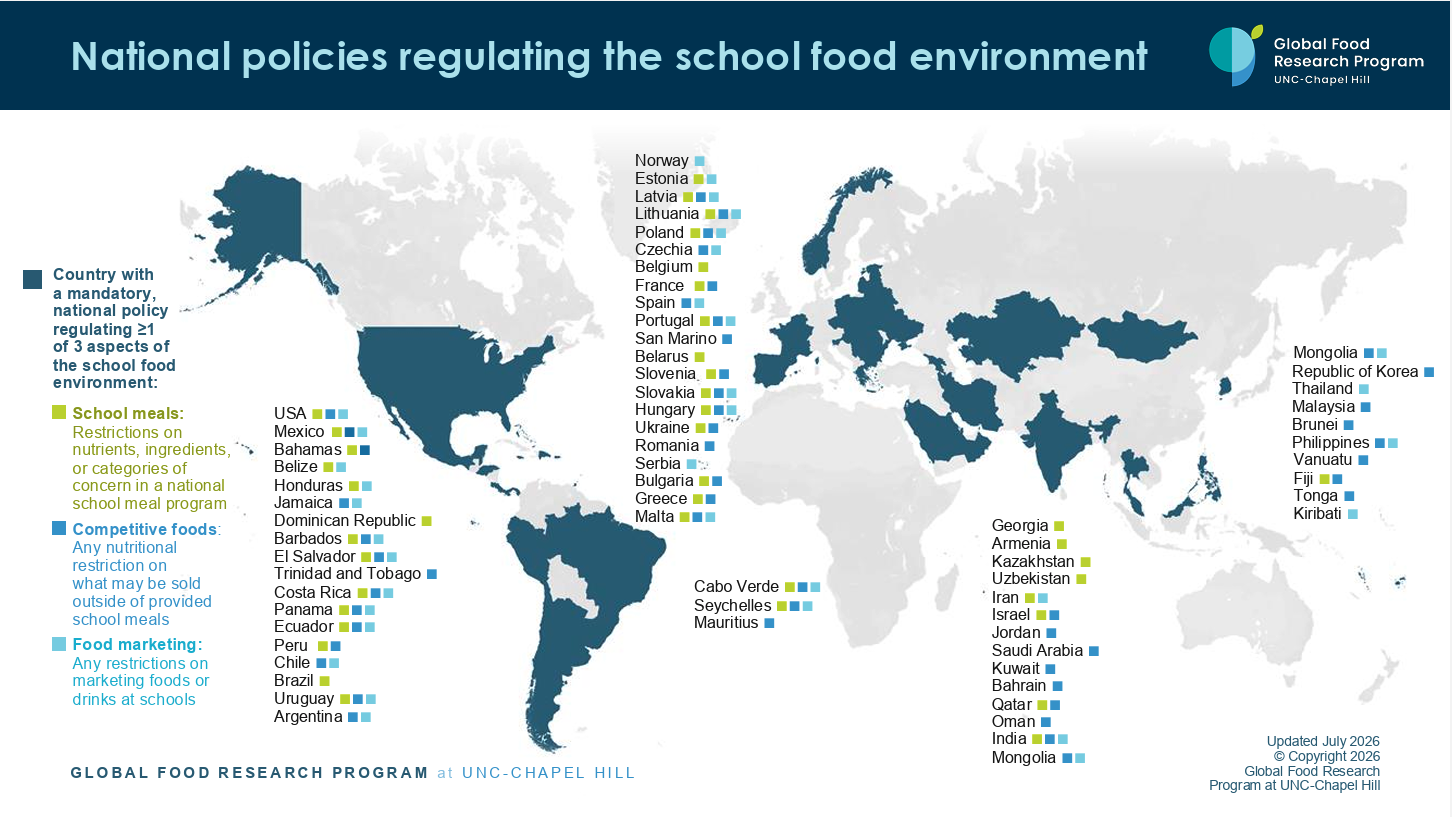
Source: Global Food Research Program at UNC-Chapel Hill. Maps: National policies regulating the school food environment
Guiding questions to collect local evidence:
Does your setting have a school food policy (national/province/state)?
Yes:
- What components does it include?
- How is it implemented and enforced?
- What populations or school types does it cover?
- What gaps or opportunities exist to strengthen it?
- What rights-based provisions (international, constitutional, legal) are/can be used to anchor the policy?
- If the policy exists at the state/provincial level, what opportunities exist to expand adoption?
No:
- What existing programs or policies could serve as building blocks?
- What barriers and opportunities exist for policy development?
- What rights-based provisions (international, constitutional, legal) can be used to anchor the policy?
Children’s food environments—the settings where they access and eat food—include school, home and community. Millions of children are denied the diverse, nutritious diet guaranteed by their human rights to health and adequate food, a diet they need to be healthy, develop fully, enjoy their childhood and be educated. This is largely driven by poverty, inequity and shifts in agricultural and dietary patterns away from traditional foods toward foods high in fat, salt and sugar that are often ultra-processed, fueling a triple burden of childhood malnutrition: undernutrition, overnutrition and micronutrient deficiencies, which often coexist.
- One in five children and adolescents aged 5-19 (391 million) are living with overweight—more than double the number in 2000, with 80% living in low- and middle-income countries. In 2025, obesity surpassed underweight for the first time among this age group (9.4% vs. 9.2%).
- Globally, 60% of adolescents consumed more than one sugary food or beverage the previous day, 32% consumed soft drinks and 25% consumed more than one salty processed food.
- In 2025, 2.7 billion people could not afford a healthy diet, putting nutritious food out of reach for millions of children—particularly those in low-income countries.
- 75% of adolescents aged 12-15 from 31 countries have inadequate fruit and vegetable consumption (defined as less than 5 servings/day).
- Approximately 300 million schoolchildren have iron-deficiency anemia, which causes about six lost IQ points per child.
Guiding questions to collect local evidence:
- What do children’s food environments look like? (e.g., availability of nutritious food at school, at home and in the community)
- What do children’s diets commonly look like? (e.g., consumption of ultra-processed products, adherence to dietary recommendations)
- How many children are impacted by a form of malnutrition—undernutrition, overnutrition and/or micronutrient deficiencies?
- How do the above vary by demographics (e.g., household income, race/ethnicity, age, geographic location)?
- What existing data sources can help answer these questions? (e.g., national nutrition surveys, school health assessments, local research)
School is where most of the world’s children spend many of their waking hours and eat many of their meals and snacks—whether provided by the school or purchased from vending machines, canteens and surrounding vendors. Schools and the vicinity around them are also where many children are exposed to marketing for ultra-processed products and their associated brands, including through sponsorships.
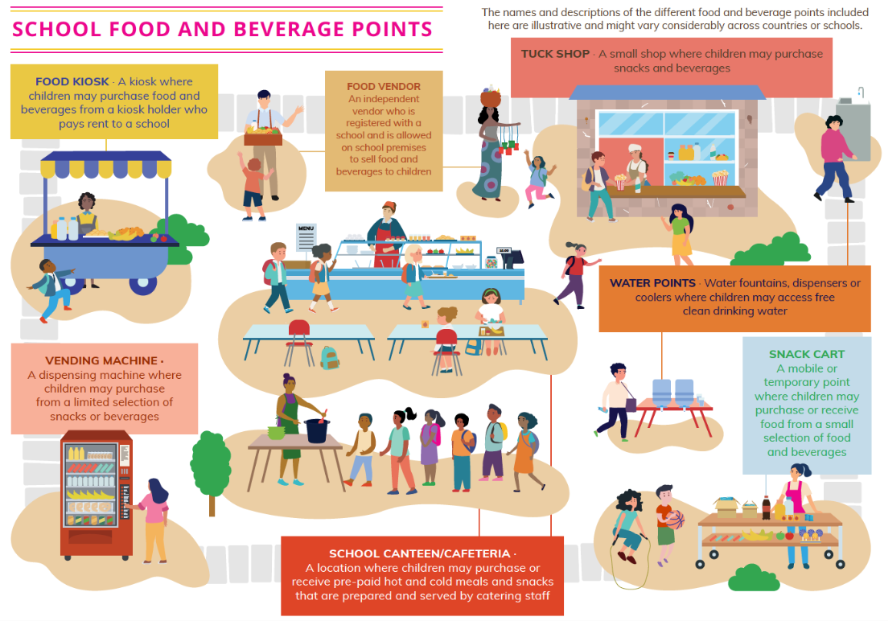
Source: World Health Organization. Nudges to Promote Healthy Eating in Schools: Policy Brief. 2022.
- 89% of the world’s girls and 91% of its boys are enrolled in primary school.
- Children consume up to 50% of their calories in schools.
- 466 million children now benefit from school meals worldwide. However, children in lower-income countries benefit the least: 27% of children in low-income countries receive school meals compared to 79% in high-income countries.
- School meals typically represent 70% of a country’s food that’s under public control.
- A systematic review and meta-analysis of 20 studies found that the sale of food in schools or their immediate vicinity was associated with higher body mass index, whereas the availability of healthy food provided by school significantly decreased the odds of obesity.
- A systematic review found that nearly half (14 of 31) of studies showed an association between the proximity and density of food establishments (e.g., fast food restaurants, convenience stores and grocery stores) around schools and overweight/obesity in children and adolescents, though findings were mixed overall.
- Studies in Mongolia and the Philippines found that 85-92% of outdoor advertisements around schools promoted unhealthy foods and beverages. In Uganda, 86% of more than 1,000 advertisements around schools were for unhealthy products, with sugar-sweetened beverages (51%) and alcoholic beverages (23%) most prevalent.
Guiding questions to collect local evidence:
- What does the school food environment typically look like, and how does this vary across different types of schools and communities?
- What foods and beverages are served in school meals? Are there nutritional standards in place, and if so, do meals meet them?
- Where do children obtain food during the school day? (e.g., school-provided meals, school canteens/vending machines, food vendors near schools, food brought from home)
- Is there marketing of unhealthy products in and around schools? What types of products are most commonly marketed? (e.g., sweetened beverages, snacks, fast food)
- Does the food and beverage industry sponsor school activities, such as sports teams, events or supplies? What forms does this sponsorship take?
Evidence shows that policies and interventions for healthier school food environments can decrease students’ consumption of unhealthy food and beverages while increasing their consumption of healthier options, providing a buffer against malnutrition. Policies that mandate procurement from local smallholder farmers for school meal programs also support local livelihoods and contribute to more sustainable food systems.
Why local procurement for school food matters
Public procurement standards, which dictate where school food comes from, allow schools to use their purchasing power to prioritize local, smallholder and sustainably produced nutritious food over processed and ultra-processed products from large-scale industrial suppliers. This does double duty: it supports children’s nutrition while also strengthening local food economies, shortening supply chains and reducing the environmental footprint of school meals. Since schools are large institutional buyers, procurement policy is a powerful lever for reshaping diets and food systems.
General evidence:
- A WHO review found that school nutrition policies are generally viewed favorably by stakeholders, including governments, parents, school staff and students, though this varies by policy or intervention type.
- A separate WHO review found that comprehensive school nutrition policies combining multiple components—such as dietary interventions, nutrition education, physical activity and changes to the school food environment—are associated with improved dietary outcomes and reduced BMI among schoolchildren.
- A systematic review of 36 school-based interventions to reduce consumption of sugar-sweetened beverages found that legislative or structural changes—such as banning sugar-sweetened beverages from vending machines and cafeterias or replacing them with healthier defaults like water—were the most effective approach, with 9 of 10 such studies reporting decreased consumption.
Policy-specific evidence:
Implementing nutrition guidelines for food provided in and near schools
- A meta-analysis of 39 studies, mostly from high-income countries, on school meal standards found they increased children’s fruit consumption (+0.76 servings/day) and reduced total fat (-1.5% energy) and sodium intake (-170 mg/day) across their entire diet, not just at school.
Banning or restricting the sale and marketing of unhealthy food in or around schools
- A systematic review and meta-analysis of 29 studies, mostly from high-income countries, found that competitive food and beverage standards in schools restricting the sale of unhealthy foods outside of school meals reduced children’s sugar-sweetened beverage intake by 0.18 servings per day and unhealthy snack intake by 0.17 servings per day.
- By 2019, Chilean children consumed less sugar at school (-11.8 percentage points), less saturated fat (-1.1 pp) and less sodium (-10.3 mg/100 kcal). However, consumption of these nutrients increased at other locations, underscoring the need to regulate areas around and beyond schools.
A study of 300,000 Chilean schoolchildren aged 4–6 found that Phase 1 of the policy was associated with a lower probability of excess weight after six months of exposure (1.91% lower among girls, 2.24% among boys) and after 18 months (2.85% lower among girls, 2.40% among boys).In 2016, Chile implemented a comprehensive food policy that included front-of-package warning labels, restrictions on child-directed marketing and a ban on the sale and promotion of foods with warning labels in schools.
➔ For evidence on the impact of food and beverage marketing on children’s diets and the effectiveness of marketing restrictions: See Food Policy Hub’s marketing restrictions evidence page
Providing healthier food directly via school meals and snacks
- Brazil combines mandatory nutrition standards with free school meals for more than 40 million children. Adolescents who frequently consumed school meals were found to have healthier diets, and were less likely to have overweight (11% lower prevalence) or obesity (24% lower prevalence) than those who consumed fewer school meals.
- A systematic review of 216 education-sector interventions (not limited to nutrition programs) in 52 low- and middle-income countries found that school feeding programs are one of the few interventions that show positive impact on both school participation (e.g., enrollment, attendance, dropout) and learning outcomes (e.g., math and language test scores).
- A meta-analysis of 39 studies, mostly from high-income countries, found that direct provision of healthy foods outside of school meals increased children’s fruit consumption by 0.27 servings per day and combined fruit and vegetable consumption by 0.28 servings per day, with the strongest effects on fruit intake.
- School feeding programs are cost-effective and cost-beneficial, with an estimated US$7.00-9.00 in returns for every US$1.00 invested and positive effects across education, health and nutrition, social protection and local agriculture.
- A modeling study found that if universal school meals adhering to health and sustainability recommendations were provided to all children globally by 2030, undernourishment in food insecure populations could drop by 24%; more than 1 million cases of diet-related noncommunicable diseases could be prevented annually if healthier eating habits were carried into adulthood; and food-related environmental impacts could be halved.
Procuring food for school meals from local farmers
- Brazil’s National School Feeding Program (PNAE) mandate requiring 30% of school feeding resources to go to local farmers generated R$15 million (US$5 million) in GDP growth, R$39 million (US$12 million) in family farmer income growth and 24,000 jobs.
- A separate study found that Brazil’s PNAE mandate increased family farmers’ average income by 32.6% between 2013 and 2017, with the largest gains among smaller farmers, whose production value rose 64.5% at the 10th percentile of farm size, compared to 34.5% at the 75th percentile.
- The Purchase from Africans for Africa program linked small farm procurement with school feeding programs in five countries. In its pilot, productivity rates on small farms increased by about 115% and the program offered farmers a guaranteed market for more than a third of the food they produced.
Guiding questions to collect local evidence:
Does your setting implement any of these school food policies or interventions?
Yes:
- What evidence exists on their impact on children’s diets and health outcomes?
- What gaps or challenges have been identified that could be addressed through a more comprehensive approach?
- What additional data is needed to strengthen the evidence base?
No:
- What evidence is most relevant for advocating for these policies?
- Are there existing school policies or programs that could serve as entry points for introducing these interventions?
School food policies and programs—particularly school nutrition guidelines and school meals—can improve access to healthy, nutritious foods, while decreasing disparities between students and reducing stigma. Providing food in school can be a lifeline for the poorest students, helping protect against hunger and improving nutrition and school attendance, particularly for girls.
- A U.S. study found that racial disparities in school lunch quality were largely eliminated after updated National School Lunch Program standards took effect in 2012, with predominantly Black and Latino schools reaching parity with predominantly white schools in access to nonfat milk, fruits, vegetables and whole grains.
- A study of school meal programs across 32 sub-Saharan African countries found that onsite meals combined with take-home rations increased girls’ enrollment by 28% in the first year, sustained at 30% in subsequent years.
- In poor communities in low- and middle-income countries, the value of school meals has been estimated to be equivalent to 10-15% of a household’s income for families with children enrolled in school feeding programs.
- Evaluations from 13 organizations revealed that school feeding has some of the strongest evidence of effect related to gender parity, equality and inclusion in education (SDG 4.5), followed by cash transfers.
Guiding questions to collect local evidence:
- What evidence, if any, shows how school food policies have improved equity outcomes (e.g., reduced participation gaps, improved nutrition for low-income students)?
- What data exists on disparities in school meal access, quality or participation (e.g., by income level, race/ethnicity, gender, geography)?
- How can this data be used to demonstrate that comprehensive school food policies address both nutrition and equity goals?
- Global Food Research Program at UNC-Chapel Hill’s fact sheet on Policies to support nutritious school food environments
- The School Meal Coalition’s Research Consortium for School Health and Nutrition’s SCHOOL MEALS AND FOOD SYSTEMS: Rethinking the consequences for climate, environment, biodiversity and food sovereignty
- The World Food Programme: