
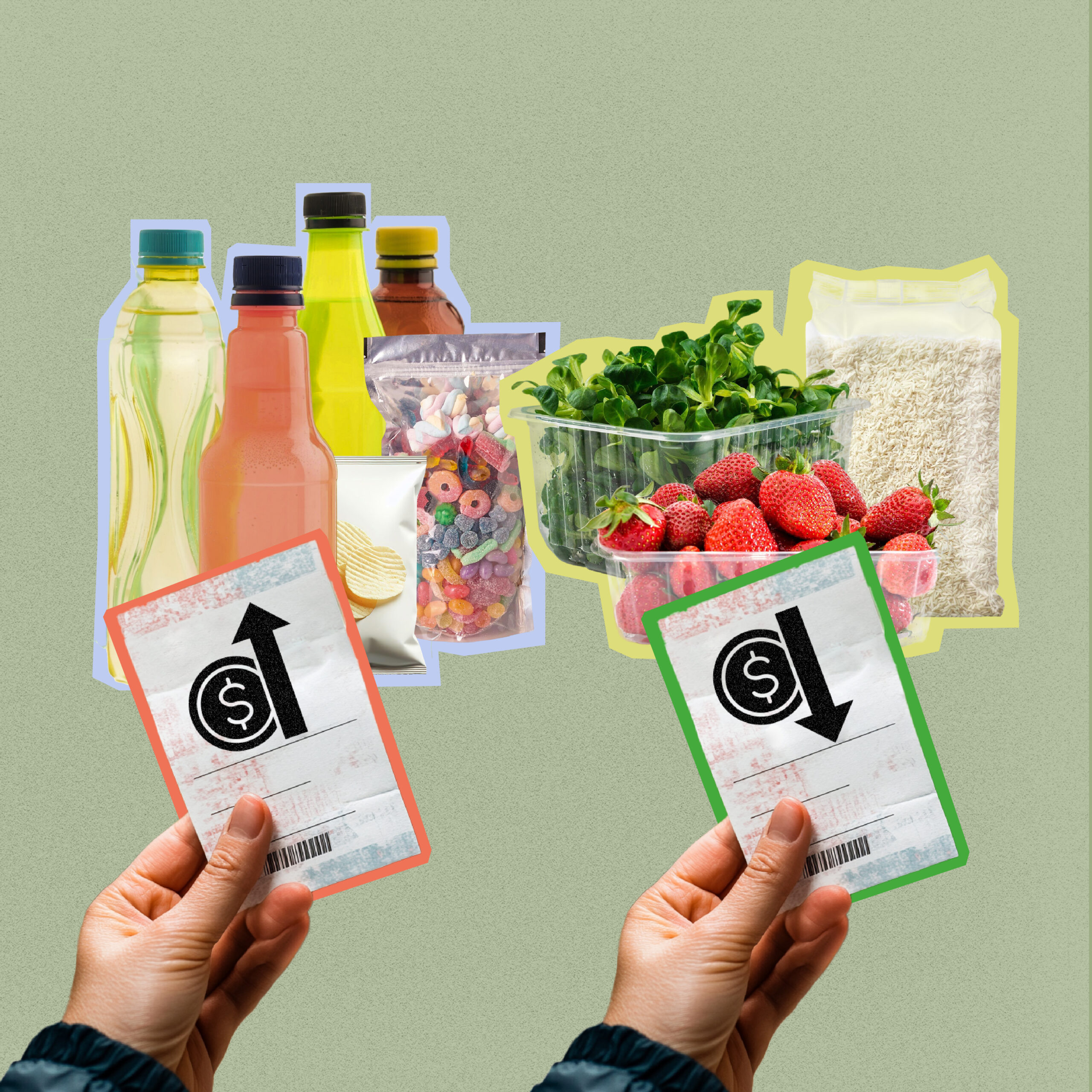
How can fiscal policies for healthier diets be adopted? How can fiscal policies for healthier diets be adopted?
Build the policy rationale
Gather local evidence on the problems that the policy is needed to address (e.g., rates of malnutrition and diet-related chronic diseases, gaps in production and affordability of healthy foods). This will help stakeholders develop and defend an appropriate policy response.
- Indicators to use: UNICEF’s Analysis Tool (Worksheets)
- Country-specific data sources:
- WHO Global Database on Child Growth and Malnutrition
- The DHS Program Demographic and Health Surveys
- Check if your country has a national nutrition survey
- FAO’s FAOSTAT food and agriculture data
Collect evidence on why the policy is part of the solution, including its potential impact on healthy food availability or accessibility and consumer or producer behavior and outcomes. Data collected should explicitly describe how the policy contributes to health equity and support states’ human rights obligations.
Fiscal policies for healthier diets can be framed as measures that advance the right to health and the right to food by ensuring healthy foods are economically and/or physically accessible.
- Global data to supplement local evidence: Food Policy Hub’s fiscal policies for healthier diets evidence page
Develop measurable policy objectives
Setting strong evidence-backed objectives will help:
- Ensure the policy is well designed to achieve objectives
- Promote transparency as to why it is being introduced or amended
- Facilitate monitoring and evaluation to make sure objectives are being met
- Protect the policy from legal challenges by demonstrating it serves a legitimate public interest and is proportionate to achieve those aims
The primary objective of fiscal policies for healthier diets should be to increase consumers’ purchase and consumption of healthy products—a term that should be clearly defined at the outset to specify it covers unprocessed foods such as fruits, vegetables, legumes and nuts. This can be achieved:
- Directly through demand-side, consumer incentives (e.g., vouchers, discounts)
- Indirectly through supply-side, agricultural policies that increase production and lower prices (e.g., subsidies for inputs, loans and grants).
Objectives of supply-side policies also include supporting farmer incomes and livelihoods, ensuring food security and local production.
Not all policies that positively affect diets are designed primarily for that purpose. For example, cash transfer programs and investments in agricultural infrastructure often have broader goals like poverty reduction or rural development, but can meaningfully shift food access and consumption as a secondary effect. Recognizing these adjacent policies broadens the available toolkit.
Research the policy environment
Map what already exists. Consider both the policy and the operational landscape: what related fiscal policies are already in place (e.g., agricultural subsidies, VAT rules) that could support or undermine a new policy, and what existing programs and administrative infrastructure could support implementation.
- Tool to document existing nutrition policies and strategies and programs: Table 2.2 (p. 13) and Table 2.3 (p. 14) of World Health Organization’s Landscape analysis on countries’ readiness to accelerate action in nutrition
Experts suggest pairing healthy food subsidies (e.g., discounts, vouchers) with taxes on unhealthy food and potentially using tax revenue to fund subsidies to help ensure cost-effectiveness and sustainability. The introduction of healthy food subsidies may be a good opportunity to also introduce or strengthen tax policies toward public health objectives, and vice versa.
- Guide to adopting taxes: See Food Policy Hub’s taxes on unhealthy foods and beverages adoption page
“Taxation and subsidy strategies can redistribute the relative costs of foods, promoting equity and empowering decision-making.” – United Nations’ Special Rapporteur on the Right to Health, Dr. Tlaleng Mofokeng
Understand the legal context
It is important to understand whether there are existing national and international laws that may affect policy development (e.g., International trade and investment law, fiscal and tax law) as well as which laws can be leveraged to advance it, such as:
- Public health law
- Human rights law (e.g., right to health, right to adequate food and nutrition)
- Constitutional law
- Example: South Africa’s Child Support Grant is grounded in the constitutional rights to social security and to basic nutrition for children
- Social welfare law
- Example: In Mongolia, a food stamp program was later formalized under the country’s Social Welfare Law
- Human rights documents repository:Global Health Advocacy Incubator’s Right to Health Policy Hub offers human rights documents that support public health policies related to food and nutrition
- Searchable database of fiscal policy laws and court decisions: Global Health Advocacy Incubator and O’Neill Institute for National and Global Health Law’s FULL database
Map potential stakeholders
Conducting a stakeholder mapping analysis to determine different stakeholders’—and especially policymakers’ interests, influences and positions—is important to know who to engage in policy development and how. While stakeholders may vary by setting, some of the important players to map include the following.
Key government stakeholders:
- Ministry of Health
- Ministry of Agriculture
- Ministry of Finance
- Ministry of Trade
Other stakeholders to map:
- Researchers/academic institutions
- Supportive civil society organizations and community groups
- Consumer groups/associations
- Retailers
- The media
- The food and beverage and agribusiness industry, which may present powerful resistance
- Agricultural stakeholders—Farmers and farmer organizations, input suppliers (seeds, fertilizer, equipment), wholesalers, traders, distributors, cold storage/packhouse operators, etc.
Alongside stakeholder mapping, it can be useful to map trade flows for relevant products since this may shape which stakeholders are most affected by a given fiscal policy and how. Specifically, this includes which products are imported versus domestically produced, and whether domestically produced goods are consumed locally or exported.
- Country-specific trade data: FAO’s FAOSTAT food and agriculture data
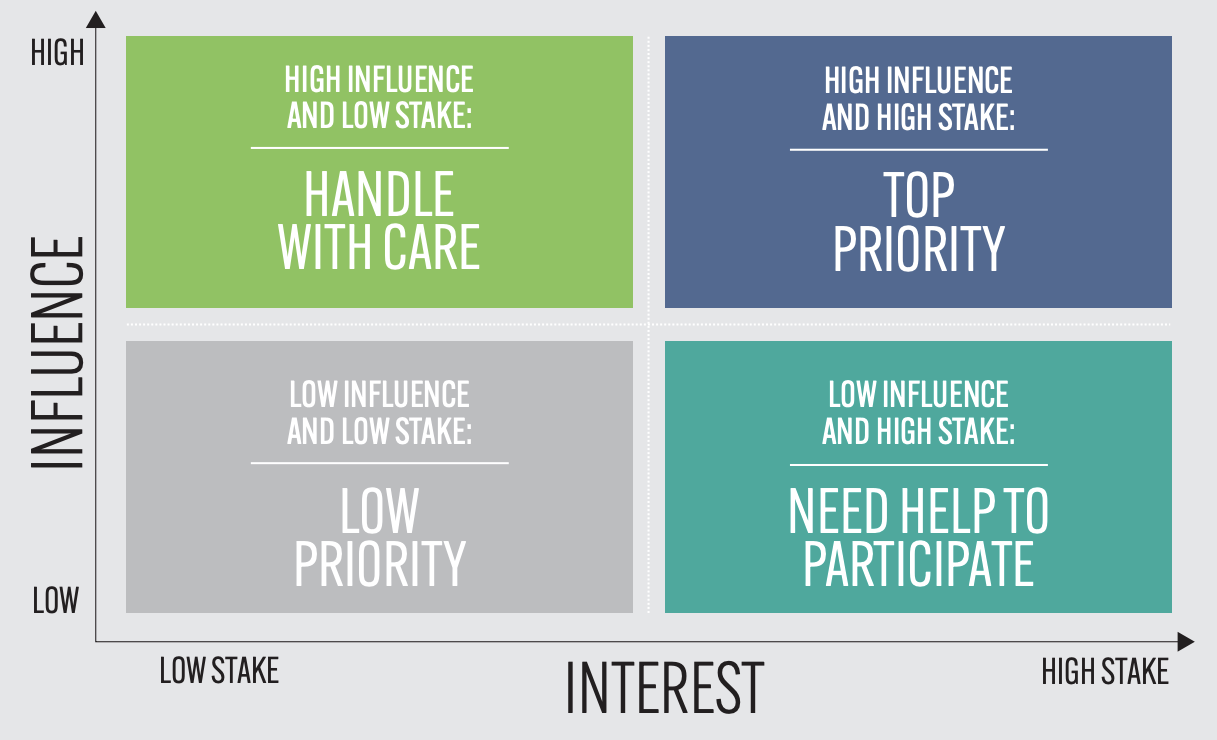
Source: Toolbox 2 in the World Health Organization’s and United Nation Development Program’s “Action for health taxes from policy development to implementation.”
Guidance on conducting a stakeholder analysis:
- 7-9 of Global Health Advocacy Incubator’s Advocacy Action Guide Four Phases to Health Policy Success
- 9 of Global Health Advocacy Incubator’s Legal Advocacy Action Guide Legal Strategies for Public Health and Industry Accountability
- Toolbox 2 on p. 21 of the World Health Organization’s and United Nation Development Program’s Action for health taxes from policy development to implementation
- 23-26 of the United Nation Development Program’s Institutional and Context Analysis for the Sustainable Development Goals
Resources:
- Food and Agricultural Organization of the United Nations: FAOSTAT
- Food Policy Hub: What is the evidence for fiscal policies for healthier diets?
- Food Policy Hub: How can sweetened beverage taxes and taxes on unhealthy food be adopted?
- Global Health Advocacy Incubator: Advocacy Action Guide Four Phases to Health Policy Success
- Global Health Advocacy Incubator: Legal Advocacy Action Guide Legal Strategies for Public Health and Industry Accountability
- Global Health Advocacy Incubator: Right to Health Policy Hub
- Reeve et al.: Health sector advocacy for repurposing agricultural investments affecting fruits, vegetables and legumes
- The DHS Program: Demographic and Health Surveys
- UNICEF: Landscape Analysis Tool and Worksheets
- United Nation Development Program: Institutional and Context Analysis for the Sustainable Development Goals
- World Health Organization and United Nation Development Program: Action for health taxes from policy development to implementation
- World Health Organization: WHO Global Database on Child Growth and Malnutrition
Building strong multisectoral coalitions across government and civil society is important for food policy success. Coalitions should offer clear, consistent and sustained messaging on the policy rationale and be prepared to confront industry interests and lobbying. Every coalition member should be free from food and beverage industry affiliation.
Government partnerships
When different government departments join forces and work together from early on, it helps with policy alignment, coherence and political support.
Key departments to engage include:
- Health
- Finance
- Agriculture
- Trade and commerce departments/ministries
- Government’s legislative and executive branches
Civil society partnerships
Civil society organizations, including nongovernmental organizations and academia, play crucial roles in supporting government efforts.
They can:
- Survey public opinion
- Build support via the media and community outreach
- Develop local evidence
- Counter industry interference
- Monitor policy implementation
- How to develop civil society coalitions: Prevention Institute’s Developing Effective Coalitions: An Eight Step Guide
- Worksheet to identify potential partners: P. 7 of Healthcare Association of New York State, Inc.’s Coalition building toolkit
- Coalition-building for public health advocacy campaigns: Global Health Advocacy Incubator’s webinar Building Effective Coalitions for Public Health Advocacy Campaigns
Resources:
- Global Health Advocacy Incubator: Building Effective Coalitions for Public Health Advocacy Campaigns
- Healthcare Association of New York State, Inc.: Coalition building toolkit
- Prevention Institute: Developing Effective Coalitions: An Eight Step Guide
Industry interference is most clearly documented in the food and beverage and agribusiness industry’s active pursuit of tax breaks and subsidies for its own products, advantages that undermine healthy food production and policy. The current landscape of agricultural subsidies and tax breaks tends to heavily favor staple commodities used in processed and ultra-processed products.
Examples:
- U.S.: Between 2019 and 2023, agribusiness and Big Food spent $523 million lobbying Congress specifically on the Farm Bill, legislation governing agricultural and food policy. Producers of corn and soybeans, primary ingredients in processed foods and sweeteners, received $5.1 billion in direct subsidies in 2024. Fruit and vegetable producers, by contrast, have no equivalent unified lobbying force and receive minimal support, remaining ineligible for direct subsidies.
- India: India’s food subsidy system (Public Distribution System) overwhelmingly channels support toward rice and wheat rather than more nutritious alternatives, such as millets and pulses. The politically powerful grain-farmer lobby that benefits from the existing subsidy structure is a large barrier to a more diversified distribution system.
Advocates can monitor and report on industry lobbying and develop strong counter-messaging in support of subsidies and other fiscal policies for healthier foods to gain public and policymaker approval.
- Guide to countering industry interference: See Food Policy Hub’s countering industry interference adoption page
Resources:
- Food Policy Hub: How can industry interference be countered?
Civil society-led advocacy
Civil society can lead advocacy work to register and garner support from stakeholders including politicians and the public, making sure that policy messaging is clear and consistent throughout the process.
Public awareness campaigns can be used to educate the public on the need for fiscal policies for healthier diets and can be targeted toward decision-makers at key decision moments.
Engaging affected people in advocacy may be more effective. This could include:
- People who have experienced food insecurity
- Doctors who offer trusted voices on health impacts
- Small-scale farmers who produce healthy whole foods
Using earned media to spread the narrative is important to retain control over it and to expose industry efforts to counter it. Conducting community engagement work with affected communities can help build a policy that is equitable and responsive to those it affects the most.
For heathy food subsidies, persistence in maintaining positive opinions—especially politically—is important even after a policy is implemented to help ensure sustained funding.
- Campaign development tools: Global Health Advocacy Incubator’s Communications & Media Advocacy Action Guide for a guide with tools to develop, implement and evaluate public health communication and media advocacy campaigns
- Community engagement strategies: P. 11 of ChangeLab Solutions’ Sugary Drink Strategy Playbook Reducing Sugary Drinks to Promote Community Health and Equity
Academia
Public health researchers can analyze and collate the existing evidence on fiscal food policies for healthy diets and present it to policymakers, and help fill in research gaps.
- Existing evidence: Food Policy Hub’s fiscal policies for healthier diets evidence page
Managing conflict of interest
WHO and leading academics recommend that mechanisms be put in place to manage and prevent conflicts of interest and improve transparency. In all cases where industry is involved, proper safeguards should be mandatory to ensure that public health is prioritized over industry interests.
- Guide to countering industry interference and preventing conflicts of interest: Food Policy Hub’s countering industry interference adoption page
Resources:
- ChangeLab Solutions: SUGARY DRINK STRATEGY PLAYBOOK Reducing Sugary Drinks to Promote Community Health and Equity
- Food Policy Hub: What is the evidence for fiscal policies for healthier diets?
- Food Policy Hub: What is the evidence on food and beverage industry interference?
- Global Health Advocacy Incubator: Communications & Media Advocacy Action Guide
Develop a strong policy
Fiscal policies for healthier diets can focus on supply-side actors (e.g., small-scale farmers and producers) and demand-side points (e.g., retailers and consumers), or a combination of both, to improve affordability of and access to nutritious food.
- Additional examples, see Global Food Research Program at UNC-Chapel Hill’s Fiscal policies: encouraging production and consumption of healthy, whole and minimally processed foods
Questions to develop a fiscal policy for healthier diets include:
- Should the policy focus on the supply side, demand side, or both?
- Who should benefit and what mechanism should be used?
- Which foods and beverages should the policy apply to and not apply to?
1. Should the policy focus on the supply side, demand side, or both?
More than one approach can often serve the same broader objective (e.g., increasing healthy food consumption), so the choice should also weigh what is politically feasible given the existing policy environment.
Supply-side:
- Target producers and wholesalers
- Aim to increase availability and potentially lower prices of healthy food
- Best for objectives focused on: Increasing production of nutritious foods, supporting farmers, long-term market transformation
- Examples: infrastructure investment, subsidized agricultural inputs, farm grants
Demand-side:
- Target consumers and retailers
- Directly reduce cost or increase purchasing power
- Best for objectives focused on: Immediate healthy food access for high-risk populations, addressing affordability barriers
- Examples: cash transfers, food vouchers, point-of-sale discounts, cash-back rebates
Supply- and demand-side: Addresses both longer-term market transformation and farmer well-being and more immediate healthy food access
- Examples: Public procurement policies (stimulates demand from institutions while creating a reliable market for producers)
2. Who should benefit and what mechanism should be used?
The choice of beneficiaries and mechanism should align with your objectives.
Universal mechanisms (benefit all consumers or producers): No eligibility requirements; every consumer or producer of a qualifying product or product group can access the benefit. E.g., a VAT reduction that lowers prices for all consumers purchasing qualifying products.
Targeted mechanisms (benefit specific populations):
Eligibility can be based on income level, health status, life stage, farm size or producer type. E.g., income-qualified vouchers
3. Which foods and beverages should the policy apply to?
Ideally, the decision of which food and beverage products or crops to subsidize or support will be based on dietary guidelines, reflecting healthy foods to encourage given local cultural context and dietary needs. This definition can be echoed by frameworks that help identify products of concern to exclude:
- NOVA classification (level of processing): NOVA groups foods into four categories based on the extent of industrial processing—(1) unprocessed or minimally processed foods, (2) processed culinary ingredients, (3) processed foods and (4) ultra-processed foods. Regulatory attention generally focuses on groups 3 and 4.
- Nutrient profile model (NPM) thresholds: NPMs identify products excessive in nutrients and ingredients of concern (sodium, added sugar, nonsugar sweeteners, saturated fat), rather than certifying products as healthy. Fiscal policies for healthier diets should not apply to any products that exceed thresholds established by a strong, evidence-based NPM. Other policies for healthier food environments, such as taxes on unhealthy foods, can rely on the same NPM.
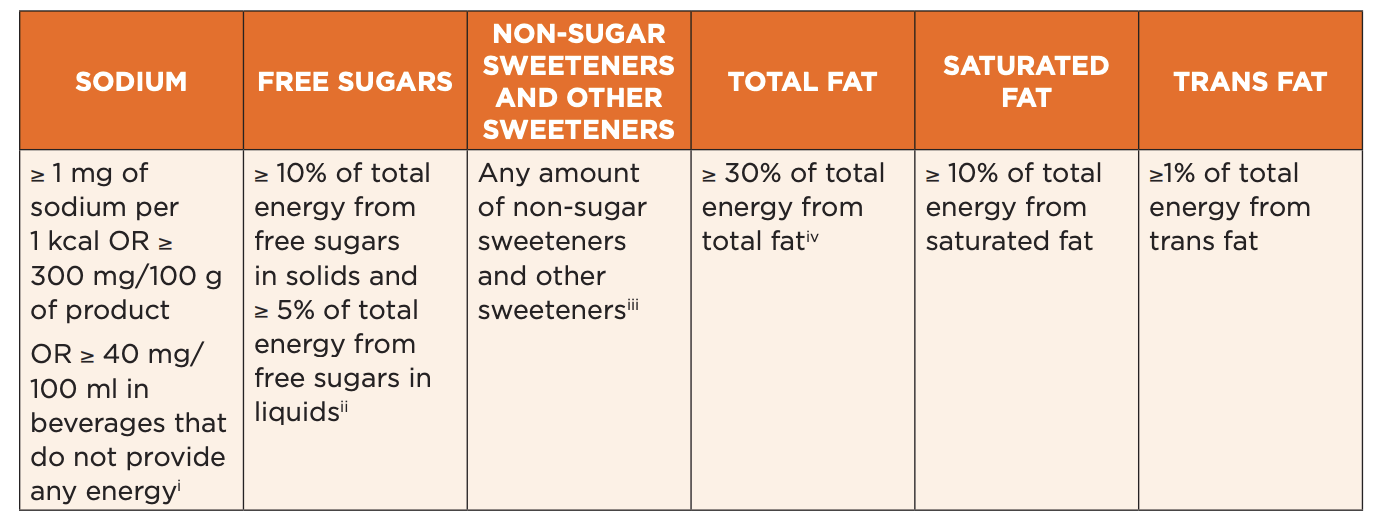
Recommended criteria for identifying food and drinks excessive in nutrients and ingredients of concern curated from PAHO, SEARO and AFRO regional NPMS Source: Global Health Advocacy Incubator. Nutrient Profile Models: A valuable tool for developing healthy food policies.
These decisions should be paired with policy education campaigns and nutrition education efforts.
- Food-based dietary guidelines: FAO’s collection of dietary guidelines from around the world.
- Nutrient profile model guidance: Global Health Advocacy Incubator’s Nutrient Profile Models: A valuable tool for developing healthy food policies for recommendations on adopting a strong nutrient profile model
Resources:
- Food and Agricultural Organization of the United Nations: Dietary guidelines
- Global Health Advocacy Incubator: Nutrient Profile Models Position Paper
Implementation should be considered from the early policy stages, with a monitoring and evaluation framework developed alongside the policy’s introduction that assigns responsibilities for monitoring, enforcing compliance and sanctioning violations. Monitoring helps ensure the policy is having impact, identifies loopholes, proposes opportunities to improve or expand it and sets up more accurate evaluations.
Tax policies are monitored and enforced through existing tax authority systems, while subsidies, cash transfers and other policies that require government investment involve program-specific oversight.
Inform the public that the policy is in effect
For policies that require direct consumer enrollment or redemption (e.g., cash transfers, vouchers, rebates, public distribution systems), use strategic communication campaigns to ensure eligible consumers know the policy exists and how to access it.
Messaging should include (as relevant):
- Why the policy is being introduced
- Which specific foods or products are covered
- Where and how to access benefits (e.g., redemption locations, application processes)
- Who is eligible
- Guide to public health communication and media advocacy: Global Health Advocacy Incubator’s Communications & Media Advocacy Action Guide
Monitor implementation
The monitoring system should include oversight by the appropriate government agency to ensure the policy is functioning as intended, including that funds are disbursed appropriately and that requirements are met by relevant stakeholders. It should also track barriers that limit the policy’s effectiveness in achieving its intended goals.
What to monitor depends on the policy type:
| Policy Type | Example Monitoring Activities |
| Vouchers, cash transfers | Enrollment rates, spending patterns (e.g., share of funds spent on targeted healthy foods) |
| VAT (tax exemptions/reductions) | Retail audits (e.g., food price tracking), tax compliance |
| Farm grants | Fund disbursement, grant recipient compliance |
| Discounts and rebates | Retail purchase data |
Develop an enforcement system
Include sanctions, penalties or other enforcement measures for noncompliance. Tax-based policies (VAT exemptions/reductions) use existing tax authority enforcement systems, while policies involving government investment use mechanisms such as financial penalties. Citizen oversight and government reporting frameworks add accountability and help ensure transparency in fund use.
After introducing a fiscal policy for healthier diets, evaluate:
- Whether the policy is being implemented as intended
- Effectiveness in achieving policy objectives
- Impact on longer-term goals
Why evaluation matters
Evaluation data supports other countries implementing similar policies by demonstrating successes and identifying improvement opportunities. Robust data collection strengthens the evidence base for effective policy design, helping policymakers make informed decisions.
Key evaluation principles
- Establish baselines by collecting pre-policy data relevant to the public health objective
- Ensure independence through conflict-of-interest-free evaluations
- Create oversight—some countries use independent advisory committees
- Promote transparency by making data public and sharing results through media
- Break down analyses by sex, gender, geography, and especially socioeconomic status to allow researchers to assess impacts on health equity
Evaluations may measure:
1. Is the policy working as intended (Process evaluation)?
- Enrollment rates among eligible populations
- Benefit redemption rates
- Retailer participation and compliance rates
- Price pass-through to consumers (whether reduced taxes result in lower consumer prices)
- Number/proportion of smallholder farms with healthy crops receiving subsidies
- Share of institutional food procurement sourced from smallholder farms or healthy food categories
- Improvements in agricultural infrastructure and market access (e.g., roads, irrigation, territorial markets)
2. Is the policy meeting its objectives? (Outcome evaluation)
- Prices of targeted foods
- Sales of targeted foods
- Consumption of targeted foods
- Crop output and agricultural production shifts
- Farmer income and livelihoods
3. Is the policy achieving longer-term goals? (Impact evaluation)
- Population-level dietary intake
- Diet quality indicators (diversity, fruit and vegetable consumption, whole grains, etc.)
- Child growth and nutrition status (e.g., stunting, wasting, overweight and obesity)
- Health equity outcomes across socioeconomic groups